
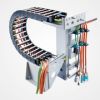





At first glance, a cable carrier may cable carrier a simple component, but choosing the wrong one can lead to serious problems: from premature wear to machine failure. In this blog, we discuss 5 common mistakes people make when selecting a cable carrier and how you can avoid them.
1. Misjudging the inner diameter
Error: The cable carrier is too small for the cables and hoses that need to be stored in it.
Consequence: Cables become pinched or damaged during movement.
Solution: Do not only take the outer diameter of the cables into account, but allow sufficient margin (guideline: 10–20% extra space). Preferably use a cable carrier dividers for a neat layout.
2. Underestimating the bending radius
Error: A bending radius that is too small is selected.
Consequence: Cables and hoses become damaged internally or wear out much faster.
Solution: Always check the minimum bending radius of the cables and adjust the cable carrier . Use manufacturers' bending radius tables and choose a size that is larger rather than smaller.
3. Not taking the mounting position into account
Error: The cable carrier is being used in an application for which it is not suitable (e.g., suspended, horizontal, or vertical).
Consequence: Excessive load, uneven wear, or even jumping out of the guide.
Solution: Choose a cable carrier is specifically suitable for the direction of movement and installation position of your application. If in doubt, consult a specialist.
4. Choosing the wrong material
Error: Using a standard plastic track in an environment with high temperatures, chemicals, or risk of wear.
Consequence: Rapid degradation or even breakage of the track.
Solution: Match the material to the working environment:
Plastic: for light and normal applications
Metal or hybrid: for heavy industrial applications
Heat- or chemical-resistant plastic: for extreme conditions
5. Not taking future expansions into account
.. Consequence: When cable carrier or expansions cable carrier , theentire chain must be replaced.
Solution: Always leave space for an extra cable or modification. A cable carrier is "big enough" today may be too small tomorrow.
✅ Conclusion: Well chosen is half won.
A well-chosen cable carrier not only cable carrier your cables and hoses, but also extends the service life of your machine, prevents malfunctions, and saves on maintenance costs. Avoid these common mistakes and invest in the right solution.