
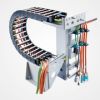





Modern mechanical engineering is all about reliability, efficiency, and safety. An essential but often underestimated component of this is the energy chain —also known as a cable chain. These chains ensure controlled cable routing in moving applications and protect cables from wear, kinking, and malfunctions.
But where exactly are energy chains used in mechanical engineering? And why are they indispensable? In this article, we take a closer look at the most common applications and advantages.
💡 What is an energy chain?
An energy chain is a mechanical guidance system for organizing and protecting moving cables and hoses. They are often used in machines with moving parts, such as linear axes, robots, machining centers, and more.
✅ Want to know which energy chain is best suited to your machine?
Request advice without obligation.
📌 Main applications in mechanical engineering
1. CNC machines and machining centers
CNC machines require constant and accurate cable routing. Energy chains ensure that data connections, cooling hoses, and power cables move smoothly without becoming tangled or damaged.
Advantages:
- Prevents cable breakage
- Increases machine reliability
- Reduces maintenance costs
🔍 Want to know more about energy chains for CNC machines?
Use our energy chain filter
2. Automation lines and conveyor belts
In production lines, components often move over long distances. Energy chains ensure that cables controlling sensors, motors, or actuators move safely, without the risk of kinking or wear.
Chains used: long stroke lengths, robust outer casings, possibly with cable rubs for damping.
3. Industrial robots
Robots often have many moving axes. Energy chains are crucial for the smoothness and precision of these movements. They are often combined with cable rubs to dampen vibrations and noise.
Advantage: prevents cable strain during frequent turning or swiveling.
💬 Request a free consultation now for robot applications with energy chains!
Click here to contact us
4. Portal and pick-and-place systems
Systems that move objects between production steps usually have long linear movements. A reliable energy chain prevents cable failures that can lead to downtime or damage to products.
5. Special applications: cleanrooms and food-grade machines
For environments with high hygiene requirements, there are energy chains made of special plastics. These prevent contamination and are easy to clean.
✅ Why are energy chains essential in mechanical engineering?
- Reliable operation: prevents malfunctions and unexpected downtime
- Cost-effective: less wear and tear, less maintenance
- Safety: protects personnel and equipment
- Scalability: suitable for any type of movement and length
🎯 Conclusion: Energy chains as a silent force in your machinery
Although often invisible during use, energy chains are crucial for the optimal functioning of machines. Whether it's a CNC milling machine, a robot arm, or a complete transport line—without reliable cable guidance, you can't expect top results.
🔧 Would you like to know which energy chain is suitable for your application?
Please contact our specialists – we will be happy to help you.
📘 Want to see right away which energy chain is right for your application?
Use the energy chain filter.