
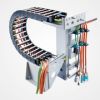




In a world where machines are becoming faster, smarter, and more reliable, it is often the smallest components that make the difference. One of them? The cable carrier. Although often overlooked, this component plays a crucial role in modern automation.
In this blog, we explain why Cable carriers are Cable carriers in an automated world and how they contribute to efficiency, reliability, and innovation.
🤖 1. Reliable cable routing in dynamic systems
In modern automation lines, cables and hoses are constantly in motion. Think of robots, gantry arms, or pick-and-place machines. Without proper guidance, cables become entangled, break, or cause malfunctions.
Cable carriers keep cables neatly in place, ensure a controlled bending radius, and prevent wear and tear. This allows the machine to continue functioning for a long time without malfunctioning.
⚙️ 2. Part of predictable maintenance
Predictive maintenance is the trend in industrial automation. By choosing components that are predictable and maintenance-friendly, companies can minimize downtime.
Cable carriers to predictability because they prevent cable wear and tear and are easy to inspect or replace. Some advanced caterpillars can even be equipped with sensors for real-time monitoring.
🚀 3. Faster machines, higher demands
The faster and more precisely a machine needs to move, the higher the demands on the cable routing. At high speeds or accelerations, a loose cable can throw a print head off balance, cause vibrations, or even cause damage.
A well-designed cable carrier ensures stable, repeatable movement—even at high speeds. This makes them essential for modern high-performance machines.
🌐 4. Suitable for any sector and environment
From the food industry to cleanrooms, from offshore installations to AGVs: Cable carriers available in countless designs and materials. This makes them suitable for use in virtually any automated application.
Examples:
- Stainless steel Cable carriers for hygienic environments
- Wear-resistant plastic variants for continuous 24/7 use
💡 5. Supporting modular and scalable automation
Modern factories are flexible: machines are modified, relocated, or expanded. Cable carriers this possible. They are modular, easy to expand, and adapt to changing cable configurations.
In short: they form a sustainable, scalable solution within the broader picture of smart, flexible production.
✅ Conclusion: Small part, big impact
At a time when production needs to be faster, smarter, and more reliable, Cable carriers are simply indispensable. They protect cables, improve reliability, accelerate movements, and reduce maintenance costs. Exactly what modern automation requires.
🎯 Not sure which cable carrier is right cable carrier your application?
👉 Start the cable carrier and find the right solution right away. Low maintenance costs. Exactly what modern automation requires.