Short answer
Choose PVC for dry, clean environments with short to medium travel lengths, and PUR as soon as oil, coolant, heavy wear or cold come into play. Use TPE for the toughest applications with the most cycles and the longest travel lengths. With TRAXLINE the jacket is tied to the class.
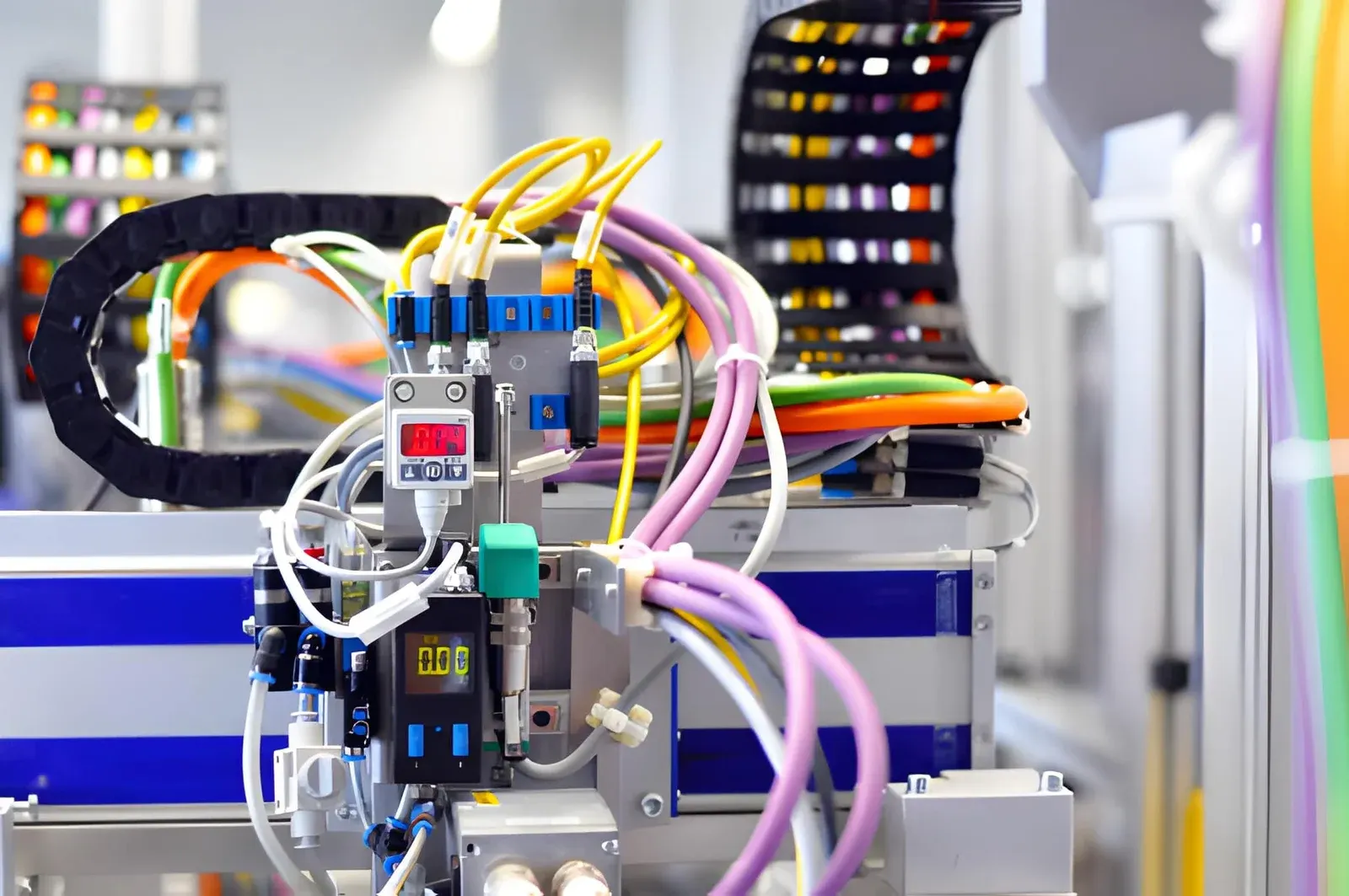
You choose between a PUR or PVC cable based on the environment and the movement. PVC is sufficient in a dry, clean machine with a short to medium travel length. PUR is the better choice as soon as oil, coolant, heavy wear or cold are involved. TPE is for the toughest applications. The jacket is the first layer to take a beating in a cable carrier: it rubs against the crossbars and other cables and comes into contact with everything flying around in the machine.
What does the cable jacket do in the cable carrier?
The jacket holds the cores together and protects them from the outside world. In a cable carrier it has three tasks:
- Absorbing wear: the cable keeps moving slightly relative to the carrier and the neighbouring cables.
- Sliding well: a jacket with too much grip catches and drags the neighbouring cable along, causing cables to twist or corkscrew.
- Withstanding the environment: oil, coolant, chips, moisture, cold or sun.
A jacket that cannot cope with this becomes stiff, swells or cracks. The cable then breaks from the outside in, even though the conductors themselves are fine. Are cables already twisting in your carrier? Then see cables twisting in the carrier.
What are the properties of PVC, PUR and TPE?
PVC: the basis for dry environments
PVC is a widely used, economical jacket material. It is easy to process and is sufficient in a clean, dry environment at normal temperatures. Its weak points are well known: PVC is less wear-resistant than PUR, can be affected by oil and becomes stiff in the cold. PVC contains chlorine, a halogen. In a fire this produces corrosive smoke gases.
PUR: wear-resistant and oil-resistant
PUR (polyurethane) is tough and highly wear-resistant. It resists oil well and stays more flexible at low temperatures than PVC. That is why PUR is the standard for cables that have to move a lot and over long distances, in machines with oil, grease or chips. PUR contains no chlorine, unlike PVC.
TPE: for the toughest applications
TPE is a thermoplastic elastomer. It combines the suppleness of rubber with the processing of plastic. A TPE jacket stays flexible, slides well and is wear-resistant. With TRAXLINE, TPE is the jacket of the 1000 class, for the highest number of cycles and the longest travel lengths. How well TPE resists a particular oil or chemical depends on its composition. Check the datasheet of the series for this.
PVC, PUR and TPE compared
Below are the general properties side by side. The datasheet of the series remains decisive, because the exact composition differs per cable.
| Property | PVC | PUR | TPE |
|---|---|---|---|
| Wear resistance | Reasonable | Very good | Good |
| Oil and grease | Limited | Good | Depends on type |
| Flexible in the cold | Becomes stiff | Stays more flexible | Stays flexible |
| Halogen | Contains chlorine | No chlorine | No chlorine |
| TRAXLINE class | 200 and 400 | 700 | 1000 |
| Motion cycles up to | 2 to 4 million | 7 million | 10 million |
| Travel length up to | 25 to 100 m | 500 m | 1000 m |
The cycles and travel lengths in the table apply to control and power cables. Data and bus cables have their own limits per series.
Which TRAXLINE cable has which jacket?
With the TRAXLINE cables from Tsubaki Kabelschlepp, you do not choose the jacket separately. It belongs to the class. Once you choose the class by travel length and cycles, the jacket is fixed.
- PVC is used in the 200 and 400 classes: CONTROL 200, CONTROL 400 600V, POWER 400 1kV and DATA 400 C, including the shielded C versions.
- PUR is used throughout the 700 class: CONTROL 700, POWER 700, POWER ONE 700 and DATA 700. All BUS and network cables, the FOC 700 fibre optic cable, the SYSTEM S and M system cables and the POWER ONE HEAVY DUTY high-voltage cables also have a PUR jacket.
- TPE is used in the 1000 class: CONTROL 1000 TPE, POWER 1000 TPE, POWER ONE 1000 TPE and DATA 1000 TPi C TPE.
Two things follow from this. If you want a BUS, network or fibre optic cable, it is always PUR. And if you need PUR because of oil but your travel length is short, you still choose the 700 class. It can handle more cycles and a longer travel length than needed, but your jacket suits the environment. An example is the CONTROL 700 C 600V, a shielded control cable with a PUR jacket.
Which jacket suits your environment?
Oil, grease and coolant
In lathes, milling machines, presses and other metalworking, oil and coolant almost always come into contact with the carrier. Choose PUR. For water-based coolant, ask about resistance to water and hydrolysis in the datasheet. That varies with the composition.
Chips and heavy wear
With many cycles, high speed or chips nearby, a PVC jacket wears faster. PUR or TPE last longer. Keep the carrier itself clean too. If your carrier or cable wears noticeably fast, see cable carrier wears quickly.
Cold stores and freezers
PVC becomes stiff when it is cold. A stiff jacket in a moving carrier can crack. In cold stores, freezers or unheated halls, you therefore choose PUR or TPE. The exact temperature limits for moving use are in the datasheet of each series.
Outdoors
Outdoors, the cable has to cope with sun, moisture and temperature changes. Check the datasheet to see whether the series is UV-resistant and suitable for outdoor use. With long outdoor travel lengths, such as on cranes, you automatically end up with the 700 or 1000 class and therefore with PUR or TPE. Those long travel lengths also call for a carrier such as the TKHP.
Fire safety
If a halogen-free cable is required, for example in areas where people work or where corrosive smoke causes damage, PVC is ruled out. In that case, always check the datasheet to see whether the series meets the requirement.
How to choose the jacket in four steps
- (01)First choose the class by travel length and cycles. That gives you a first jacket. How this works is explained in flexible cable: when is a cable truly flexible?
- (02)Look at the environment. Oil, coolant, chips or cold? Then at least PUR, so the 700 class.
- (03)Look at the requirements. Halogen-free required? Then no PVC. BUS, network or fibre optic? Then it is always PUR.
- (04)Choose the lightest class that meets everything. A heavier class than needed gives you no benefit.
The Cable finder does steps 1 and 4 for you. You enter type, cores, cross-section, shielding, travel length and cycles, and see the jacket for each cable. If the lightest cable does not suit your environment, choose the first cable with PUR or TPE from the list.
Calculate it yourselfCable finderThe right flexible cable for your cable carrierOpen the cable finderHave you chosen the cables? Add them to your request list. You will hear stock and price within 1 working day. Want the carrier straight away too? In the Cable carrier configurator, choose your TRAXLINE cables directly in the Cable package step. We can supply the carrier completely filled. More about the types of cable in the carrier is in which cables belong in a cable carrier.
Frequently asked questions
Which is better, a PUR or a PVC cable?
For a cable carrier, PUR is usually the better choice: more wear-resistant, more resistant to oil and more flexible in the cold. PVC is sufficient in a dry, clean machine with a short to medium travel length and fewer cycles.
Can I use a PVC cable in a cable carrier?
Yes, if it is a cable made for the cable carrier, such as the TRAXLINE 200 and 400 classes. For oil, coolant, heavy wear or cold, choose PUR or TPE.
Is a PUR cable halogen-free?
PUR contains no chlorine, unlike PVC. Whether a specific cable is specified as halogen-free, you check in the datasheet of the series.
When do you choose a TPE cable?
For the toughest applications: the most motion cycles and the longest travel lengths. With TRAXLINE the 1000 class has a TPE jacket, with control and power cables up to 10 million cycles and 1000 m travel.
Can I choose the jacket separately with TRAXLINE?
No. The jacket belongs to the class: PVC with 200 and 400, PUR with 700 and TPE with 1000. If you need PUR for the environment, you choose the 700 class, even if your travel length is short.
Next step
Calculate it yourself or browse the range. We check your result free of charge.
Series on this topic
Question about this topic?
Ask Bas directly
Cable Carriers Specialist at Wisman Techniek