Short answer
Cable breakage on a robot usually occurs around the wrist, on axes 4 to 6, where the bundle rotates and bends at the same time. Causes are torsion without a ball joint, kinking, a striking loop, the wrong package length and no retraction system. So do not just replace the cable, tackle the guidance.
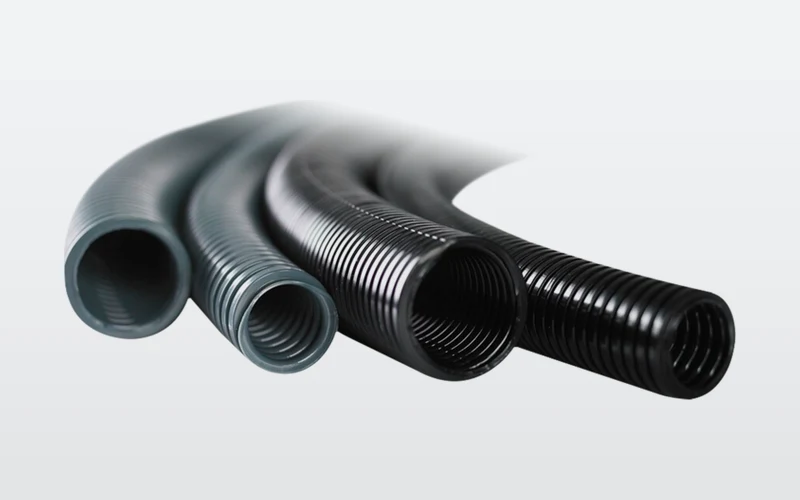
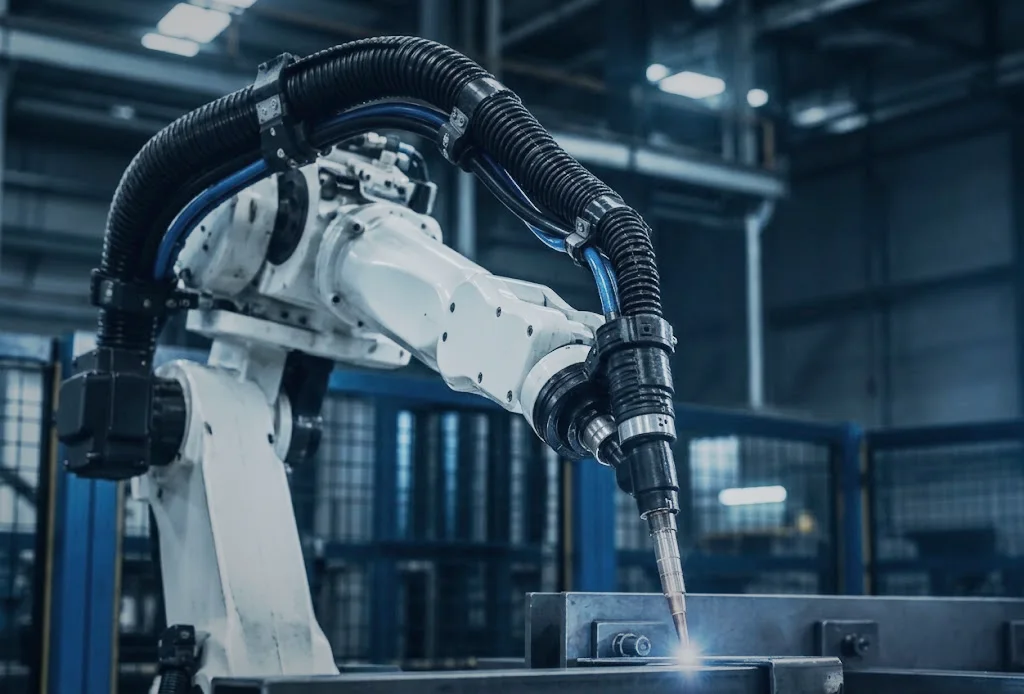
Cable breakage on your robot almost always occurs in the same place: around the wrist, on axes 4 to 6, where the cable bundle rotates, bends and changes direction at the same time. The cable itself is rarely the real problem. Usually the cause lies in the guidance: a hose package that twists, kinks, strikes or hangs at the wrong length. Anyone who only replaces the cable will see the same fault return some time later.
Where do cables break on a robot?
Things rarely go wrong on the large axes. Axes 1 to 3 make large, steady movements and the bundle is usually well guided along the arm there. The risk lies higher up the robot.
- At the wrist, axes 4 and 5: here the package rotates and bends the most, over a short distance. Torsion and tight bends come together.
- At the tool flange, axis 6: the bundle rotates with the tool and is attached to the welding torch, gripper or spray nozzle.
- At fixed points: where the bundle is fixed, such as a clamp or the connection to the tool, the load concentrates. If there is no proper transition there, the cable breaks exactly at that spot.
- On the upper arm: if the length is not properly managed, a loop forms there that swings back and forth.
Why does a cable break at the wrist?
A cable for moving use is made to bend. On a robot it has to endure more: bending, twisting and pulling in the same cycle. These are the five causes we come across most often.
Torsion without a pivot point
When the wrist rotates, the bundle is twisted about its own axis. If the hose is rigidly fixed there, all that twisting goes into the cables themselves. A ball joint lets the hose pivot at an angle in the clamp, so the movement is spread over a longer section.
Kinking in too tight a bend
When the bundle enters a sharp bend, the conductors on the outside are stretched and those on the inside compressed. A corrugated protective hose keeps the bend wider and prevents the package from folding over. Cables have their own minimum bending radius, which you will find in the datasheet.
A striking loop
If a loop hangs beside the arm, it strikes the robot, the cell or the workpiece with every fast movement. The hose wears through, and the cables inside take a jolt with every impact.
Wrong package length
If the package is too short, it pulls tight when the robot extends and puts tension on the connections. If it is too long, a loop forms. The right length depends on all the positions the robot takes in its program, not just the rest position.
No retraction system
The difference in length between retracted and extended has to go somewhere. A retraction system on the upper arm pulls the extra hose back and releases it when the robot extends. Without that system the difference hangs as a loop in the cell.
What is inside the hose also plays a part. An installation cable not made for movement breaks sooner. A hose that is too full makes the cables chafe against each other. Allow clearance in the inner diameter, and more clearance for hoses that swell under pressure.
Which signs point to cable breakage or a worn hose package?
Cable breakage often announces itself. Watch for these signs:
- Intermittent signals or faults that come and go, often only in certain robot positions
- The same cable failing again and again, even after replacement
- Chafe marks on the protective hose, the arm or the cell
- A hose that starts to rotate or slips out of a clamp
- A loop that brushes the cell when extending
- Broken cable ties or loose fixings
- A retraction system that no longer springs back
A fault that only occurs in certain positions is a strong indication. The conductors are then partly broken inside the sheath and only make contact when the cable lies a certain way. Let the robot run slowly through its program and watch where the package pulls tight, kinks or strikes.
Cause and solution at a glance
| Cause | What you see | Solution |
|---|---|---|
| Torsion at the wrist | Hose rotates, cables twisted | Ball joint at axes 4 and 5, more flexible hose series |
| Kinking | Sharp bend, hose folds over | Wider bend, correct hose size, holders in the right place |
| Striking loop | Chafe marks on arm and cell | Retraction system on the upper arm |
| Package too short | Tight when extending, tension on connections | Determine length over all positions in the program |
| Package too long | Loop beside the arm | Shorten length and adjust retraction system |
| No retraction | Loop when retracting | Add a retraction system |
| Wrong cables | Breakage after a short time | Cables for continuous movement |
| Hose too full | Cables chafe against each other | Larger hose size with clearance |
The components in the right-hand column fit into one system. The hose size determines which clamps and holders and which retraction system you can use. So choose them together. How a dress pack is built up is explained in what is a dress pack. How to choose hose size and series is covered in choosing a dress pack for your robot.
When do you replace the cables, the hose or the whole dress pack?
Not every breakage calls for a new package. Work in this order:
- (01)Find the cause first. Look at where the cable broke and what movement the robot makes there. Without the cause you are only replacing the symptom.
- (02)Replace the cable with a cable for moving use. If an installation cable was fitted, the breakage will otherwise return. What to look for is explained in which cables belong in a cable carrier.
- (03)Replace worn components separately. Hose, clamps, clamping jaws, springs and wear parts are available separately. So a worn hose package does not always have to go as a whole.
- (04)Adjust the guidance. If a ball joint or retraction system is missing, add it. On a package with Reiku hose and clamps, a retraction system can be retrofitted.
- (05)Replace the whole dress pack if the build does not suit the robot or the process, or if several components are worn at once.
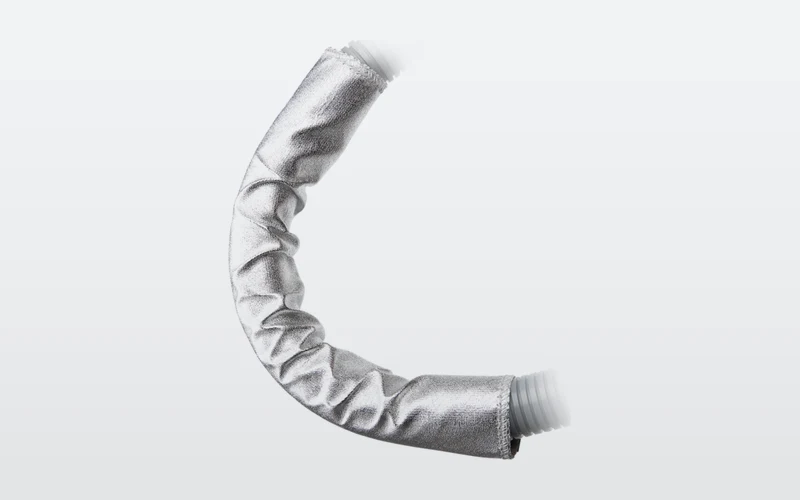
If the cables need to stay in place, there are two-part, closable protective hoses that you fit around the bundle afterwards.
How do you plan replacement without extra downtime?
A broken cable usually means unplanned downtime. Replacing the hose package, on the other hand, is something you can plan. Our robot division installs dress packs during planned stops and then checks the movement together with you.
This is how it works:
- (01)You send the robot model, application and what goes to the tool.
- (02)We assemble the package and feed the cables and hoses in at our workshop in Ruurlo.
- (03)The dress pack is delivered to you ready for installation.
- (04)During the planned stop we install it on the robot, in the Netherlands and Belgium.
If you have several robots of the same type, it helps to use the same package for each robot type. Then you know which parts you need in stock and replacement becomes predictable.
Want to see for yourself what belongs on your robot? Then assemble the package in the dress pack configurator. You get a parts list per axis, which our robot division checks. Prefer a proposal straight away? Request a quote for your dress pack.
Frequently asked questions
Why do my robot's cables keep breaking in the same place?
Because the load concentrates there. Usually that is at the wrist or at a fixed point without a proper transition. So do not just replace the cable, look at the torsion, the bend and the length of the package at that point.
Can I replace just the protective hose of my dress pack?
Yes. Protective hoses and wear parts are available separately. Give us the robot model and hose size and we will find the matching hose.
Does a retraction system help against cable breakage?
It prevents a loop that strikes the robot or the cell and keeps the length of the package under control. That removes two common causes of wear.
How can I tell whether a cable in the hose package is partly broken?
A fault that only occurs in certain robot positions strongly suggests it. Let the robot run slowly through the program and watch where the fault starts.
Can you install the dress pack during a planned stop?
Yes. Our robot division delivers the package ready for installation and installs it on site in the Netherlands and Belgium, at a time you choose.
Next step
Calculate it yourself or browse the range. We check your result free of charge.
Question about this topic?
Ask Daan directly
Robotics Division at Wisman Techniek