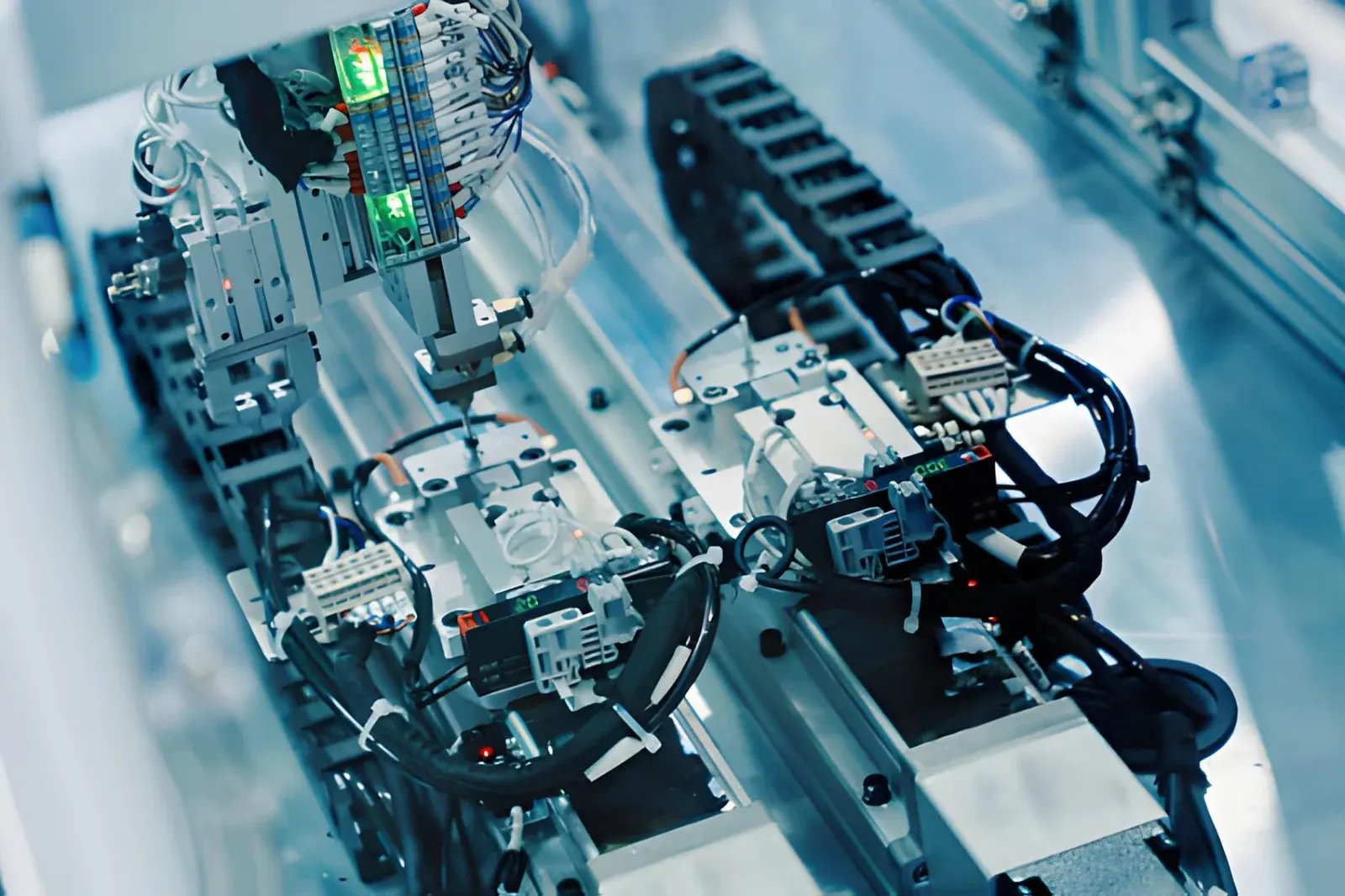
Rollon has redesigned its TV actuators. These are linear axes with a ball screw, in sizes 65, 80 and 110. According to Design World, which wrote about it on 21 October, they can handle higher moment loads and are suitable for longer strokes and higher speeds. IndustrieVandaag also reported the news on 26 October.
What changes on the axis
The axis runs on a rail with two preloaded recirculating ball blocks. In the new design these blocks are placed as far apart as possible, with the screw nut between them. As a result the carriage can absorb more moment, for example from a gripper or a second axis that protrudes from it.
For long strokes, optional support for the spindle is available. It limits spindle deflection and allows higher speeds. Repeatability is up to 5 μm. A polyurethane sealing strip keeps dirt away from the spindle and guide. Rollon mentions automation, packaging and robotics as applications.
What does this mean for the cable carrier on the carriage?
A stronger axis is used to do more with it: a heavier gripper, an extra axis on top or a longer stroke in less time. The carriage then usually also carries more cables and hoses, such as a motor and encoder cable for the next axis, compressed air or vacuum. These almost always run along in a cable carrier. Which carrier belongs to these actuators is not stated in the reports. What is certain is what a faster and longer movement demands of the cable carrier:
- Speed and acceleration. Every type of cable carrier has a limit, separately for self-supporting and gliding. If the axis becomes faster or the cycle shorter, check whether the type is still sufficient. How to do this is explained in determining cable carrier speed and acceleration.
- Self-supporting length. A longer stroke means a longer carrier. If the travel length becomes too long to be self-supporting, the upper section starts to sag or the carrier has to glide in a guide channel. See self-supporting or gliding.
- Weight and layout. Every cable that is added makes the carrier heavier and fuller. This affects the self-supporting length, the bending radius and the service life of the cables.
- Cables for movement. An axis that moves back and forth all day needs flexible cables made for use in a cable carrier, with a bending radius that suits the carrier.
What to look out for with a new or modified axis
Are you building a machine with a faster or longer linear axis, or using an existing axis for heavier work? Then include the cable carrier in the design, not only at assembly.
- Start with the cables. List which cables and hoses go along, with their diameter and minimum bending radius. The inner dimensions and the radius of the carrier follow from this.
- Calculate the length. With calculating the length of your cable carrier you can see straight away how much carrier you need for the stroke.
- Check the fill. With the fill level calculator you can see whether there is enough space around the cables, even if a cable is added later.
- Watch for noise and vibration. With precise axes, a carrier that vibrates or ticks can cause interference. Read quiet cable carrier for this.
What Wisman Techniek does
Wisman Techniek is the dealer of Tsubaki Kabelschlepp in the Netherlands and supplies cable carriers for linear axes and gantries, from compact plastic carriers to series for high speeds, such as the QUANTUM and the TKR. In our workshop in Ruurlo we fit the cables and mount the end connectors, so the carrier is ready for installation. With the cable carrier configurator you put the carrier together yourself based on your cables and stroke. A specialist checks it free of charge before you receive a quote.
Calculate it yourselfCable carrier configuratorCalculate, select and assemble a cable carrierOpen the cable carrier configurator