Short answer
Every type of cable carrier has a maximum speed and acceleration, separately for self-supporting and gliding. Calculate what your machine requires, from the stroke and the time per movement, and choose a type that is above that with a margin. Gliding, the limits are almost always lower than self-supporting.
You determine the speed and acceleration of a cable carrier from the movement of your machine: how far the moving part travels and in how much time. You compare those two values with the limits of the type, for the arrangement you use. A cable carrier that can handle 10 m/s self-supporting often manages only a quarter of that gliding. If you only look at inner dimensions and travel length and forget the speed, you choose a carrier that fits on paper and wears quickly in practice.
Which speed and acceleration do we mean for a cable carrier?
The limits in the manufacturer's data refer to the driver, the end that moves with the machine. The speed of the driver is therefore the speed of your machine. The bend of the carrier rolls along at half the speed, but you do not need to calculate with that yourself.
- Speed (m/s): the highest speed the machine reaches during the movement.
- Acceleration (m/s²): how quickly the machine gets up to speed and brakes again. For comparison: 1 g is approximately 9.81 m/s².
Per type there are two sets of limits in the data: one for self-supporting and one for gliding. Which arrangement you have depends mainly on the travel length. To find out, first read self-supporting or gliding, because the choice determines which limits apply.
What is the maximum speed of a cable carrier?
That differs greatly per series and per arrangement. A few examples from our range:
| Type | Self-supporting: speed | Self-supporting: acceleration | Gliding: speed | Gliding: acceleration |
|---|---|---|---|---|
| QUANTUM Q040 | 40 m/s | 300 m/s² | 2 m/s | 3 m/s² |
| QUANTUM Q080 | 25 m/s | 100 m/s² | 3 m/s | 3 m/s² |
| UNIFLEX Advanced UA1455 | 10 m/s | 50 m/s² | 2,5 m/s | 20 m/s² |
| M0950 | 10 m/s | 30 m/s² | 8 m/s | 20 m/s² |
| TKHP90-R | no data | no data | 10 m/s | 50 m/s² |
| S/SX0650 (steel) | 2 m/s | 3 m/s² | 0,8 m/s | 2 m/s² |
Three things stand out. The QUANTUM is made for very high speeds and accelerations, for example with linear motors, but only self-supporting. The TKHP is made precisely for long gliding travel lengths at high speed, such as on cranes. And steel carriers such as the S/SX are strong and heat-resistant, but not intended for fast movements.
The values are maximums. With a heavy cable package or close to the limit of the travel length, it is better to calculate with a margin, or choose a heavier type.
How do you calculate the speed and acceleration of your machine?
The speed is often given in the specification of the machine or the drive. If you only have the stroke and the time per movement, you calculate it yourself. For a movement that accelerates up to halfway and then brakes (with no section at constant speed), two simple formulas apply:
- Maximum speed = 2 × stroke ÷ time
- Acceleration = 4 × stroke ÷ time²
If the machine travels part of the stroke at constant speed, the peak speed is lower than this result and the acceleration higher. If you know the speed and acceleration of the drive, use those values: they are more accurate than an estimate from the cycle time.
Note: the travel length of the cable carrier is the stroke of the machine. The length of the carrier itself is something else. You calculate that with calculating the length of your cable carrier.
Worked example 1: a fast gantry over 1.5 metres
A gantry moves a part over 1.5 m in 0.6 s, with no section at constant speed.
- Maximum speed: 2 × 1.5 ÷ 0.6 = 5 m/s
- Acceleration: 4 × 1.5 ÷ 0.6² = 4 × 1.5 ÷ 0.36 = 16.7 m/s²
With a 1.5 m stroke the arrangement is self-supporting. A UNIFLEX Advanced UA1455 is permitted 10 m/s and 50 m/s² self-supporting, and goes up to 4.8 m travel length self-supporting. That fits with room to spare. A steel S/SX0650 is permitted 2 m/s and 3 m/s² self-supporting. It is therefore ruled out here, however strong it otherwise is.
If the same movement becomes twice as fast, in 0.3 s, the speed doubles to 10 m/s and the acceleration becomes four times as large: 66.7 m/s². The UA1455 is then at its speed limit and above its acceleration limit. You then end up with a series such as the QUANTUM.
Worked example 2: a trolley over 40 metres
A trolley travels 40 m at a peak speed of 4 m/s. That travel length is too long to be self-supporting, so the carrier glides in a channel.
- A UA1455 goes up to 120 m gliding, but is only permitted 2.5 m/s gliding. It is ruled out.
- An M0950 goes up to 260 m gliding and is permitted 8 m/s and 20 m/s² gliding. That fits, with a margin.
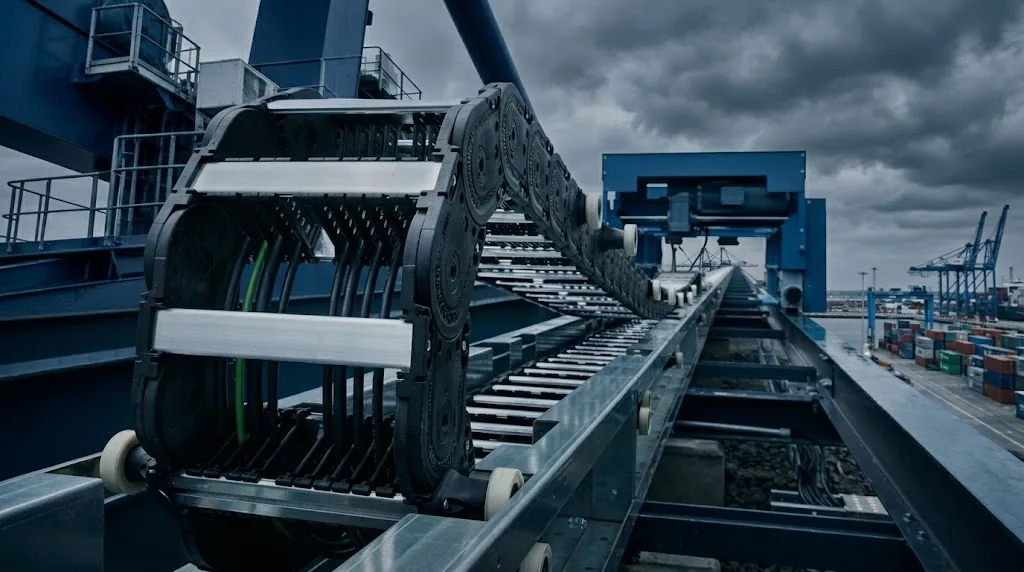
- For longer travel lengths or higher speeds the TKHP90-R is an option: gliding up to 1500 m, 10 m/s and 50 m/s².
This example shows why with a gliding arrangement you must always read the gliding column. If you see the self-supporting 10 m/s of the UA1455 and look no further, you choose a carrier that wears too quickly on this trolley. You can read more about long travel lengths in cable carrier for a long travel length.
The cable carrier configurator does this check for you. You enter travel length, speed and acceleration and the configurator shows per type whether it fits, for self-supporting and gliding. Types that are too slow are ruled out with the reason given.
Calculate it yourselfCable carrier configuratorCalculate, select and assemble a cable carrierOpen the cable carrier configuratorWhat happens if your cable carrier goes too fast?
A carrier running above its limits does not fail immediately. It wears faster and starts to behave differently. What we see in practice:
- More noise and vibration: the links hit down harder when rolling off. Read how this works in the case of a quiet cable carrier.
- Flapping: a self-supporting carrier that brakes hard whips afterwards and falls onto itself.
- Wear of the gliding surfaces: with a gliding carrier the glide shoes and the channel wear faster.
- Running out of the channel: at high acceleration a gliding carrier can bounce up and end up next to the channel.
- Cables that start to shift: at every start and stop the cables pull on their strain relief. If they are not secured properly, they start to move in the carrier and break sooner.
Do you recognise one of these signals on an existing machine, and has the machine recently been set to run faster? Then that is a good first suspect.
Troubleshooting guideCable carrier wears quicklyWorn side plates, sliding surfaces or hinges after a short time.Go to the solutionDo speed and acceleration also affect the cables?
Yes. The cables move along with the carrier and have to handle the same starts and stops. At high accelerations and many movements per day you need cables made for movement in a cable carrier, with a class that matches your travel length and the number of movement cycles. With the Cable finder you search for a flexible cable by type, cores, travel length and cycles. Which properties count is explained in which cables in a cable carrier.
Secure the cables properly at both ends and keep the fill level below 85%. That way they cannot hit each other and the links at a hard start.
What do you provide when requesting a cable carrier?
With this information we can take speed and acceleration into account straight away:
- (01)The travel length (stroke) of the machine
- (02)The arrangement: horizontal, vertical, self-supporting or gliding, if you already know
- (03)The maximum speed in m/s
- (04)The acceleration in m/s², or the stroke and the time per movement
- (05)The cables and hoses that need to go in, with diameter and weight if you have them
If you do not know the speed or acceleration precisely, provide the cycle time. Wisman checks the choice free of charge. You can also request a quote for a cable carrier directly.
Frequently asked questions
How fast may a cable carrier move?
That differs per type and per arrangement. In our range the self-supporting limits run from 2 m/s for steel carriers to 40 m/s for the QUANTUM Q040. Gliding they are usually between 0.8 and 10 m/s. The value for your type is on the series page and in the configurator.
Why is the permitted speed lower gliding than self-supporting?
With a gliding carrier the upper run lies on the lower run and glides over it. This friction and the wear of the gliding surfaces increase with speed. That is why the limits are lower gliding for most types. Series such as the TKHP and the M series are made to travel fast gliding as well.
How do I calculate the acceleration if I only know the cycle time?
For a movement that accelerates up to halfway and then brakes, the acceleration is 4 × stroke ÷ time². At 1.5 m in 0.6 s that is 16.7 m/s². If the movement has a section at constant speed, the acceleration is higher.
Is a steel cable carrier suitable for high speeds?
Usually not. Steel carriers are made for heavy packages, heat and a rough environment. In our data their self-supporting limits are around 2 to 5 m/s. For fast movements choose a plastic series.
What if my machine is set to run faster?
Then check again whether the carrier stays within its limits, for speed and acceleration. A carrier that fitted with room to spare before can be at or above its limit after a faster setting. Send us the new values and we will check it.
Next step
Calculate it yourself or browse the range. We check your result free of charge.
Series on this topic
Question about this topic?
Ask Bas directly
Cable Carriers Specialist at Wisman Techniek