Short answer
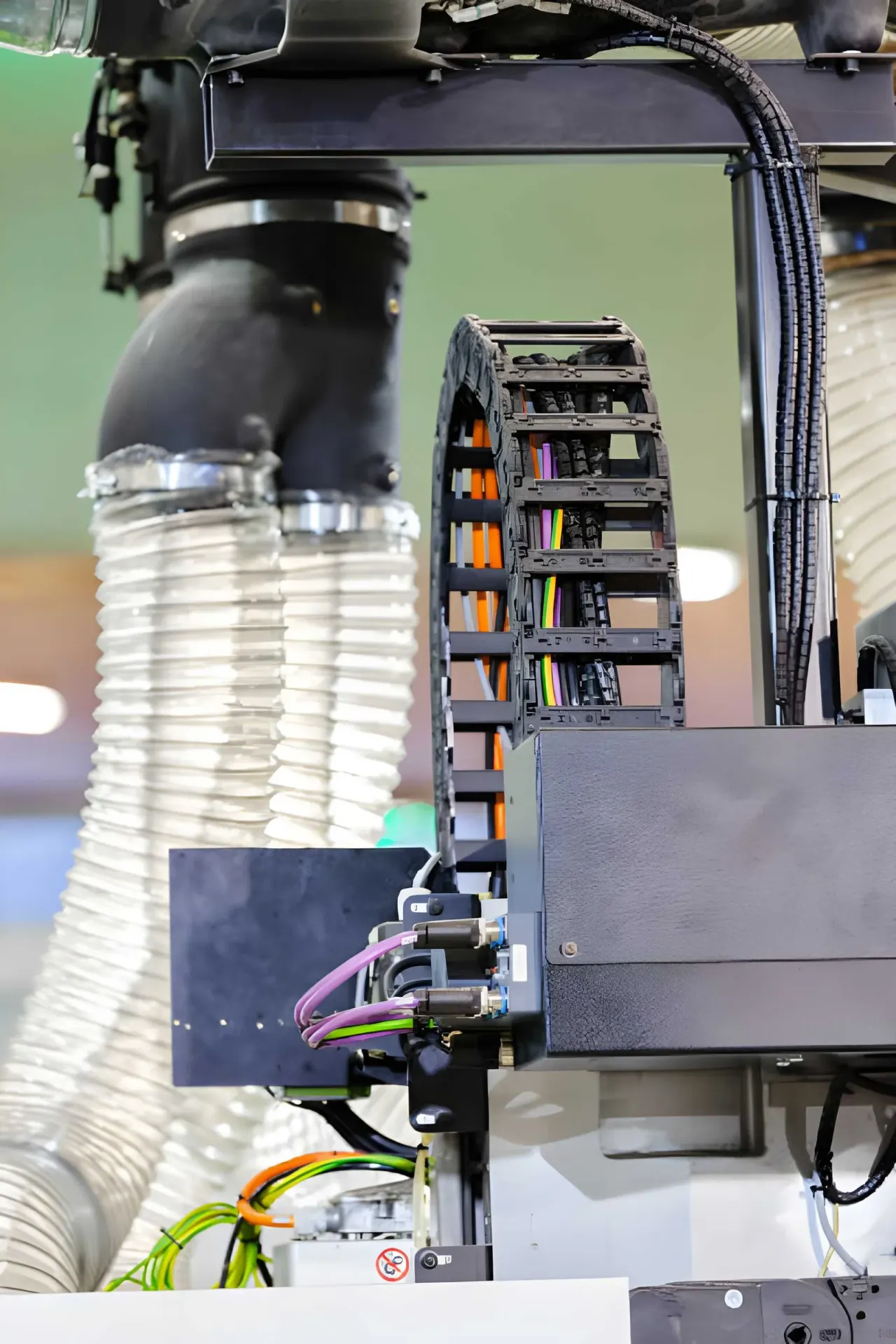
For moving machine parts you use highly flexible cables made for continuous movement. A hybrid cable combines power and signal in one shielded jacket, which saves cables and space in the cable carrier. Choose separate cables if the travel is longer or if you need more movement cycles than the hybrid cable can handle.
A machine cable that lies still lasts for years. A cable that moves with a machine part has a very different life: it bends with every stroke, sometimes millions of times. Ordinary installation cable is not made for that and breaks sooner or later. For moving machines you therefore need flexible cables, and in some cases a hybrid cable that combines power and signal.
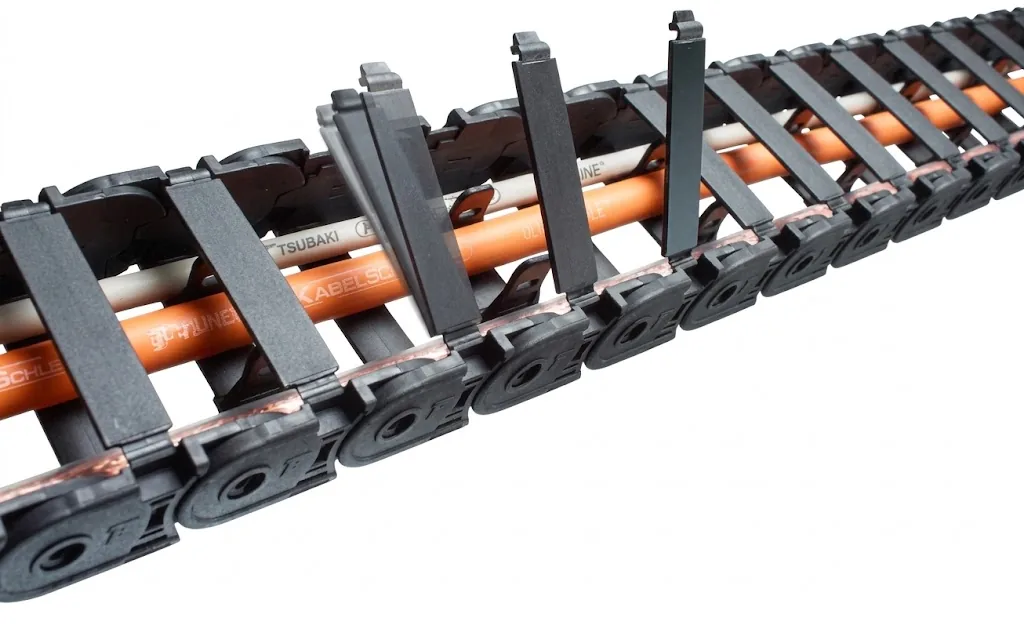
In this article you read which types of flexible cables exist, when a hybrid cable is useful and how to choose the right cable by movement, travel and environment. The examples come from the TRAXLINE range of Tsubaki Kabelschlepp.
What makes a cable suitable for a moving machine?
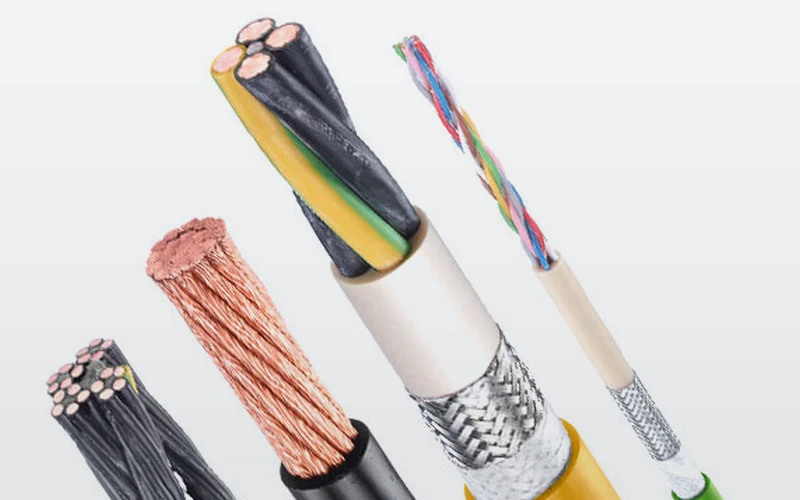
A cable for continuous movement is built differently from a fixed cable:
- Fine-stranded conductors: many thin wires bend better than a few thick ones
- Short lay length: the cores are tightly stranded, so they do not wander in the bend
- Wear-resistant jacket: that can withstand rubbing in the carrier and oil or coolant
- Specified movement cycles and bending radius: the manufacturer states how many movements and which radius the cable can handle
A cable that merely feels supple is not suitable for that reason alone. How to recognise a truly flexible cable is explained in flexible cable.
What types of flexible cables are there?
In a machine, several types of cables usually go into the cable carrier together:
- Control cables: control current and signals to sensors, valves and switches
- Power cables: power for motors and drives, multi-core or single-core
- Data cables: measuring and feedback signals, such as from encoders, with twisted pairs and shielding
- Bus and network cables: PROFIBUS, PROFINET, CAN bus, USB, Ethernet and coax
- Fibre optic cables: optical data, insensitive to electromagnetic interference
- Hybrid system cables: power and signal in one jacket
The full overview with all variants is under flexible cables.
What is a hybrid cable?
A hybrid cable combines cores for power and cores for signals in one jacket. Instead of a separate motor cable and a separate signal cable to a drive, there is one cable.
In the TRAXLINE range these are the system cables:
| Cable | Sheath | Shielding | Motion cycles up to | Travel length up to |
|---|---|---|---|---|
| SYSTEM S 700 C | PUR | Shielded | 5 million | 50 m |
| SYSTEM M 700 C | PUR | Double shielded | 5 million | 50 m |
See the data per cable under SYSTEM S 700 C and SYSTEM M 700 C.
When do you choose a hybrid cable?
A hybrid cable is useful when space and simplicity matter most:
- Fewer cables in the carrier: one cable instead of two or more, so a narrower or lighter carrier
- Simpler layout: fewer cables to arrange, secure and connect
- Compact machines: where the installation space for the cable carrier is limited
- Servo drives: where power and feedback go to the same point
Separate cables are the better choice if:
- the travel is longer than the hybrid cable can handle
- you need more movement cycles
- you want to be able to replace the cables independently
- power and signal go to different points
If in doubt, compare both options with your travel and the number of movements per day. That usually decides it.
Which class suits your machine?
With TRAXLINE cables the class is in the name: 200, 400, 700 or 1000. The higher the number, the more demanding the application. For the control cables the manufacturer gives these figures:
| Class | Sheath | Motion cycles up to | Travel length up to |
|---|---|---|---|
| CONTROL 200 | PVC | 2 million | 25 m |
| CONTROL 400 | PVC | 4 million | 100 m |
| CONTROL 700 | PUR | 7 million | 500 m |
| CONTROL 1000 | TPE | 10 million | 1000 m |
A short axis in a clean machine asks for something different from a gantry with a long travel that moves all day. Choose the class by the travel and the number of movements you expect over the service life. More about the classes in which cables in a cable carrier.
Choosing jacket and shielding
Two choices determine whether a cable lasts long in your environment:
- (01)Jacket: PVC for dry, clean environments; PUR as soon as there is oil, coolant, heavy wear or cold; TPE for the most demanding applications. See PUR or PVC cable.
- (02)Shielding: motor and servo cables on a frequency converter and encoder cables are shielded. With TRAXLINE, C stands for shielded and CD usually for double shielded. See shielded cable in the cable carrier.
Bending radius and space in the carrier
Even a highly flexible cable has a limit. The site calculates the bending radius of the carrier at a minimum of 7.5 times the diameter of the thickest cable, and generously at 10 times for many movements. If the data sheet gives a larger value, that applies. A hybrid cable is often thicker than the separate cables it replaces, so recalculate the radius. How is explained in determining the bending radius.
Calculate it yourselfCalculate the bending radiusMinimum bending radius from your thickest cableCalculate itHow to choose in four steps
- (01)List your connections: power, signals, data and hoses, with the points they go to.
- (02)Determine the movement: travel, speed and the number of movements per day.
- (03)Choose per connection: separate cables or a hybrid cable, and the class that suits your travel.
- (04)Choose jacket and shielding by the environment and the signals.
In the Cable finder you search for a cable by cores, cross-section and travel. Want the cables in the right carrier straight away? Use the Cable carrier configurator: in the Cable package step you choose a cable from the range directly. If you wish, we supply the carrier complete, cut to length and filled with your cables. Rather have a proposal straight away? Request a quote.
Calculate it yourselfCable finderThe right flexible cable for your cable carrierOpen the cable finderFrequently asked questions
What is a hybrid cable?
A cable that combines cores for power and for signals in one jacket. As a result you need fewer cables in the cable carrier and the layout becomes simpler.
Which hybrid cables do you supply?
The TRAXLINE system cables SYSTEM S 700 C and SYSTEM M 700 C, with a PUR jacket, shielded or double shielded, for up to 5 million movement cycles and travel lengths up to 50 metres.
Can I use ordinary installation cable in a moving machine?
No. Installation cable is not made to bend continuously and breaks sooner or later in a cable carrier. Use a cable with a specified number of movement cycles and bending radius for moving use.
Which cable do I choose with oil or coolant?
A cable with a PUR jacket. With TRAXLINE that is the 700 class. For the most demanding applications there is the 1000 class with TPE.
Do you supply flexible cables cut to length?
Yes, per metre cut to length, and if you wish assembled complete in the cable carrier in Ruurlo.
Next step
Calculate it yourself or browse the range. We check your result free of charge.
Series on this topic
Question about this topic?
Ask Bas directly
Cable Carriers Specialist at Wisman Techniek