
Short answer
The IP rating of a cable entry says how well it keeps out dust and water. IP54 is enough in a dry, clean hall, you choose IP65 or IP66 where water is sprayed or cleaning is done, and IP68 only if the entry can end up under water. The rating applies only to the complete entry, with the right grommets or rubber seals and empty positions closed. The cabinet is only as sealed as its weakest opening.
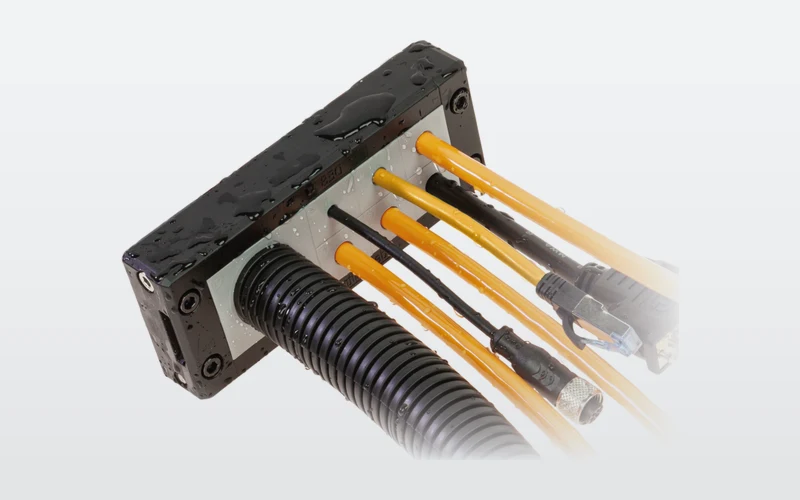
The IP rating of a cable entry indicates how well the entry keeps dust and water out of the cabinet. For a dry, clean production hall, IP54 is usually enough. If water is sprayed or wet cleaning is done, choose IP65 or IP66. You only need IP68 if the entry can end up under water. More important than the number on the label is that the whole entry is right: the correct grommet or rubber seal for each cable, empty positions closed and an opening that fits. A control cabinet is only as sealed as the weakest point in the wall.
In this article you can read what the numbers mean, which IP rating suits your environment and where things go wrong in practice. How to choose between cable gland, frame and entry plate is explained in choosing a cable entry.
What does the IP rating of a cable entry mean?
IP stands for Ingress Protection. The coding is laid down in the standard EN/IEC 60529. The first digit concerns solid particles such as dust, the second digit concerns water.
| Digit | First digit: dust and solid particles | Second digit: water |
|---|---|---|
| 4 | Particles larger than 1 mm | Splashing water from all directions |
| 5 | Dust protected: what gets in does not hinder operation | Water jet from all directions |
| 6 | Dust-tight | Powerful water jet |
| 7 | - | Temporary immersion |
| 8 | - | Continuous immersion, under the manufacturer's conditions |
IP54 therefore means: dust protected and resistant to splashing water. IP66 is dust-tight and resistant to a powerful water jet. With IP68 the manufacturer itself determines at what depth and for how long the entry may be under water. Those conditions are in the product data.
Note: a higher second digit does not always include the lower ones. Immersion (7 or 8) is a different load from a water jet (5 or 6). That is why good entries often show a double rating, such as IP66/IP68. That means it has been tested for both.
Which IP rating suits your machine?
Choose the rating based on the environment where the cabinet is located, not on what sounds highest. A higher rating often requires a different product or a different seal.
- IP54: dry halls, cabinets inside a machine, places where at most some dust or a splash of water arrives. Many split frames and glands for cables with connectors fall into this class.
- IP65 and IP66: machines that are cleaned wet, places with coolant or splashing water from all sides, and outdoor installations under a canopy. In the food industry and on machining equipment this rating is often required.
- IP68: cabinets that can end up under water in the event of a fault or flood, pits and cellars, and waterside applications where water can remain standing.
If you are torn between two ratings, also look at the rest of the cabinet. An IP66 entry in a cabinet with an IP54 door does not make the cabinet more sealed than IP54.
Why does a cable entry not always achieve its IP rating?
The stated IP rating was tested with a complete, properly fitted entry. In practice, things go wrong in a few places.
- (01)The grommet or rubber seal does not match the cable. Every grommet and rubber seal has a clamping range. If the cable is thinner than the range, the seal does not close all the way round. If it is thicker, the membrane tears or you cannot get the entry closed.
- (02)Empty positions have been left open. A frame with a few unused positions only achieves its rating with blind grommets or blind rubber seals in them. An open position is simply a hole.
- (03)Multiple grommets where a single one is needed. With some frames the rating depends on the grommets. With the Icotek KEL-ERM, IP66 applies with single grommets and IP65 with multiple grommets.
- (04)The cable sheath is not round or smooth. A seal closes on a round, smooth sheath. Flat cables, braided hoses or a damaged sheath leak past the grommet.
- (05)The gasket does not sit properly. A frame seals with a gasket against the cabinet wall. An uneven wall, a cut-out that is too large or fixings tightened too loosely make the seal worse.
Even within one product family the rating differs per version. For the Icotek KEL frames the range runs from IP54 to IP66, depending on frame and seal. So always look at the rating of the exact type, not the family.
Which cable entry do you choose for IP66 or IP68?
For cables with connectors there are split solutions that also achieve a high rating:
- Split frames with elastomer seal: the DES frames from Detas Ultra achieve IP66 or NEMA 4X with any combination of entry rubbers. At Icotek the KEL-ER frames achieve IP66. View the variants at cable entry frames.
- Split cable glands: the Icotek KVT-ER is a split cable gland for a round metric hole (M25 to M63) and achieves IP66/IP68. With it you can also lead cables with plugs into a cabinet that can end up under water. See split cable glands.
- Entry plates with membranes: handy for many cables without connectors. The cable passes through the membrane, which closes tightly around the sheath. View the cable entry plates for the rating per type.
The Cable entry planner asks for Icotek which IP rating you need (54, 66 or 68) and only shows solutions that achieve it. If you ask for IP68, the KEL frames drop out, because those are tested up to IP66. You get the layout, the drawing of the cabinet wall and the article numbers.
Calculate it yourselfCable entry plannerFrom cable list to cable entry with article numbersOpen the plannerWhen is a brush entry enough?
A brush entry has no IP rating for water. It finishes an opening neatly, keeps out coarse dirt and part of the dust and lets cables through easily, including with connectors. Use it in a dry environment where no waterproofing is needed, for example in a floor or an intermediate wall. If the cabinet has to be sealed, choose a frame, plate or gland. More about brushes can be found at brush seal.
IP rating, strain relief and EMC: how do they relate?
A good seal often also secures the cable. That way the entry absorbs tensile forces, so that there is no pull on the terminals. This applies especially to cables coming out of a cable carrier, which therefore move. Whether an entry provides enough strain relief is stated per product in the data. Also read what strain relief is.
With shielded cables you usually ground the shield just inside the cabinet with an EMC clamp. The entry takes care of the sealing, the clamp of the earthing. How to go about that is explained in connecting EMC shielding.
Unsure about the right IP rating?
Send us your cable list, the environment of the cabinet and the size of the opening. Olaf and his colleagues will check free of charge which entry achieves the rating you need, with the right grommets or rubber seals for each cable.

Frequently asked questions
What is the difference between IP65 and IP66?
Both are dust-tight. IP65 is tested with a water jet from all directions, IP66 with a powerful water jet. If pressure spraying is used during cleaning, choose IP66.
Is IP68 always better than IP66?
Not always. IP68 concerns continuous immersion, IP66 a powerful water jet. Those are different tests. An entry with IP66/IP68 has been tested for both. If it only says IP68, check the data to see whether it can also withstand a water jet.
Does a cable entry achieve its IP rating with empty positions?
Only if the empty positions are closed with blind grommets or blind rubber seals. An open position in a frame or plate is a hole in the cabinet wall.
Can a split cable entry be waterproof?
Yes. There are split frames and glands with an elastomer seal that achieve IP66 or IP66/IP68, including for cables with connectors. The rating differs per type, so look at the data for the exact version.
Does the IP rating of the entry count for the whole control cabinet?
No. The cabinet is only as sealed as the weakest point: door, gasket, ventilation and every entry all count. An entry with a higher rating than the cabinet does not make the cabinet more sealed.
Next step
Calculate it yourself or browse the range. We check your result free of charge.

Question about this topic?
Ask Olaf directly
Inside Sales at Wisman Techniek