Short answer
The copper surcharge on a cable is the difference between the current copper price and the copper value already included in the cable price. You calculate it per metre using the copper weight of the cable from the datasheet. The formula is copper weight (kg/m) × ((DEL quotation + procurement costs) − copper base) / 100, with the quotation, costs and base in € per 100 kg. If the quotation is below the base, there is no surcharge.
The copper surcharge on cables is an amount per metre on top of the cable price. It follows the copper price of the day. The price of a cable includes a fixed amount of copper value, the copper base. If copper is more expensive than that base, you pay the difference as a copper surcharge. You calculate it with the copper weight of the cable: copper weight (kg/m) × ((DEL quotation + procurement costs) − copper base) / 100. This immediately shows why a thick power cable has a much higher surcharge than a thin control cable.
Below you can read what each part of the formula means, how to check the copper surcharge yourself and why the amount on your quote can differ from what you paid last month.
What is the copper surcharge on cables?
Copper is the most expensive raw material in a cable, and its price changes every day. That is why cable manufacturers do not put the full copper value in their price list. They work with a fixed base and add the rest at the time of sale. That part is called the copper surcharge, in German price lists the Kupferzuschlag.
The advantage is that a price list does not have to be redone every week. The cable price stays the same and only the surcharge moves with the market. The drawback for a buyer is that the total price of the same cable can differ from month to month. If you know how it is built up, you can compare quotes better and estimate a budget more accurately.
The copper surcharge applies to cables with copper conductors: control cables, power cables, data cables and bus cables. A fibre optic cable without copper cores has no copper weight and therefore no surcharge.
What does the copper surcharge consist of?
The formula has four parts. Two belong to the market, two to the cable and the price list.
| Part | What it is | Where to find it |
|---|---|---|
| Copper weight | How much copper there is in one metre of cable, in kg/m | Cable datasheet |
| DEL quotation | The copper price of the day, in € per 100 kg | Daily quotation, derived from the London Metal Exchange |
| Procurement costs | Purchasing and handling costs on top of the quotation | Price list of the manufacturer or supplier |
| Copper base | The copper value already included in the cable price, in € per 100 kg | Price list of the manufacturer or supplier |
The DEL quotation stands for Deutsches Elektrolytkupfer für Leitzwecke: copper of the purity used in cables. On our site we derive this quotation from the LME Copper cash settlement in dollars per tonne and the ECB reference rate of the same day. Dollars per tonne divided by the rate and by ten gives euros per 100 kg.
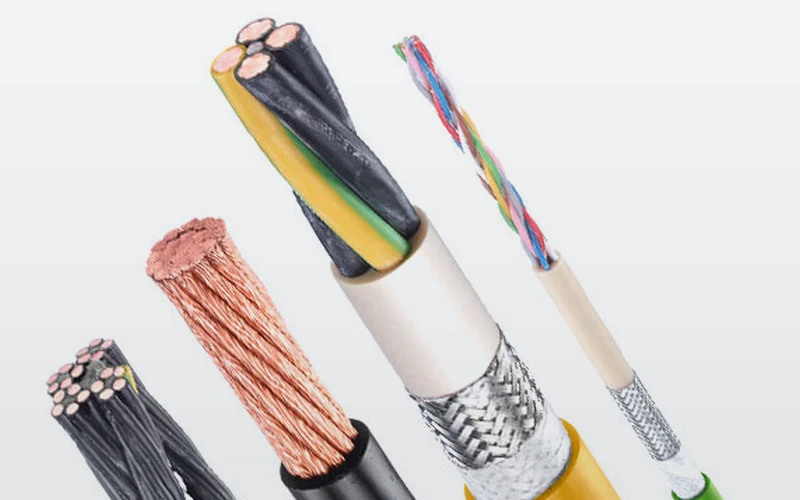
The copper weight differs per cable. It depends on the number of cores and the cross-section. A cable with four 1.5 mm² cores has much less copper than a cable with four 25 mm² cores. The copper weight is in the datasheet, often as "Cu-Zahl" or "copper number" in kg/km. Divide that number by a thousand for kg/m.
Procurement costs and copper base are agreements from the price list. For the TRAXLINE cables we supply, we use a copper base of € 150 per 100 kg and procurement costs of 1% of the quotation. Other price lists may use a different base. So never compare the cable price alone, but always the cable price and surcharge together.
How do you calculate the copper surcharge per metre?
The formula is:
Copper surcharge per metre = copper weight (kg/m) × ((DEL quotation + procurement costs) − copper base) / 100
You work in four steps:
- (01)Look up the copper weight in the datasheet and convert it to kg/m.
- (02)Take the DEL quotation of the day and add the procurement costs.
- (03)Subtract the copper base. What remains is the extra cost of the copper per 100 kg.
- (04)Multiply by the copper weight and divide by 100. Round to two decimal places. That is the surcharge per metre.
For the total, multiply the rounded surcharge per metre by the number of metres. If the quotation plus costs is below the base, the result is zero. A negative surcharge does not exist.
Worked example: copper surcharge for three cables
Suppose the DEL quotation today is € 1,200 per 100 kg. The procurement costs are 1% of that, so € 12. With a copper base of € 150, that leaves 1,200 + 12 − 150 = € 1,062 per 100 kg. You use that figure for every cable.
| Cable | Copper weight | Surcharge per metre | For 100 metres |
|---|---|---|---|
| CONTROL 200, 4G1,5 mm² | 0,058 kg/m | € 0,62 | € 62,00 |
| CONTROL 200, 7G1,5 mm² | 0,101 kg/m | € 1,07 | € 107,00 |
| POWER 700, 4G25 mm² | 1,000 kg/m | € 10,62 | € 1.062,00 |
The calculation for the first cable: 0.058 × 1,062 / 100 = 0.616, rounded € 0.62 per metre. For 100 metres that is € 62.00.
The example shows where the money is. With a thin control cable, the surcharge is a small part of the price. With a heavy power cable, the copper surcharge can be a large part of the total. If the quotation rises by € 100 per 100 kg, the POWER 700 4G25 becomes about one euro per metre more expensive, and the thin CONTROL 200 only about six cents.
You can see the copper weight and the current surcharge per variant on every series page, for example for the CONTROL 200 and the POWER 700. Choose a variant and the number of metres there, and the page calculates the surcharge with today's quotation.
Why does the copper surcharge on cables keep changing?
Because the DEL quotation changes every trading day. The copper price responds to supply and demand, to stocks at the metal exchanges and to the exchange rate between the euro and the dollar. A weaker euro makes copper more expensive in euros, even if the dollar price stays the same.
This has two consequences for your purchasing:
- A quote is a snapshot. The surcharge on a quote is calculated with the quotation of that day. We calculate the final copper surcharge with the quotation of the day of your order confirmation.
- The same item can cost a different amount per order. If you order the same cable every month, the total per invoice can differ, while the cable price has stayed the same.
If you work with a budget for a project with a lot of cable, allow a margin on the surcharge. With heavy power cables, that margin counts the most.
Can you limit the copper surcharge on cables?
You cannot influence the quotation itself. You can influence the copper weight, by choosing the right cable.
- Choose the cross-section you need. A cable that is heavier than the current requires costs extra copper. The cross-section follows from current, length and voltage drop, and the electrical engineer determines that.
- Choose the right class. The TRAXLINE classes 200, 400, 700 and 1000 differ in how often and how far the cable may move. A heavier class often has a different construction and a different weight. With the Cable finder you can see which lightest class suits your travel length and number of movements.
- Combine where possible. Sometimes a hybrid cable replaces two separate cables. Whether that suits your machine, you can read in flexible and hybrid cables for machines.
Never save on copper by choosing a cable that is not made for movement. A cheaper cable that breaks after a short time in the cable carrier costs much more than the surcharge. What makes a cable suitable for movement is explained in flexible cable: when is a cable really flexible?.
Calculate it yourselfCable finderThe right flexible cable for your cable carrierOpen the cable finderHow do you request cables with the copper surcharge included?
If you know which cables you need, put them on your request list with the number of metres via the flexible cables or include them in a quote request. You will hear stock and price within 1 working day, with the copper surcharge of the day included. The quote shows the cable price and surcharge separately, so you can compare them.
If the cables go into a cable carrier, you can link them directly to your cable carrier in the cable carrier configurator. You then see which cable carrier fits your cable package and choose whether you want the cables supplied with it, cut to length or laid in. What else you can arrange with us as a buyer is on for buyers.
Frequently asked questions
What is the DEL quotation?
The DEL quotation is the daily price for copper suitable for electrical conductors, in euros per 100 kg. Cable manufacturers use it to calculate the copper surcharge. We derive it from the LME copper price in dollars per tonne and the ECB exchange rate of the same day.
Where can I find the copper weight of a cable?
In the datasheet of the cable, usually as the copper number in kg/km. Divide by a thousand for kg/m. For the TRAXLINE cables you can see the copper weight per variant on the series page.
Why is the copper surcharge shown separately on the quote?
Because it moves with the copper price and the cable price does not. By showing them separately, you see what the item costs and what the copper of that day costs. That way you can also compare quotes with a different copper base fairly.
Can the copper surcharge also be zero?
Yes. If the DEL quotation plus procurement costs is below the copper base, the surcharge is zero. We do not charge a negative surcharge, meaning a discount at low copper prices.
Which quotation is used to invoice my order?
We calculate the final copper surcharge with the quotation of the day of your order confirmation. The amounts on the site and in a quote are therefore an indication.
Next step
Calculate it yourself or browse the range. We check your result free of charge.

Series on this topic
Question about this topic?
Ask Bas directly
Cable Carriers Specialist at Wisman Techniek