Short answer
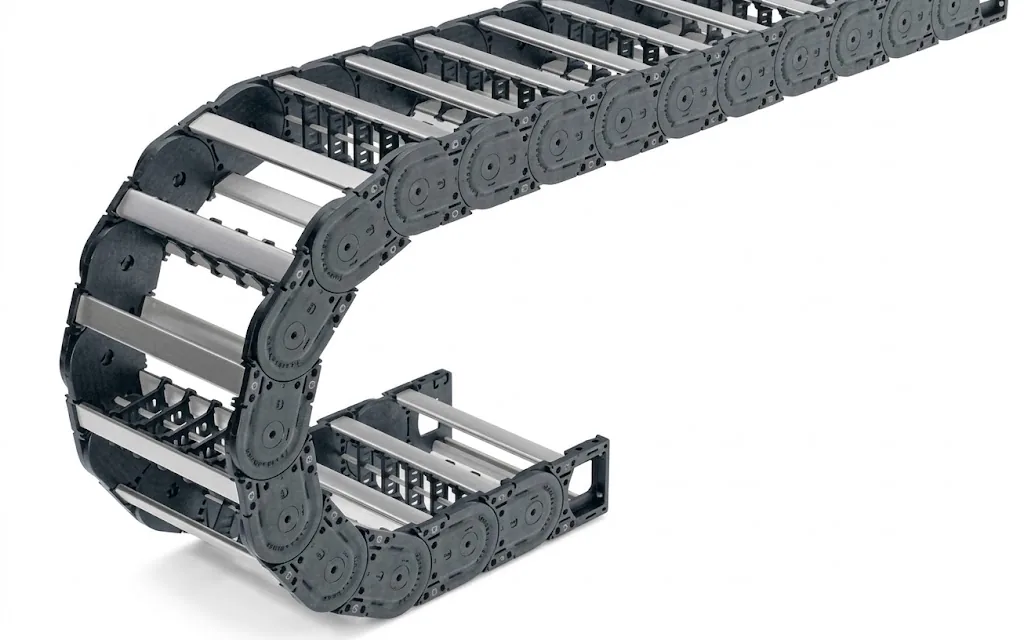
The end connectors join the cable carrier to the machine, at the fixed point and at the driver. For each end you choose how it is mounted: outside or inside the bend, turned 90°, universal or with a flange. Which options are possible differs per series. Choose the mounting that matches the place where you can fit it.
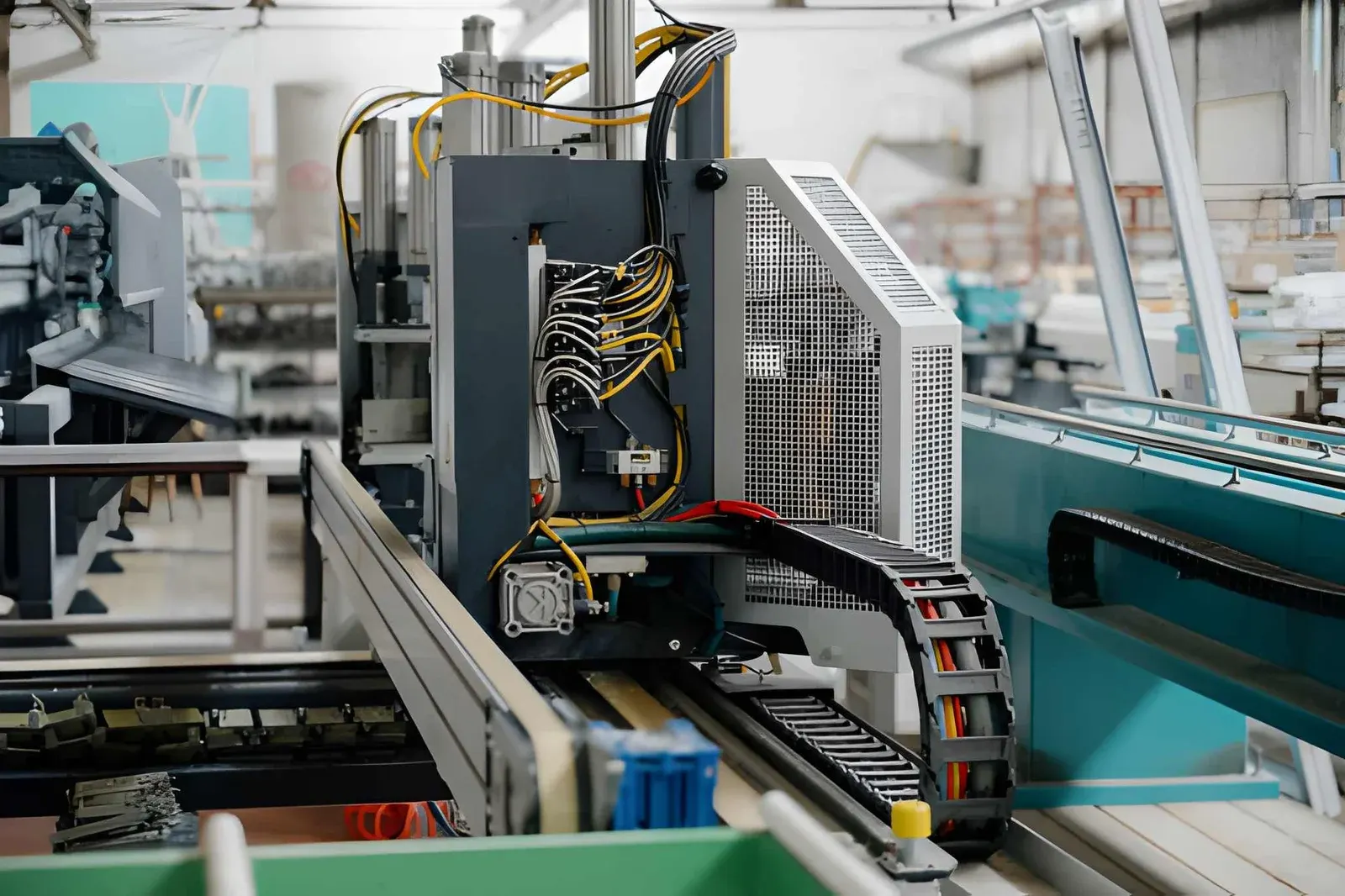
A cable carrier is fixed at two ends: at the fixed point (FP) and at the driver (MA), the part of the machine that moves. That is what the end connectors are for. Which ones you need depends on where you can mount: on the outside of the bend, on the inside, at right angles to it or with a flange. The strain relief for the cables is usually also located at the end connectors.
What types of end connectors are there?
Tsubaki Kabelschlepp uses one letter per end. With F in front it concerns the fixed point, with M the driver. FA is therefore the end connector at the fixed point on the outside, MI the end connector at the driver on the inside.
| Letter | Mounting | When do you choose this one? |
|---|---|---|
| A | Outdoors | The mounting is on the outside of the bend. The most commonly used version. |
| I | Inside | You can only mount on the inside of the bend. |
| H | 90° outwards | The mounting is at right angles, with the flat side facing outwards. |
| K | 90° inwards | The mounting is at right angles, with the flat side facing inwards. |
| U | Universal (UMB) | One end connector that you can mount in several ways. |
| F | Flange | Mounting with a flange, for example on larger and heavier series. |
You may choose a different version on each side, for example FA at the fixed point and MI at the driver.
Which end connectors suit which series?
That differs per series. A few examples from the catalogue:
- The UA1665 is available as universal (UMB), outside, inside and turned 90°. Universal is the standard.
- The QT0320 is available as outside, inside and turned 90°.
- The M1250 is available as universal, outside, inside and with a flange.
- The TKA38 and the M1300 only have universal end connectors.
For each type, the Cable carrier configurator shows which versions are available.
How do you choose the right mounting?
- (01)Look at where you can mount. If there is room for bolts on the outside of the bend, choose outside (A). If a wall or profile is in the way, choose inside (I) or turned 90° (H or K).
- (02)Look at the direction of the cables. The end connectors also determine how the cables enter and leave the carrier. Let them run in a straight line to the connection point.
- (03)If in doubt, choose universal. With series that have a UMB end connector, you can still change the mounting direction later.
Strain relief at the end connectors
Cables must be secured at both ends, so that they can move freely in the carrier but cannot shift. For most series the strain relief can be fitted directly to the end connector, with a comb or a C-rail. You can read more about this in what is strain relief.
Frequently asked questions
What do FA and MA mean for a cable carrier?
FA is the end connector at the fixed point with the mounting on the outside. MA is the same at the driver. The second letter indicates the version: A outside, I inside, H and K turned 90°, U universal, F flange.
May I choose a different end connector on each side?
Yes. You choose the fixed point and the driver independently of each other, as long as the series has those versions.
Are the end connectors included with the cable carrier?
At Wisman Techniek you order the cable carrier with the end connectors you choose. In the configurator they appear in the bill of materials, together with the strain relief.
Next step
Calculate it yourself or browse the range. We check your result free of charge.
Series on this topic
Question about this topic?
Ask Bas directly
Cable Carriers Specialist at Wisman Techniek