Short answer
Shortening or lengthening a cable carrier is always done in whole links of the same series, the same type and the same bending radius. First calculate the new length with the new stroke (with a fixed point in the middle, half the travel length plus π × bending radius plus two links, rounded up to whole links). Then adjust the cables, fix the strain relief again and let the machine make the full stroke slowly. When lengthening, the cables often have to be replaced, because a cable in a cable carrier should be made of one piece.
Shortening or lengthening a cable carrier is necessary when the stroke of a machine changes, when the fixed point moves or when a machine is modified. It is almost always possible, provided you do it in whole links and with links of the same series, the same type and the same bending radius. The work itself is not complicated. Where it often goes wrong is with the cables: they end up too long when shortening and too short when lengthening.
In this article you read how to calculate the new length, how to add or remove links and what to do with the cables. If the carrier has to be opened for another reason, for example because of a broken link, first read repairing or replacing a cable carrier.
When do you need to shorten or lengthen a cable carrier?
The length of a cable carrier depends on three things: the travel length, the position of the fixed point and the bending radius. If one of these three changes, the length is no longer correct.
| Situation | What happens to the length |
|---|---|
| Longer stroke due to modification or a new axis | Lengthen |
| Shorter stroke, for example after moving an end stop | Shorten |
| Fixed point moved from the end to the middle | Shorten, with the same stroke |
| Fixed point moved from the middle to the end | Lengthen, with the same stroke |
| Carrier taken over second-hand from another machine | Recalculate, then adjust |
A carrier that is too short pulls taut in the extreme position. Force then acts on the end mountings and the last links, and in time these break. A carrier that is too long runs with the bend beyond the driver, ends up lying on itself or sags. Both cause wear that you would rather avoid.
How do you calculate the new length of the cable carrier?
You calculate in the same way as for a new carrier. If the fixed point is in the middle of the stroke, the length is:
- half the travel length,
- plus the bend (π × bending radius),
- plus two links,
- rounded up to whole links.
If the fixed point is at the end of the stroke, the whole travel length counts instead of half.
Worked example: the stroke becomes 600 mm longer
A machine gets a longer axis. The stroke goes from 3,000 to 3,600 mm. The fixed point is in the middle, the bending radius is 125 mm and the pitch is 50 mm.
| Old stroke 3,000 mm | New stroke 3,600 mm | |
|---|---|---|
| Half travel | 1.500 mm | 1.800 mm |
| Bend (π × 125) | 393 mm | 393 mm |
| Two links | 100 mm | 100 mm |
| Raw length | 1.993 mm | 2.293 mm |
| Rounded up to whole links | 2,000 mm (40 links) | 2,300 mm (46 links) |
So you need six extra links, 300 mm in total. That is half of the extra stroke, because the fixed point is in the middle. If the stroke goes down by 600 mm instead, you remove six links for the same reason.
With the calculator calculate cable carrier length you enter the new travel length, the radius and the pitch and immediately see the length and the number of links.
Calculate it yourselfCalculate cable carrier lengthLength and number of links from travel length and radiusCalculate itIf you do not know the pitch or the radius, look at the side plate. The type number is usually stated there. What the dimensions mean and where to find them is described in cable carrier dimensions.
Which links do you need to lengthen a cable carrier?
New links must fit exactly with what is already there. Pay attention to these points:
- (01)Same series and type: the connection between two links differs per series. Links from another series or another brand do not fit.
- (02)Same inner width: with many series the crossbars determine the width. Order crossbars in the same width as well.
- (03)Same bending radius: within one type several radii are often available. A link with a different radius gives a kink in the bend.
- (04)Same version: can be opened on the inside or outside, with or without dividers. Copy the layout of the existing carrier.
With a request, include a photo of the side plate, the inner width and the number of links. On the page parts and repair you add links and crossbars to your request list by article number or type number.
How do you shorten a cable carrier?
First isolate the machine from the power supply and secure it against unexpected movement. Then work in this order:
- (01)Put the carrier in the middle position. The cables then lie as straight as possible and no tension is put on the connections.
- (02)Open the crossbars over the section where you remove links, so that the cables lie free. Do not pull on the cables.
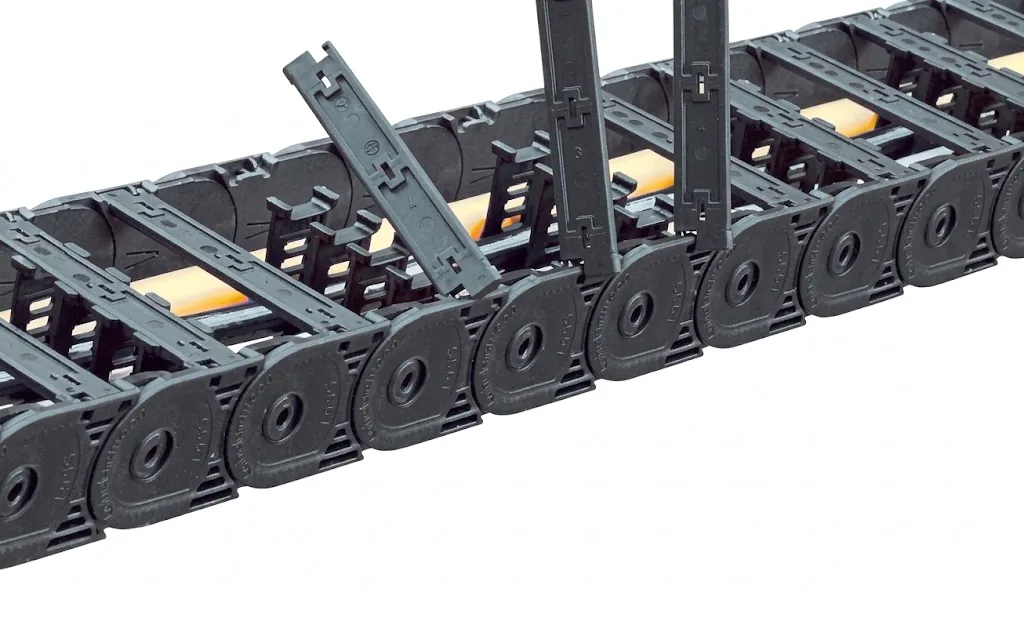
- (03)Remove the links at the end. Release the end mounting, take out the number of links you calculated and refit the end mounting. How a link connection opens differs per series. You can find the assembly instructions under downloads.
- (04)Adjust the cables. The cables are now too long. Do not take up the excess length in the carrier with a loop, but on the connection side, for example by shortening the cable and reconnecting it.
- (05)Re-secure the strain relief at the fixed point and at the driver, leaving a little extra length for the bend.
- (06)Test the full stroke slowly. Check in both end positions that the carrier is not pulled taut and that the bend does not catch on anything.
What do you do with the cables when you lengthen a cable carrier?
When lengthening, the cables are almost always too short. Extending a cable with a joint inside the carrier is not a good idea: a splice or coupling in the moving section flexes with every stroke and becomes a weak point. A cable in a cable carrier should be a single piece from fixed point to driver.
If there is enough slack on the connection side, you can sometimes shift the cable along. In most cases the cables are replaced. That is also a good moment to check whether the cables are still suitable for moving use. Highly flexible cables such as the TRAXLINE cables are made for this, and with the Cable finder you can find one by cores, cross-section and travel length. For what else to look out for, see which cables go in a cable carrier.
When laying in the cables, the same rules apply as for a new carrier: cables straight and without torsion, not crossed, with clearance and each in its own compartment. For how to go about it, see assembling a cable carrier.
Does the type still suit the new stroke?
A longer carrier is also a heavier carrier. In a self-supporting arrangement, a longer stroke means a longer self-supporting section. Each type can only span a certain length without support, and that limit depends on the weight of the carrier and cables. If the stroke becomes considerably longer, the type may no longer be able to run self-supporting and a gliding arrangement in a guide channel may be needed. You can read about the difference in self-supporting or gliding.
The installation height and the available space also deserve a check. The bend shifts along with the position of the fixed point, and it must stay clear of the machine in both end positions.
If in doubt, enter the new stroke and the cable package in the Cable carrier configurator. You will see straight away whether the current type still fits or which types do. A specialist will check the result free of charge.
Calculate it yourselfCable carrier configuratorCalculate, select and assemble a cable carrierOpen the cable carrier configuratorWhen is modifying a bad idea?
Shortening or lengthening does not return a carrier to new condition. If the carrier is worn along its whole length, with play in the links, worn side plates or brittle material, you would be adding new links to a carrier that is about to give up anyway. In that case, choose replacement. You can read about the signs in recognising wear on a cable carrier.
If the series is no longer available or you do not know which type it is, use the Replacement finder to find a type that fits in the same place. You enter the dimensions of the current carrier, of any brand.
Would you rather not do it yourself? We modify carriers in our workshop in Ruurlo, including new cables and strain relief, or on location during a planned stop.

Frequently asked questions
Can you shorten a cable carrier to any length?
No, only in whole links. The length therefore always goes up or down in steps of the pitch. Calculate the new length and round up to a whole number of links.
How many links do you need if the stroke gets longer?
If the fixed point is in the middle, the carrier becomes half of the extra stroke longer. With 600 mm of extra stroke and a pitch of 50 mm, that is six links. If the fixed point is at the end, the whole extra stroke counts.
Can you use links from another brand to lengthen?
No. The connection between links differs per series and per brand. Use links of the same series, the same type and the same bending radius as the existing carrier.
May you join a cable inside the cable carrier?
No. A joint in the moving section flexes with every stroke and becomes a weak point. Replace the cable with a single-piece cable, from fixed point to driver.
What do you do with the excess cable length after shortening?
Remove it on the connection side and not as a loop inside the carrier. Then secure the cables again with strain relief at the fixed point and at the driver.
Next step
Calculate it yourself or browse the range. We check your result free of charge.
Series on this topic
Question about this topic?
Ask Joep directly
RMO Specialist at Wisman Techniek