Short answer
Repair a cable carrier if the damage is local, the cables are fine and the cause has been removed. Replace the complete carrier in case of wear along the entire length, brittle or discoloured material, damage that returns after repair or a carrier that was chosen wrongly in the first place.

Repair works if the damage is in one place, the rest of the carrier is healthy and you know why it went wrong. Replacing is better if the carrier is worn along its entire length, if the material has become brittle or if the damage returns after repair. A repair that is needed again a few months later ends up costing more than a new carrier.
The decision depends on three things: how big the damage is, what state the cables are in and what the cause was. Not yet sure exactly what is wrong? First check the carrier with spotting wear on cable carriers or the Carrier check.
When can you repair a cable carrier?
Repair makes sense if all these points apply:
- The damage is local: a few links, a broken side plate or a loose cross connection.
- The rest of the carrier has no play in the hinges and no worn spots along its length.
- The cables are undamaged and lie straight.
- The cause was a one-off, such as a collision or an object that got into the carrier, or you have found and removed the cause.
- You know the series and type, so the new parts fit exactly.
In a repair you only replace what is broken. The carrier keeps the same length, the same radius and the same fixing, so nothing changes on the machine.
When should you replace the cable carrier?
Replacing is the better choice if one of these points applies:
- The links show play or wear along the entire length.
- The material is brittle or discoloured by heat, UV, coolant or chemicals.
- The carrier breaks in several places at once.
- The damage returns at the same spot, even after repair.
- The carrier was chosen wrongly at the time: too tight a radius, too light for the weight or open where enclosed is needed.
In those cases a new link does not help. A brittle carrier breaks again next to the repair, and a carrier that is too light fails again under the same load.
How do you decide per situation?
| Situation | Advice |
|---|---|
| One or a few links broken, rest OK | Repair |
| Cross connection loose, broken or missing | Repair |
| Worn gliding shoes, carrier itself still good | Repair |
| Different stroke or machine layout | Shortening or lengthening |
| Play or wear along the entire length | Replace |
| Brittle or discoloured material | Replace, possibly with a different series |
| Breaks again after repair | Find the cause, then replace |
| Cables damaged as well | Assess carrier and cables together |
Under cable carrier breaks you find, per cause, what you can check before ordering parts.
Troubleshooting guideCable carrier breaksBroken links, loose cross bars or a carrier that falls apart.Go to the solutionWhich repairs are possible on a cable carrier?
Not every repair is a broken link. These are the repairs we do most often:
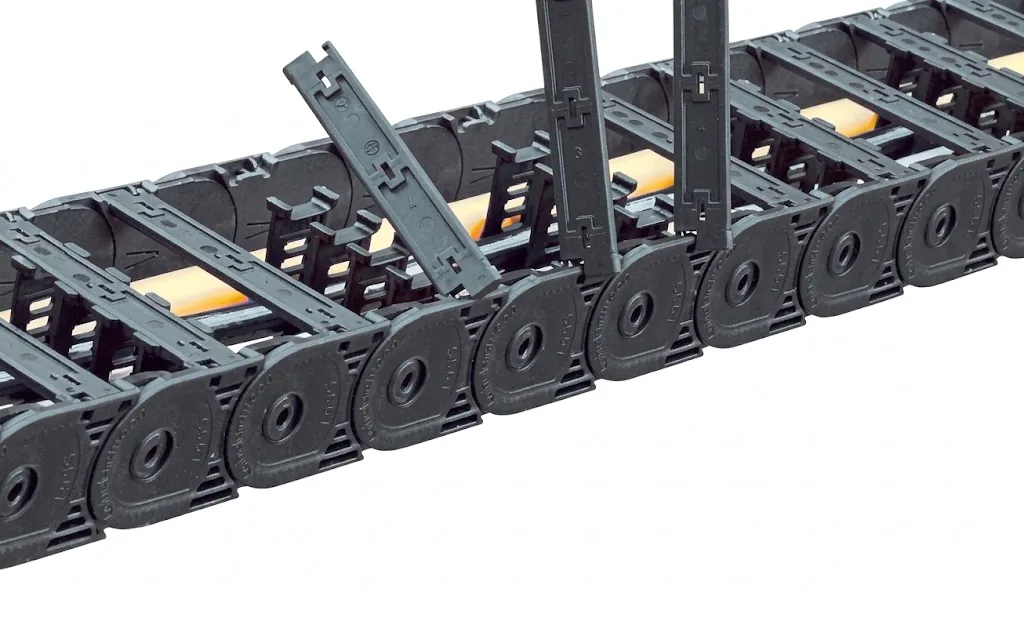
- Replacing links or cross connections: damaged parts out, new ones in. Often faster than a complete carrier.
- Shortening or extending: for a different stroke or a new machine layout we adjust the length to the pitch.
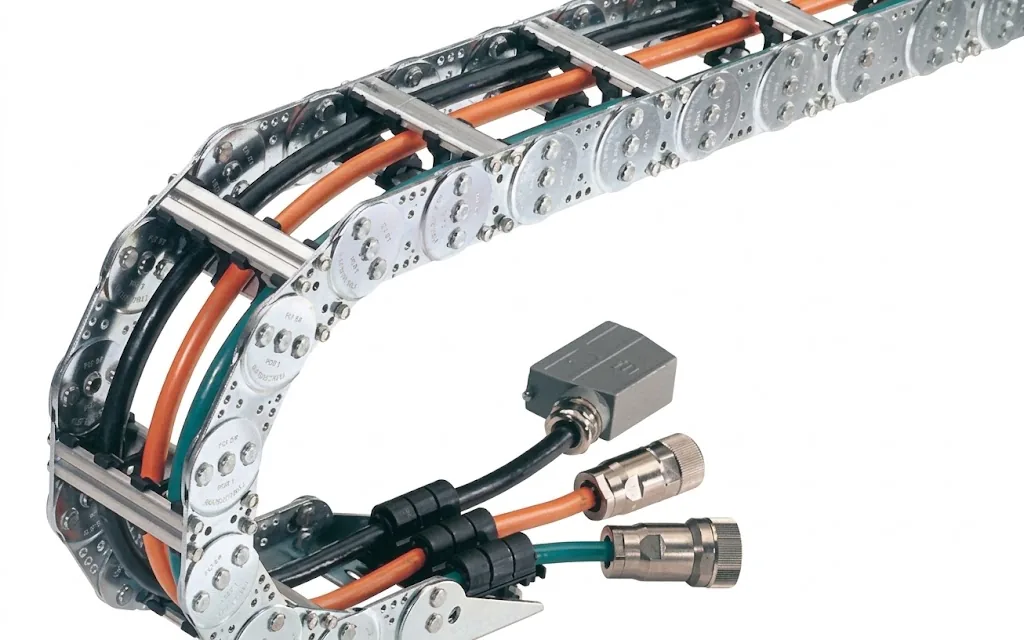
- Replacing cables: new cables in the existing carrier, with the right layout and strain relief.
- Converting: a different end fixing, extra dividers or a different inner width.
Looking for a loose part? Enter the type number or article number on the parts and repair page. You immediately see which series it belongs to and add it to your request list. Don't know what the part is called? Look in the parts of a cable carrier.
How do you replace a broken link yourself?
With the right spare links of the same series and size, this is a job for a handy fitter. Follow this order:
- (01)Photograph the break and note where it is: in the bend, at the driver or in the self-supporting section. That tells you more about the cause than the part itself.
- (02)Look up the series and size. The type is usually on the side plate. Also note the inner width and the number of links.
- (03)Open the cross connections around the break so the cables lie free. Do not pull on the cables and leave the strain relief in place.
- (04)Replace the broken links with new ones of the same series. All links must face the same running direction.
- (05)Remove the cause: align the driver and fixed point, remove obstacles and check that the carrier runs freely through the entire stroke.
- (06)Let the machine run the full stroke a few times slowly and watch. Only then go back to production speed.
Can't work out which part it is? Technical support helps identify it from your photos.
What if the cables are damaged as well?
A broken carrier often damages the cables within a few strokes as well. So always check them too. If the cores are damaged, or the cables lie in a spiral that will no longer straighten, they must be replaced.
If the cables have to be replaced anyway and the carrier is also getting on in years, it is often more logical to renew carrier and cables in one go. You then only open the machine once. For continuous flexing, highly flexible cables belong in the carrier, such as the TRAXLINE cables. If cables keep breaking, look at cable break in the cable carrier: the cause usually lies in the radius or the layout.
How do you find a replacement if repair makes no sense?
If replacement is the outcome, you look for a type that fits in the same place, with the same cable package and the same bend. In the Replacement guide you enter the dimensions of your current carrier, of any brand, and see per dimension which type fits. How to take those measurements is explained in replacing an energy chain.
Calculate it yourselfReplacement guideThe replacement for your worn or broken cable carrierOpen the replacement finderIf the old carrier was chosen wrongly, don't blindly choose the same type again. Have the application calculated or request a quote for a suitable replacement, and we will check the calculation.
Frequently asked questions
Can I replace only the broken links of a cable carrier?
Often yes, if the rest of the carrier is in good condition and the cause has been removed. If the carrier is worn along its entire length or was chosen too light, replacing is wiser.
Why does my cable carrier break again after repair?
Because the cause is still there: too much weight, too long a self-supporting length, misaligned installation or contact. Find the cause first and remove it, otherwise a new carrier will break too.
Can you shorten or extend a cable carrier?
Yes. For a different stroke or a new machine layout, the length is adjusted to the pitch, so always in whole links.
Where do I find the type number of my cable carrier?
Usually on the side plate of the links. Also note the inner width and the number of links, so the right part can be looked up.
Do I have to replace the cables if the cable carrier is broken?
Not always. But always check them too. If the cores are damaged or the cables lie in a spiral that will no longer straighten, they must be replaced.
Next step
Calculate it yourself or browse the range. We check your result free of charge.
Series on this topic
Question about this topic?
Ask Joep directly
RMO Specialist at Wisman Techniek