Short answer
Gliding shoes are replaceable plastic parts on the links of a gliding cable carrier. The upper run glides on them over the lower run and through the guide channel, so the links themselves do not wear. On many medium-sized and heavy series they are mandatory for gliding, and they often require a larger minimum bending radius. Once they are worn down to the wear limit, you only replace the gliding shoes, not the whole carrier.

Gliding shoes for a cable carrier are replaceable plastic parts fitted to the links. You need them as soon as a cable carrier runs gliding: the upper run then rests on the lower run and slides over it with every stroke, in a guide channel. The gliding shoes take up that friction, so the links themselves do not wear. Once they are worn, you only replace the gliding shoes. On many medium-sized and heavy series they are mandatory in a gliding arrangement, and a larger minimum bending radius often applies as well.
Below you can read when gliding shoes are needed, which types there are, what to look for when choosing and how to spot wear in time. The data per series comes from the Tsubaki Kabelschlepp catalogue.
What are gliding shoes on a cable carrier?
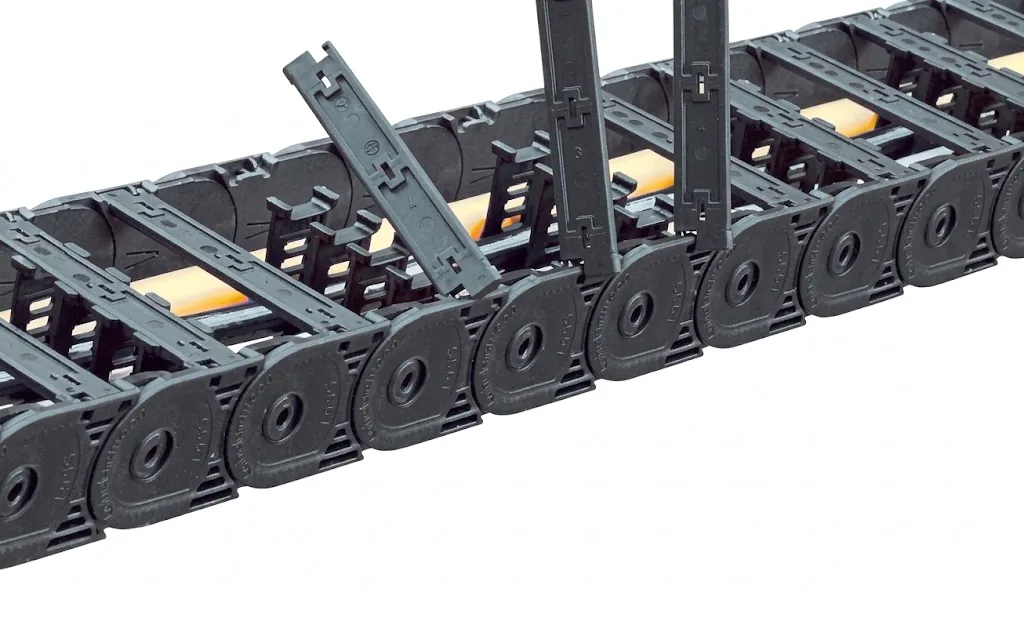
A gliding shoe is a wear part. On plastic carriers you clip or push it onto the link; on steel carriers it is bolted to the side band. When the upper run of the carrier glides over the lower run, only the gliding shoes touch each other and the channel. The links, the pivot points and the crossbars stay clear of that friction.
That has two advantages. The carrier lasts longer, because the wear material sits somewhere other than in the load-bearing part. And maintenance is simpler: replacing a set of gliding shoes is less work and costs less than a new carrier.
When do you need gliding shoes on a cable carrier?
Gliding shoes belong to a gliding arrangement. You choose one when the travel length is too long to run self-supporting. On a self-supporting carrier the upper run hangs freely above the lower run and nothing glides. Where that limit lies and how to choose, you can read in self-supporting or gliding.
Whether gliding shoes are needed for gliding differs per series:
- Mandatory on, among others, the larger types of the UNIFLEX Advanced (UA1455 to UA1995), the M series (M0650 to M1300), the QUANTUM® Q060 to Q100, the TKHP85 and the steel S/SX.
- Recommended on the XL series, with an extra large inner height.
- Not needed or not available on smaller series such as the MONO. The catalogue lists no gliding shoes for these series: they glide in the channel without gliding shoes.
A gliding carrier always runs in a guide channel, with or without gliding shoes. The channel keeps the upper run straight above the lower run. How such an arrangement works on cranes and gantries is explained in cable carrier long travel.
Calculate it yourselfCable carrier configuratorCalculate, select and assemble a cable carrierOpen the cable carrier configuratorWhat types of gliding shoes are there?
The Tsubaki Kabelschlepp catalogue lists four variants. Which you can choose depends on the series.
| Variant | What it is | When |
|---|---|---|
| Standard gliding shoes | Plastic, clipped or pushed onto the links | Gliding plastic carriers in a normal environment |
| OFFROAD gliding shoes | Same type, about 80% more wear material | Sand, dust, corundum and other abrasive particles |
| Bolted gliding shoes | Bolted to the side band of a steel carrier | Steel carriers, so that steel never glides on steel |
| Gliding discs | Clipped onto the side | Carrier installed rotated by 90 degrees that glides on its side band |
OFFROAD is available for the M series (M0650 to M1250) and the enclosed MT series (MT0650 to MT1250). It makes the carrier slightly higher. Allow for that if installation space is tight.
Gliding discs are available for the K series (K0650 and K0900), for arrangements in which the carrier lies on its side.
Which bending radius goes with gliding shoes?
This point is often missed. A gliding shoe protrudes below the link. In a tight bend the gliding shoes of two links then touch each other. That is why many types with gliding shoes have a minimum bending radius (KR) that is larger than the smallest radius in that type's list.
| Type | Smallest KR of the type | Minimum KR with gliding shoes |
|---|---|---|
| UA1455 | 52 mm | 65 mm |
| UA1665 | 75 mm | 100 mm |
| M0650 | 75 mm | 95 mm |
| S/SX0650 | 75 mm | 95 mm |
| S/SX1250 | 145 mm | 200 mm |
An example: you choose an S/SX0650 with KR 75 mm for a self-supporting carrier. If the travel length increases and the carrier has to glide, KR 75 is no longer possible. The first radius that still fits is 95 mm. The bend gets larger, and with it the installation height and the length of the carrier. With the calculation tool for cable carrier length you can see what that means for the length. How to choose the radius in general is explained in determining the bending radius.
How can you tell that gliding shoes are worn?
Gliding shoes wear gradually. On a carrier that makes many strokes a day, or in a dusty environment, this happens faster. Check these points during an inspection:
- (01)Thickness of the gliding shoe. Compare a gliding shoe in the section that glides the most with one near the fixed point, where hardly anything glides. A big difference shows how much has already worn away.
- (02)Shiny or bare spots on the link. If you see wear marks on the link itself, the gliding shoe has already worn through there and the carrier is gliding on the link.
- (03)Missing gliding shoes. A gliding shoe that has come loose causes immediate wear to the link and channel at that spot.
- (04)Wear marks in the channel. Grooves or shiny tracks in unusual places point to a carrier that runs at an angle or climbs.
- (05)Noise. A gliding carrier that scrapes or ticks louder than before often has worn or missing gliding shoes.
More signs of wear on the carrier itself are described in recognising cable carrier wear. With the Carrier check you go through the main points in a few minutes.
Troubleshooting guideCable carrier wears quicklyWorn side plates, sliding surfaces or hinges after a short time.Go to the solutionReplacing gliding shoes: how to go about it
You replace gliding shoes individually or as a set. On plastic carriers you unclip the old ones and clip on the new ones; on steel carriers they come off by undoing the screws.
- Stop the machine and isolate it. Work with the carrier in a position where you can easily reach the gliding section.
- Replace along the entire gliding length. New gliding shoes next to worn ones create height differences. The carrier then runs unevenly.
- Use the same variant. If you switch from standard to OFFROAD, check that the extra height fits in the channel and the installation space.
- Check the channel. A damaged or poorly aligned channel wears new gliding shoes just as quickly. If the carrier runs out of the channel or climbs, find that cause first.
- Let the machine make one full stroke at low speed before going back to production speed.
You order gliding shoes via spare parts. With the type number of the carrier we find the right version.
Troubleshooting guideCable carrier runs out of the channelWith long travel lengths: the carrier jumps out of the channel or rides over itself.Go to the solutionHow do you prevent rapid wear of gliding shoes?
Most wear does not come from the gliding itself, but from what gets between the surfaces or from a carrier that does not run straight.
- Keep the channel clean. Sand, chips and other dirt in the channel act like sandpaper. Include the channel in the machine's regular cleaning.
- Choose OFFROAD for abrasive dust, if the series offers that variant.
- Align the fixed point, channel and driver properly. A carrier lying at an angle in the channel wears on one side.
- Stay within the limits of the type. Travel length, speed and weight of the cable package determine the load on the gliding shoes. Recalculate after a conversion.
Would you like someone to check the gliding carriers in your installation? With maintenance and inspection we check the carrier, gliding shoes, channel and cables in one round.
Frequently asked questions
Does every gliding cable carrier need gliding shoes?
No. On smaller series such as the MONO, the carrier glides in the channel on its own profile. On many medium-sized and heavy series, such as the larger UNIFLEX Advanced, M, QUANTUM, TKHP85 and S/SX, gliding shoes are mandatory for gliding.
Can I fit gliding shoes to a cable carrier afterwards?
Only if the series offers gliding shoes. Pay attention to the minimum bending radius with gliding shoes. If the current radius is smaller, the carrier with gliding shoes will not fit and a different radius or type is needed.
What is the difference between standard and OFFROAD gliding shoes?
OFFROAD gliding shoes are thicker and have about 80% more wear material. They last longer with sand, dust or corundum. They make the carrier slightly higher.
Do I have to replace all gliding shoes at once?
Replace them along the entire gliding length. Individual new gliding shoes between worn ones create height differences, and then the carrier runs unevenly.
Does a steel cable carrier glide on gliding shoes?
Yes. On the S/SX series, gliding shoes are bolted to the side band, so that steel never glides on steel. They are mandatory for gliding.
Next step
Calculate it yourself or browse the range. We check your result free of charge.

Series on this topic
Question about this topic?
Ask Joep directly
RMO Specialist at Wisman Techniek