Short answer
The size of a cable protection hose follows from your cable bundle: choose the smallest hose whose inner diameter encloses the bundle at its thickest point. Then choose the series by movement (fixed, slightly moving or on a robot), temperature, requirements such as fire standards or conductivity, and whether you need to fit the hose around the cables afterwards. Finally, check the dynamic bending radius and whether holders are available in that size.

You choose a cable protection hose in two steps. First the size: it follows from the cable bundle that has to go through it. You take the smallest hose whose inner diameter encloses the bundle at its thickest point. Then the series: it depends on how the hose moves, how hot it gets, which requirements apply and whether you have to fit the hose around existing cables afterwards. Finally, you check the bending radius and the holders. If you keep to that order, you avoid a hose that is too tight, kinks or is worn through after a few months.
Below you can read what to look out for at each step. The data comes from the catalogue of Reiku, whose protective hoses we supply.
What is a cable protection hose and when do you choose one?
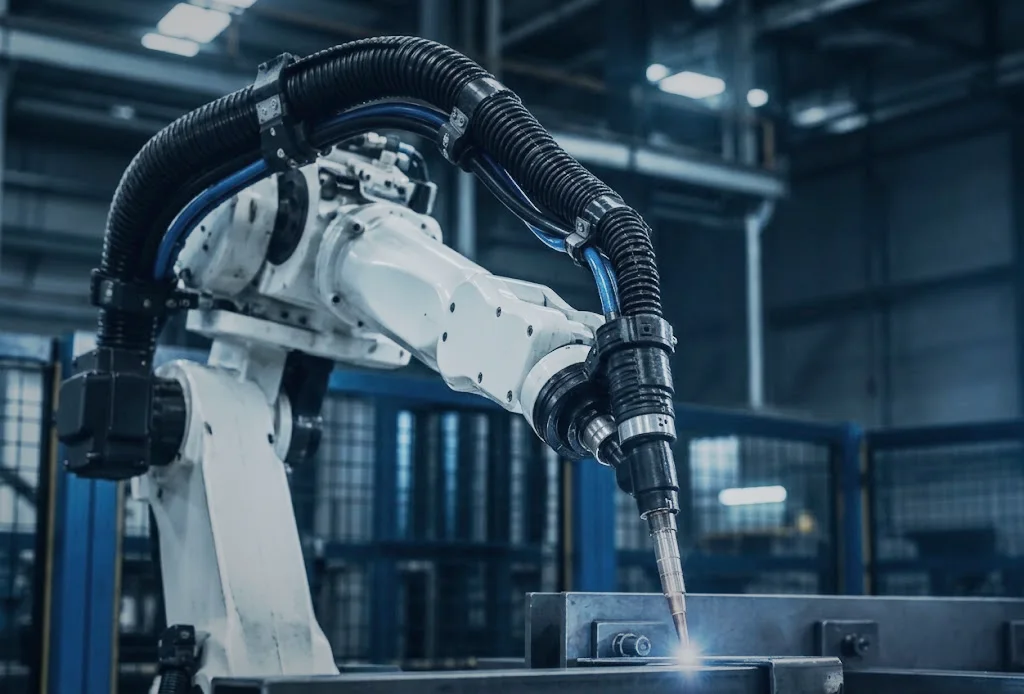
A cable protection hose is a corrugated plastic hose through which cables and hoses run. It protects them against abrasion, kinking, spatter and dirt. In the catalogue it is also called a corrugated tube. You see it in machine building along fixed parts and short movements, and on industrial robots as the heart of the dress pack.
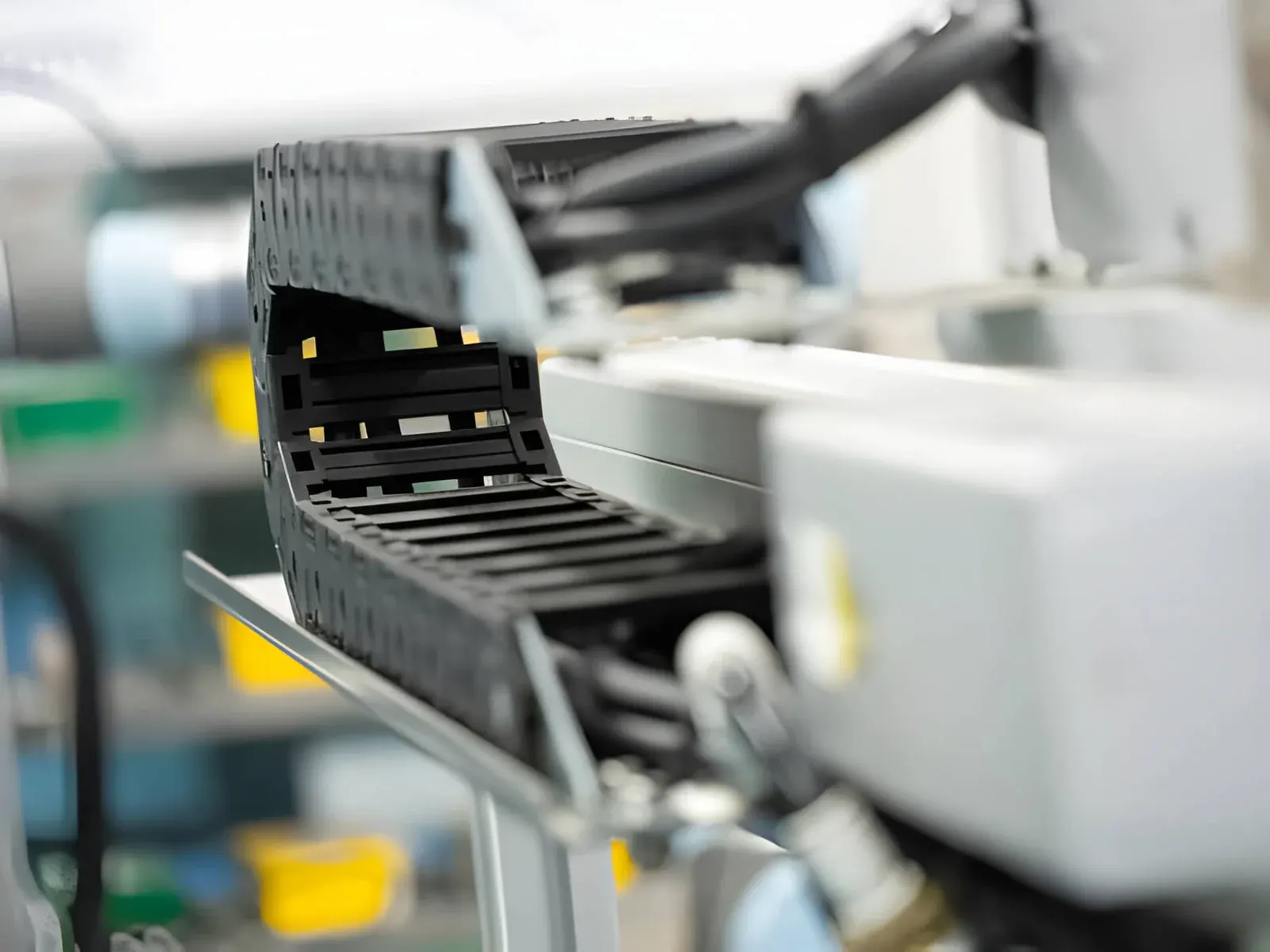
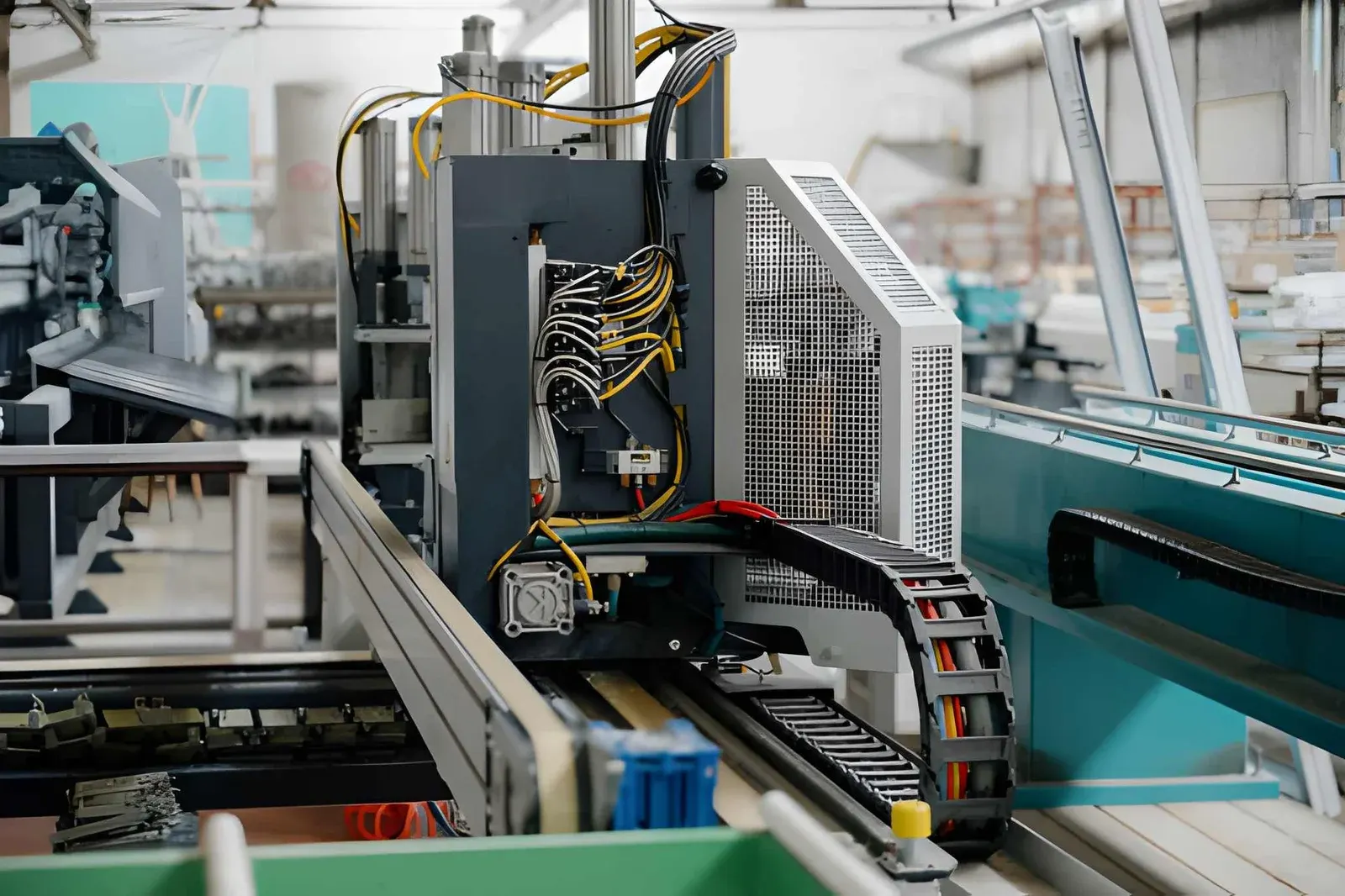
A protective hose follows a movement in all directions, including rotation. That is how it differs from a cable carrier, which moves in one plane and can handle long travel lengths and heavy cable packages there. Not sure which of the two fits? Then read cable carrier, protective hose or cable tray.
What size cable protection hose do you need?
The size is shown on the hose as nominal width (NW), for example NW 36. That size is a designation, not an exact inner dimension. That is why you calculate with the inner diameter from the table.
How to determine the size:
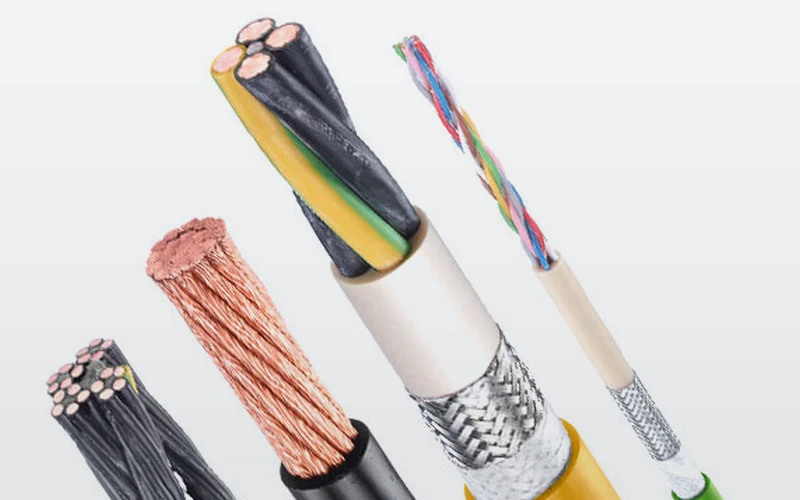
- (01)Make a list of everything that has to go through the hose: power cables, signal cables, data, compressed air hoses, cooling water.
- (02)Determine the bundle diameter. Put the cables and hoses together and measure the bundle at its thickest point. If you do not have the cables yet, let us determine the bundle.
- (03)Choose the hose. Take the smallest size whose inner diameter is equal to or larger than the bundle.
- (04)Think ahead. If a cable will be added in the foreseeable future, include it in the bundle now. Replacing a hose takes more time than choosing one size larger straight away.
Example calculation. A bundle on a robot measures 33 mm at its thickest point. In the PARRB series, NW 29 has an inner diameter of 28.2 mm. That is too small. NW 36 has an inner diameter of 35.5 mm and fits. The outer diameter is then 42.3 mm, and you need that dimension for the holders and the installation space.
In the hose selector on the protective hoses page, enter your application and bundle diameter. For each suitable series you see the smallest size, with article number.
Which cable protection hose series suits your application?
Reiku groups the hoses by application. For the same size, the series differ in material, flexibility and temperature range.
| Application | Series | Material |
|---|---|---|
| Machine and equipment building, fixed or slightly moving | PARNB, PAREB | PA 6 |
| Robot, dynamic | PARAB, PARRB, BIORRB | PA 12, PA 11 |
| Robot, very heavy dynamics | PURRB, PURVB | TPU |
| Dissipating static charge | LPRRB | PA 12, conductive |
| Fitted around cables afterwards | PARTB, PPRTB | PA 6, PP |
| High temperature, insulation | TPRIB | TPE |
| Track and brackets | PARBB, PAABB, PARMO | PA 6, PA 12 |
On a robot you usually choose from PARAB, PARRB and BIORRB. They are highly flexible, and Reiku gives PARAB the best resistance to alternate bending of the three. BIORRB is made of PA 11 based on castor oil. With a lot of torsion and fast movements around the wrist, PURRB and the reinforced PURVB made of polyurethane are the choice.
In machine building, PARNB and the lighter PAREB are often sufficient, especially where the hose is fixed or moves only slightly.
Special requirements call for their own series. LPRRB is electrically conductive and discharges static electricity. PARBB and PAABB comply with fire standard EN 45545 for railway technology, PARMO with ECE-R 118 for buses.
How hot can a cable protection hose get?
For a moving hose, look at the dynamic temperature range. It is narrower than the static range, because plastic becomes stiffer in the cold and softer in the heat.
| Series | Dynamic | Static |
|---|---|---|
| PARAB | -5 to +85 °C | -40 to +105 °C |
| PARRB | -30 to +85 °C | -50 to +140 °C |
| BIORRB | -10 to +110 °C | -40 to +130 °C |
| PURRB and PURVB | -20 to +90 °C | -30 to +90 °C |
If the robot is in a cold hall or outdoors, PARAB drops out sooner than PARRB. If it gets warm, BIORRB lasts longest dynamically. For insulation at higher temperatures there is TPRIB, up to +160 °C and briefly up to +180 °C.
In welding and other processes with radiant heat, the hose alone is often not enough. Then heat protection goes around it. With the Heat guide you determine which material and which size fit. Read more about the robot side in preventing cable breakage on your robot.
Calculate it yourselfHeat guideThe right heat protection for cables and hosesOpen the heat finderHow small can the bending radius of a cable protection hose be?
Each size has a minimum bending radius, static and dynamic. The dynamic radius applies to a hose that bends again and again, such as on a robot arm. It is considerably larger than the static one.
| PARRB size | Inner diameter | Static | Dynamic |
|---|---|---|---|
| NW 23 (23F) | 23,0 mm | 35 mm | 90 mm |
| NW 29 (29F) | 28,2 mm | 45 mm | 120 mm |
| NW 36 (36G) | 35,5 mm | 60 mm | 180 mm |
| NW 48 (48G) | 46,5 mm | 70 mm | 200 mm |
| NW 52 (52G) | 52,4 mm | 125 mm | 300 mm |
| NW 70 (70G) | 69,3 mm | 150 mm | 350 mm |
You can see that the radius does not grow evenly. From NW 48 to NW 52 the dynamic radius increases from 200 to 300 mm. If you choose a larger size as a reserve, check whether the hose can still make the bend on the robot or in the machine. The cables in the hose also have their own bending radius. Read how to determine it in determining the bending radius.
Does the cable protection hose have to fit around the cables afterwards?
In new builds you pull the cables through the hose before the connectors are fitted. On an existing machine or cables with fitted connectors, that is not possible. That is what PARTB and PPRTB are for: two-part hoses that you place around the cables and then close. They are intended for control cabinet and equipment building, not for heavy dynamics. PARTB has better resistance to alternate bending than PPRTB.
The other series are available slit lengthwise on request. A slit hose can also be placed around existing cables, but it is open along its entire length.
Which holders go with the cable protection hose?
The size of the hose determines which holders and clamps fit. Reiku's system holders are available for each NW. They fix the hose lengthwise but allow it to rotate about its own axis. That prevents torsion in the cables. On a robot, clamps, ball joints and often a retraction system are added, which keeps the hose taut when the robot turns.
The overview is at holders and fixings, where you can also search by article number and NW. Read how to put together a complete package for a robot in choosing a dress pack.
Have your cable protection hose selected
If you are choosing a hose for a robot, start in the Dress pack configurator. You choose brand and model, then the solution, and get a parts list with hose, holders and retraction system. A specialist from our robotics division checks it. For a single hose as a replacement, or an application away from the robot, send your cable list or the article number of the old hose with a quote request.
Calculate it yourselfDress pack configuratorConfigure a dress pack for your robotOpen the dress pack configuratorFrequently asked questions
What is the difference between a cable protection hose and a corrugated tube?
There is no difference. Corrugated tube is the name the catalogue uses for the corrugated hose. In practice we also call it a protective hose, cable protection hose or robot hose.
How do I determine the size of a cable protection hose?
Measure the cable bundle at its thickest point and choose the smallest hose whose inner diameter encloses the bundle. Use the inner diameter from the table, not the nominal width.
Which cable protection hose is suitable for a robot?
For most robots PARAB, PARRB or BIORRB. With a lot of torsion and fast movements around the wrist, PURRB or the reinforced PURVB.
Can I fit a cable protection hose around cables with connectors?
Yes, with a two-part hose such as PARTB or PPRTB, or with a version slit lengthwise. The latter is available on request for the other series.
How hot can a moving cable protection hose get?
That differs per series. Dynamically, the upper limit ranges from +85 °C for PARAB and PARRB to +110 °C for BIORRB. In welding or other radiant heat, heat protection goes around it.
Next step
Calculate it yourself or browse the range. We check your result free of charge.
Question about this topic?
Ask Daan directly
Robotics Division at Wisman Techniek