Short answer
A guide channel keeps a gliding cable carrier in place: the upper run glides over the lower run and the channel stops it from sliding off. For most cable carriers you choose a standard channel in galvanised steel or stainless steel. For cranes and very long travel lengths there is an open steel system, for high speeds and seawater an aluminium channel, and for small cable carriers a compact enclosed channel. The channel is 4 to 6 mm wider than the cable carrier, a little more with gliding shoes.
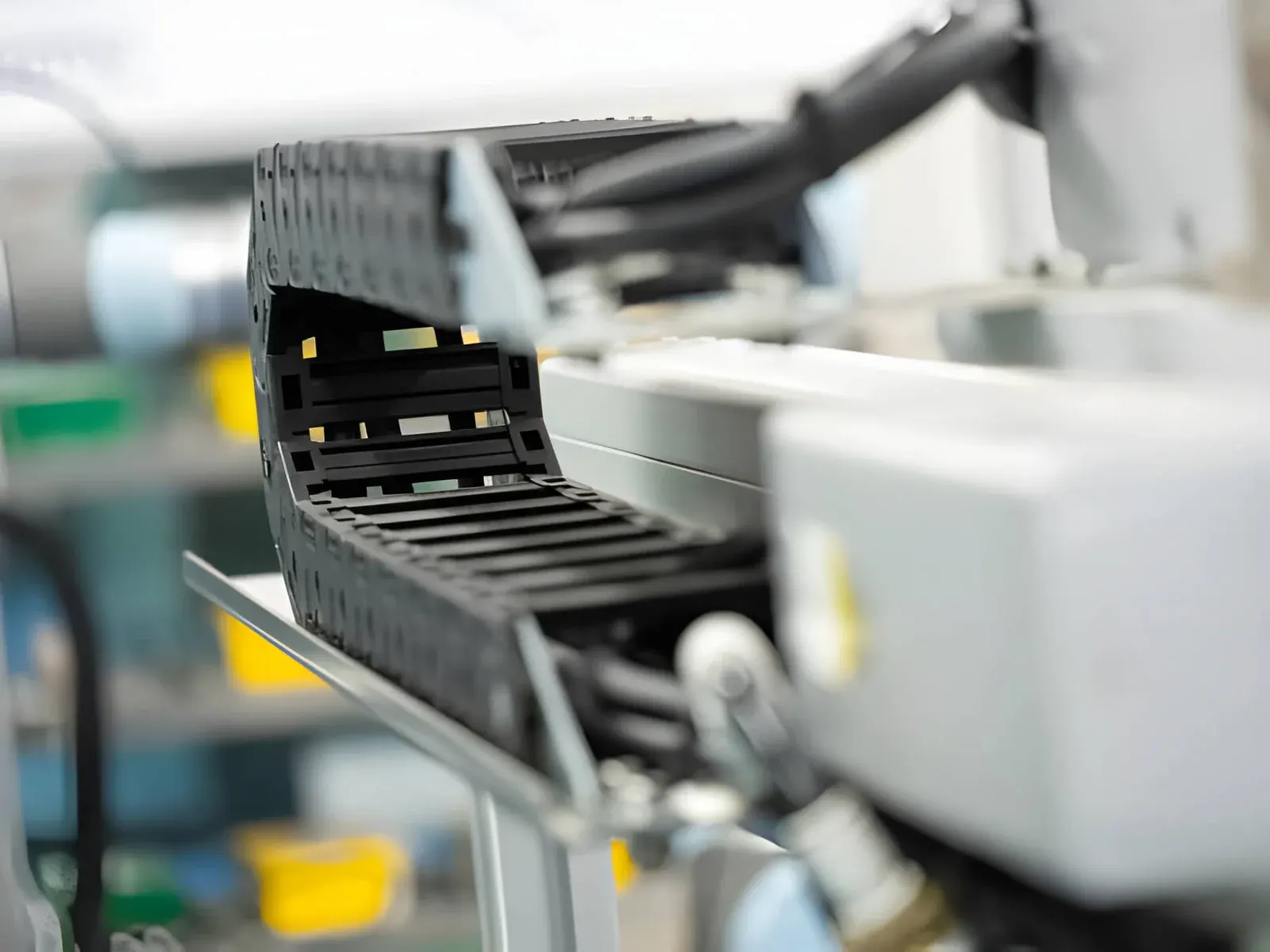
You need a guide channel for a cable carrier as soon as it runs gliding. The upper run then rests on the lower run and slides over it with every stroke. The channel keeps both runs straight above each other, so the upper run does not slide off. For most applications a standard channel in galvanised steel or stainless steel is enough. For cranes, very long travel lengths, high speeds or little installation space, you choose a different system. The inner width of the channel is 4 to 6 mm larger than the outer width of the cable carrier, and a little more with gliding shoes.
Below you can read which channel systems there are, which channel fits which series and how to determine the width, length and connection height. The data comes from the Tsubaki Kabelschlepp catalogue.
When does a cable carrier need a guide channel?
A self-supporting cable carrier carries itself. The upper run hangs freely above the lower run and does not touch it. No channel is needed for that. If the travel length becomes too long to run self-supporting, the upper run sags and the cable carrier starts to glide. From that moment you need a guide channel. Where that limit lies, you can read in self-supporting or gliding.
In a gliding arrangement the fixed point is usually in the middle of the travel length. Beyond the fixed point the upper run does not glide on the cable carrier but on a glide bar in the channel. Without a channel the cable carrier moves sideways and runs off itself.
There is also a second type of channel: the support tray. It is meant for a self-supporting cable carrier that has no even surface to rest on. Support trays are available for all cable carrier types.
Which types of guide channels for a cable carrier are there?
Tsubaki Kabelschlepp has four channel systems and a channel cover that fits every system.
| System | Material | Section length | When |
|---|---|---|---|
| Standard channel | Galvanised steel or stainless steel | 2000 or 3000 mm | Most gliding arrangements |
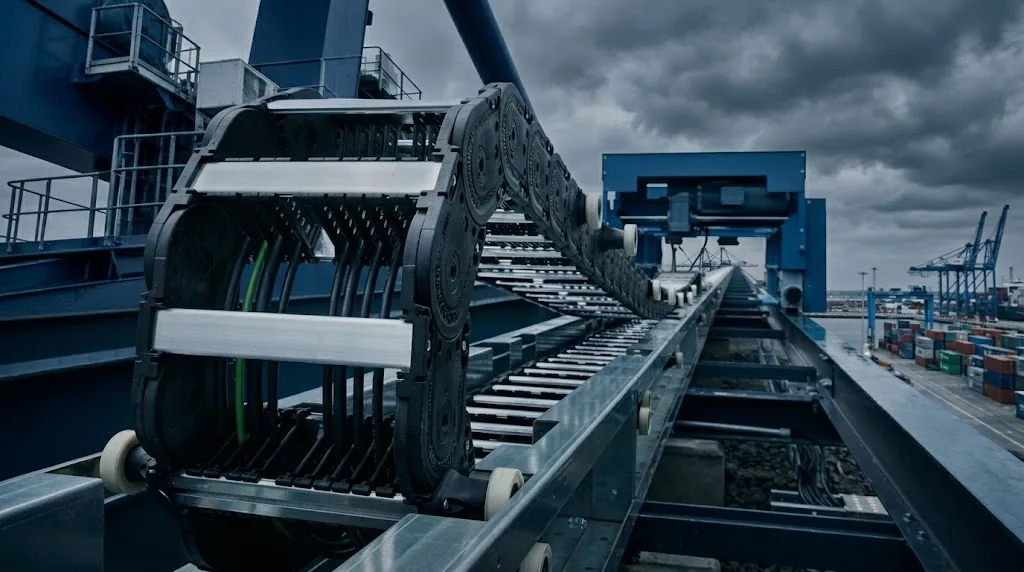
| Steel Guide System (TKSG) | Galvanised steel or stainless steel | 1000 or 2000 mm | Cranes and very long travel lengths, open construction |
| Alu Guide System (TKAL) | Aluminium | 1000 or 2000 mm | Long travel lengths at high speeds, also seawater, gliding or rolling |
| Easy Guide System (TKEG) | Galvanised steel or stainless steel | 2000 mm | Small cable carriers, standing, hanging or lying |
| Channel cover (channel enclosure) | Galvanised steel or stainless steel | 1000 or 2000 mm | Protection against dirt, falling parts, snow and ice |
The standard channel is a U-profile made of sheet steel that you can mount freely. From a channel height of 200 mm the flanges get extra reinforcement. If the cable carrier runs faster than 0.5 m/s and makes many strokes, a special glide bar is recommended.
TKSG has a modular, open design. Dirt falls through more easily, which is an advantage outdoors and on cranes.
TKAL is light and seawater resistant. Besides gliding, the cable carrier can also roll in it, with roller supports for the larger sizes.
TKEG is compact and enclosed, with holders for standing, hanging or lying installation. There are three variants: standing without cover, standing with cover and lying with cover.
Which guide channel fits which series?
Not every system is available for every series. An overview of the main combinations:
| Series | Standard channel | TKSG | TKAL | TKEG |
|---|---|---|---|---|
| [UNIFLEX Advanced](/kabelrupsen/uniflex-advanced) | UA1455 to UA1995 | UA1555 to UA1995 | UA1455 to UA1995 | UA1320 to UA1555 |
| [M series](/kabelrupsen/m) | M0475 to M1300 | M0650 to M1300 | M0650 to M1300 | |
| [QUANTUM®](/kabelrupsen/quantum) | Q040 to Q100 | Q040 to Q100 | ||
| [TKHP](/kabelrupsen/tkhp) | Ja | Ja | Ja | |
| [S/SX](/kabelrupsen/s-sx) | S/SX0650 to S/SX1800 | S/SX0650 to S/SX1252 | ||
| [K series](/kabelrupsen/k) | K0650 and K0900 | K0650 and K0900 | ||
| [QuickTrax](/kabelrupsen/quicktrax) and [EasyTrax](/kabelrupsen/easytrax) | QT0320 and ET0320 |
For the K series with aluminium hole stays, glide discs on the side are mandatory, between the cable carrier and the channel wall. Whether your cable carrier needs gliding shoes and what that means for the bending radius, you can read in gliding shoes for a cable carrier.
Calculate it yourselfCable carrier configuratorCalculate, select and assemble a cable carrierOpen the cable carrier configuratorHow wide should a guide channel be?
Depending on the cable carrier size, the inner width of the channel is 4 to 6 mm larger than the outer width of the cable carrier. You calculate with the outer width without attachments. With gliding shoes more is added, because they protrude at the side.
| Type | Without gliding shoes | With gliding shoes |
|---|---|---|
| UA1555 | Outer width + 5 mm | Outer width + 9 mm |
| UA1665 | Outer width + 5 mm | Outer width + 10 mm |
| UA1995 | Outer width + 6 mm | Outer width + 11 mm |
Too much room makes the cable carrier sway. Too little room makes it jam and wear at the side. So take the dimension per type from the catalogue, not a fixed allowance for all cable carriers.
How long does a guide channel get?
The length depends on the arrangement. The catalogue gives two calculation rules:
- One-sided arrangement: channel length = travel length + UB + L1. The glide bar is half the travel length.
- Two cable carriers facing each other: channel length = travel length + 2 × UB + X. The glide bar is X minus 2 × L1.
UB is the length by which the bend of the cable carrier protrudes beyond the driver, L1 is a dimension at the fixed point and X is the distance between the two fixed points. UB and L1 differ per type and are listed in the catalogue. You round the result to the section lengths of the channel system. Also allow for a reserve in the travel length, for example if the machine later gets a slightly longer stroke.
An example with a one-sided arrangement: with a travel length of 20 m the glide bar is 10 m. The channel itself is 20 m plus UB and L1, and is then rounded up to whole sections. How long the cable carrier itself will be, you calculate with the calculation tool for the cable carrier length.
At what height is the driver?
The driver must be at the right height above the channel. The catalogue gives two variants:
- (01)Low connection (standard): connection height = 3 × the outer height of the cable carrier. The cable carrier makes a small counter-bend at the driver.
- (02)High connection: connection height = 2 × bending radius + outer height. This causes more wear. Consult us first before choosing this.
With long travel lengths the connection height sometimes has to be lower. And if the distance between fixed point and driver differs from the catalogue, we recalculate the arrangement.
What do you look out for when installing a guide channel?
Most problems with gliding cable carriers start at the channel, not at the cable carrier itself. Look out for these points during installation:
- Align over the full length. Joints and height differences between sections make the cable carrier catch or climb.
- Connections at every joint. With the standard channel there are angle brackets at all joints and at both ends. With TKSG these are channel brackets.
- Driver centred above the channel. A misaligned driver pulls the cable carrier out of the channel.
- Room for dirt. Outdoors and in dusty halls an open system or a channel cover helps.
How to install the cable carrier itself, you can read in installing a cable carrier. In Cable carrier CAD you choose a suitable channel system and material per series and see the arrangement in 3D.
Troubleshooting guideCable carrier runs out of the channelWith long travel lengths: the carrier jumps out of the channel or rides over itself.Go to the solutionHaving a guide channel calculated or installed
A gliding arrangement involves several choices at once: series, radius, gliding shoes, channel system and the position of the fixed point. In the Cable carrier configurator you start with your travel length and cables, and a specialist then checks your configuration free of charge. If you already have a cable carrier that wears or runs out of the channel, first go through the Carrier check. You can request loose channels, glide bars and gliding shoes via spare parts. More about long strokes in cable carrier long travel length.
Frequently asked questions
Does every cable carrier need a guide channel?
No. A self-supporting cable carrier does not need a channel, at most a support tray if there is no even surface. As soon as the cable carrier glides, a guide channel is needed.
Which material do I choose for a guide channel?
Galvanised steel is the standard. You choose stainless steel for moisture, outdoors or in the food industry. Aluminium is light and seawater resistant and is used for long travel lengths at high speeds.
How much wider than the cable carrier is the channel?
Depending on the cable carrier size 4 to 6 mm, measured from the outer width without attachments. With gliding shoes more is added, for the UNIFLEX Advanced for example 9 to 11 mm.
Can I cover a guide channel?
Yes. The channel cover fits every Tsubaki Kabelschlepp channel system. It protects the cable carrier against dirt, falling parts, snow and ice and opens without tools.
How long is the glide bar in a guide channel?
In a one-sided arrangement the glide bar is half the travel length. With two cable carriers facing each other it is the distance between the fixed points minus twice the dimension L1 from the catalogue.
Next step
Calculate it yourself or browse the range. We check your result free of charge.
Series on this topic
Question about this topic?
Ask Bas directly
Cable Carriers Specialist at Wisman Techniek