Short answer
The movement determines the cable routing. If the cables are stationary, a cable tray is enough. If they move back and forth in one plane, as on an axis or gantry, you choose a cable carrier. If they twist and bend in three dimensions, as on a robot, you choose a protective hose or dress pack.
Cable tray or cable carrier, or a cable protection hose? It comes down to one question: does the cable move, and if so, how? A cable tray is for cables that are stationary. A cable carrier is for cables that move back and forth in one plane, as on a linear axis. A protective hose is for cables that bend and twist in three dimensions, as along a robot arm. If you choose the wrong solution, the cables chafe or break.
What solutions are there for cable routing?
In a machine or installation you come across three forms of cable routing. They look similar, but are made for different things.
- Cable tray: a fixed tray, ladder or track in which cables lie. The cables do not move. The tray organises and protects them along walls, ceilings and machine frames.
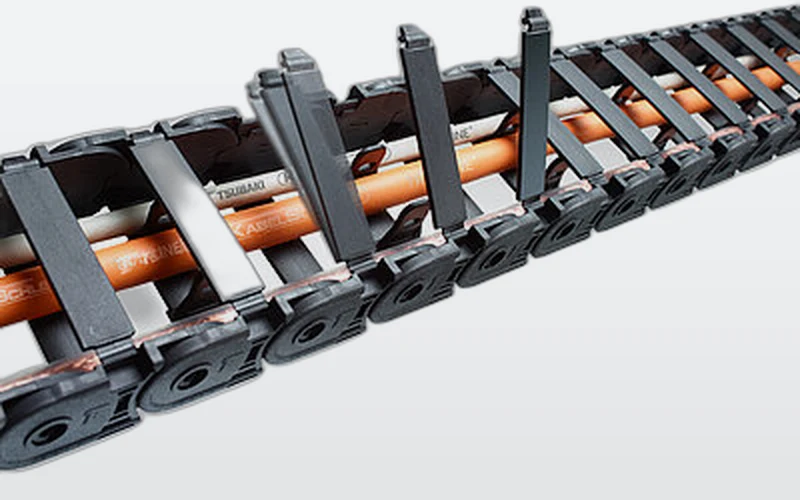
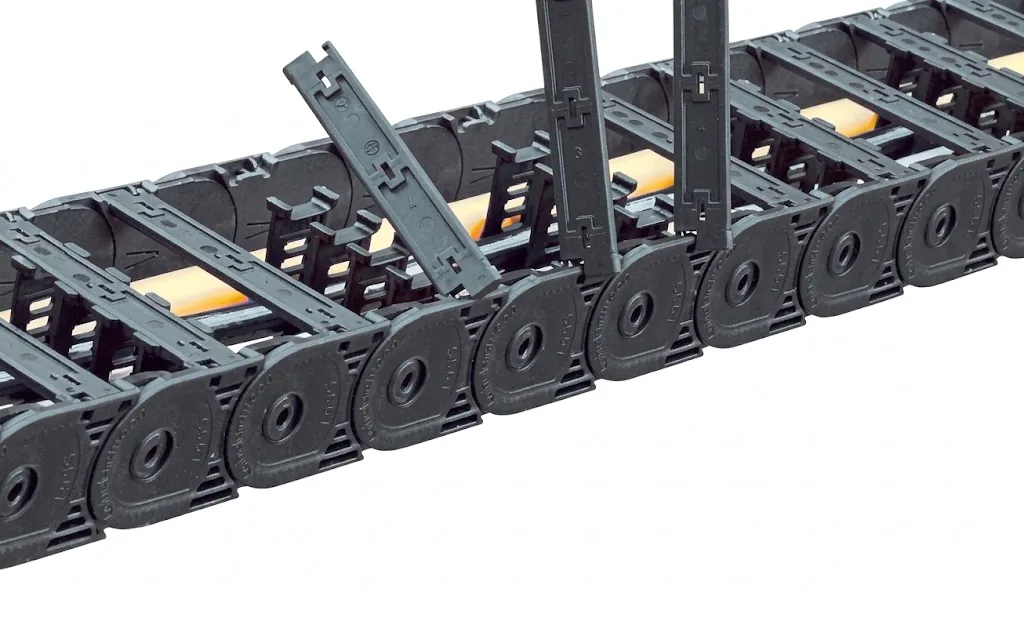
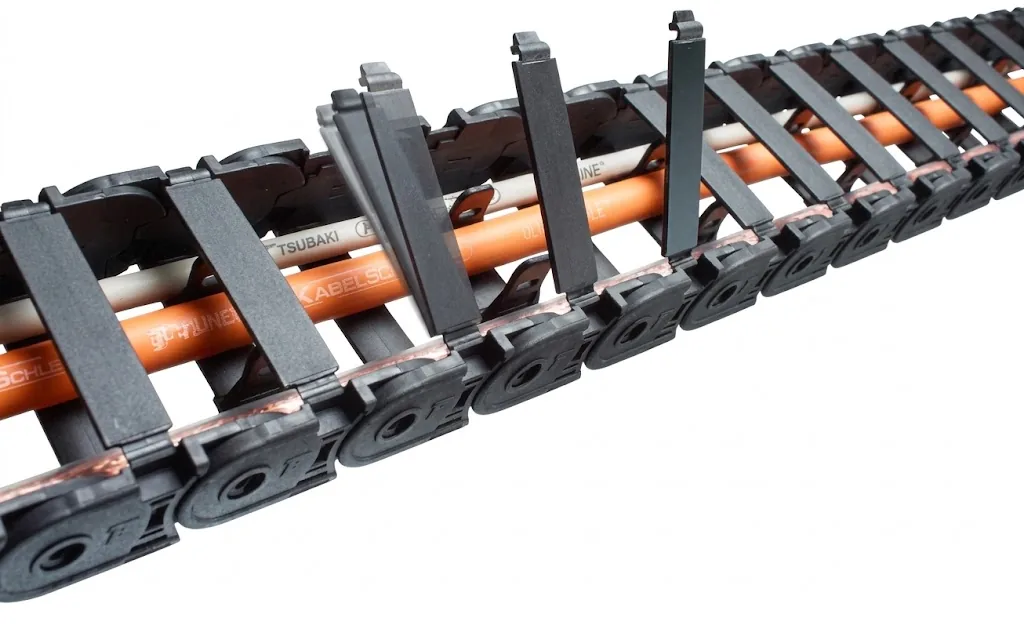
- Cable carrier: a chain of links in which the cables move along with a moving part. The carrier always bends with the same radius and keeps the cables in a fixed order.
- Protective hose: a corrugated, flexible hose around a bundle of cables and hoses. It follows the movement in all directions, including rotation.
A cable carrier is also called an energy chain or cable chain. What exactly it is, you can read in what is a cable carrier.
When is a cable tray enough?
A cable tray is intended for fixed installation. Think of cables from the control cabinet to the machine, along a wall or over a frame. As long as the cables are stationary, a tray is a logical and simple solution.
As soon as part of the machine moves, a fixed tray reaches its limit. A cable running from a tray to a moving part hangs loose, bends in a different place each time and chafes along edges. Over time that is where cable breakage occurs. For that moving section you need a cable carrier or protective hose.
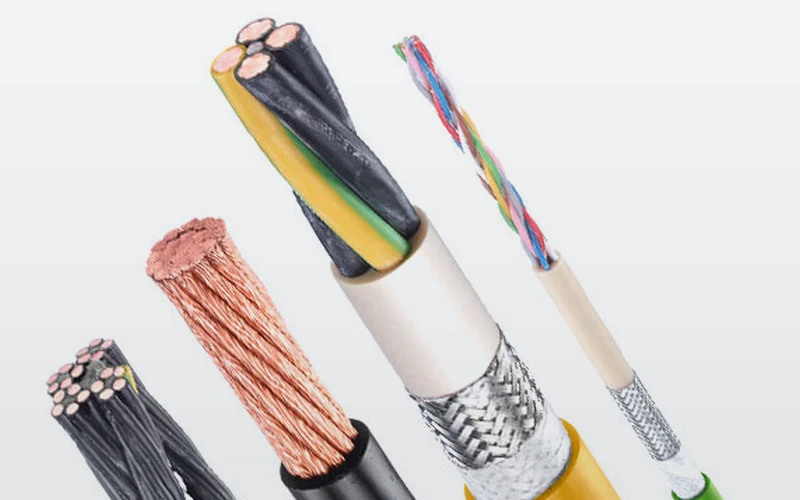
We don't supply cable trays ourselves. We focus on the moving part: the cable carrier, the flexible cables inside it and the protective hoses for robots. We also take care of the transition into the cabinet, with cable entries from Icotek and Detas Ultra.
When do you choose a cable carrier?
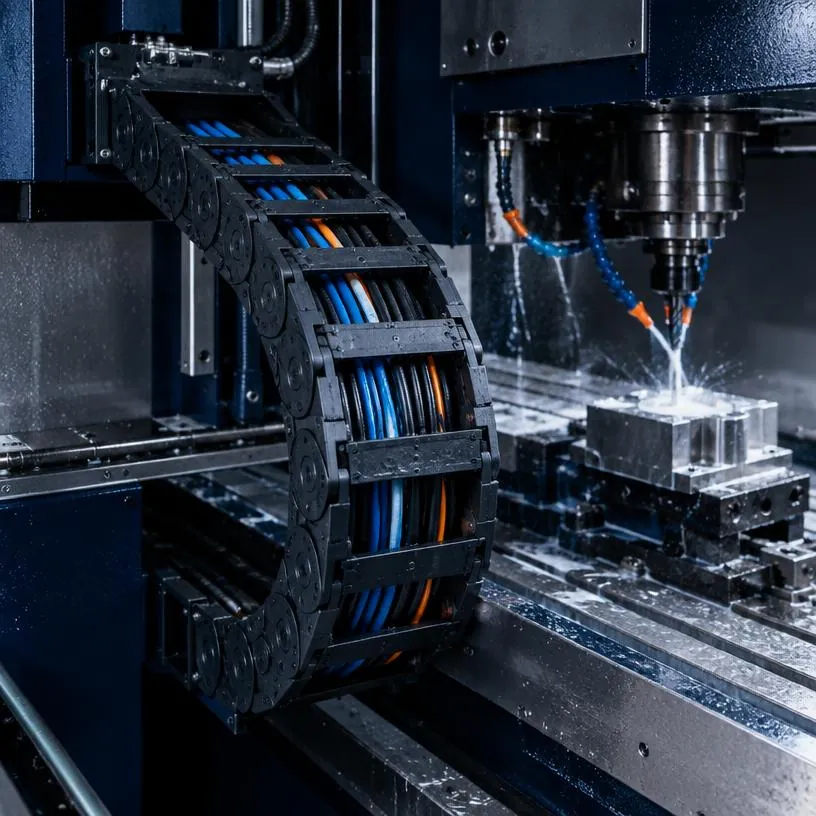
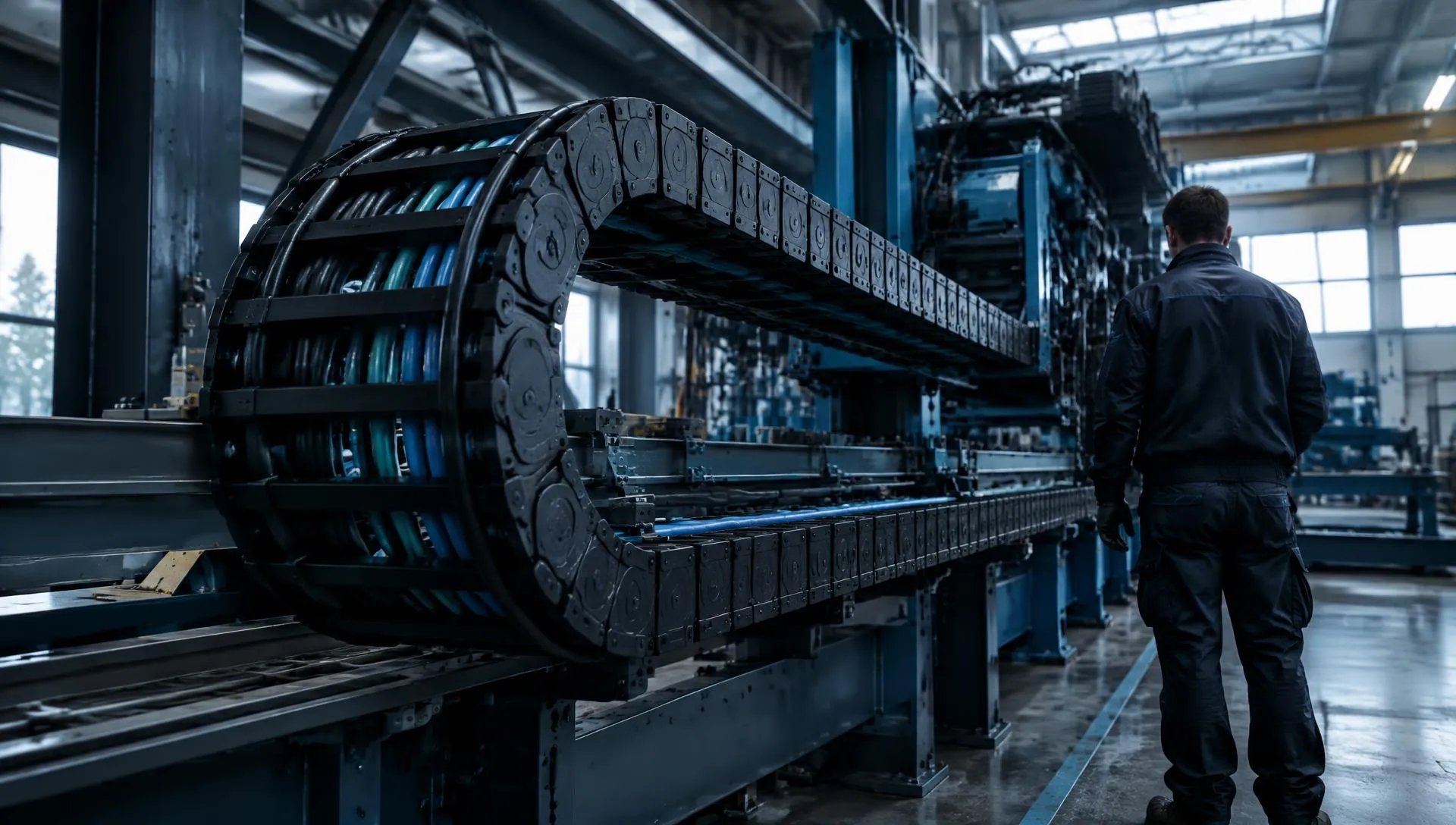
A cable carrier is the solution for movement in one plane: back and forth, on a fixed radius. That applies to linear axes, gantries, machine tools, cranes and storage systems. A circular movement in one plane can also be done with a cable carrier.
The carrier does three things. It keeps the bending radius of the cables constant. It stops cables chafing against each other, because they lie in a fixed layout with separators. And it takes up the tensile force, so it doesn't act on the cables themselves.
Unlike in a tray, the cables in a carrier are not tight. They need room to move in the bend. On the site we calculate with 10% clearance for cables and 20% for hoses, because hoses swell under pressure. You only fix the cables at the fixed point and the driver, with strain relief.
In our data the inner height of cable carriers ranges from 4.6 mm on the smallest EasyTrax to 220 mm on the largest steel S/SX. The travel length goes from a few centimetres to hundreds of metres. For most machines the UNIFLEX Advanced is a good starting point, for smaller applications the QuickTrax. You'll find the full range from Tsubaki Kabelschlepp under cable carriers.
When do you choose a protective hose?
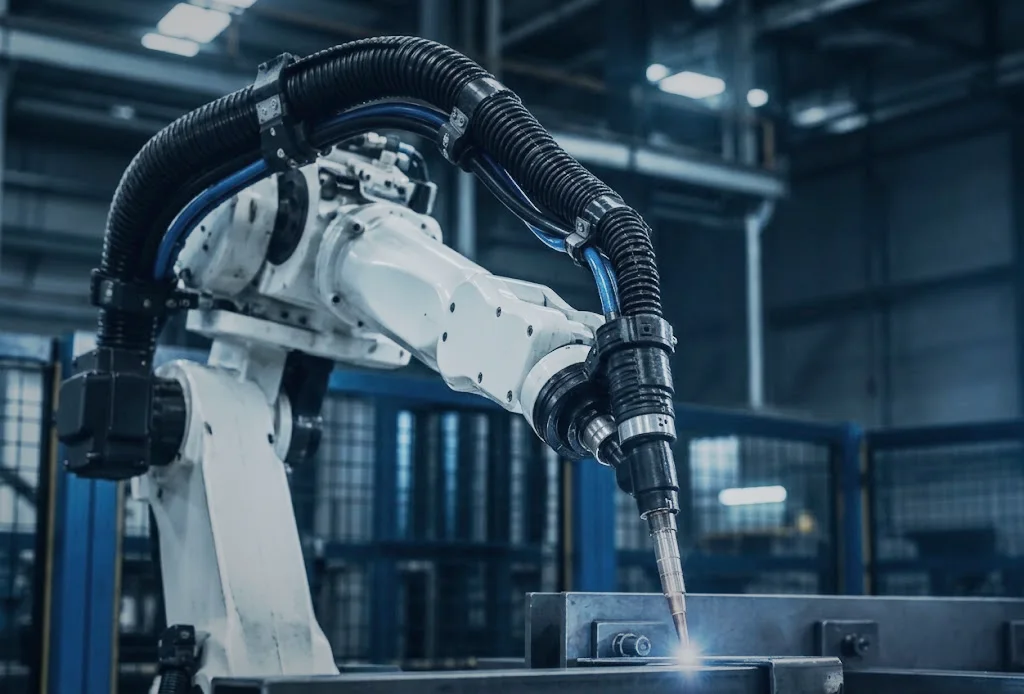
An industrial robot moves in six axes at once. The cable package to the tool bends, rotates and twists with every movement. A cable carrier can't do that, because it only bends in one direction. That is where you choose a protective hose.
The protective hoses for robots come from Reiku. They are corrugated so they stay flexible, and made of wear-resistant plastics such as PA 12, PA 11 and PUR. The hose selector contains 15 series, in standard sizes from NW 07 to NW 90. Heavily loaded points get wear parts that you replace individually.
A protective hose only works well with the right holders. Clamps fix the hose on each axis or let it slide, and a retraction system pulls back excess hose when the robot retracts. Together that is called a dress pack. How to choose hose size, series and holders is explained in choosing a dress pack.
Calculate it yourselfDress pack configuratorConfigure a dress pack for your robotOpen the dress pack configuratorCable tray, cable carrier or protective hose: the differences at a glance
| Cable tray | Cable carrier | Protective hose | |
|---|---|---|---|
| Movement | None, fixed installation | In one plane, back and forth | Three dimensions, bending and rotating |
| Bending radius | Not relevant | Always the same, fixed per carrier | Follows the robot arm |
| Cable layout | Loose side by side | Fixed layout with dividers | Bundle in the hose |
| Typical location | Wall, ceiling, machine frame | Linear axis, gantry, crane, machine tool | Robot arm, axes 1 to 6 |
| What goes with it | Mounting material | End brackets, for gliding a guide channel | Clamps, ball joint, retraction system |
| Cables | Fixed installation cable | Flexible cable for continuous movement | Flexible cable for continuous movement |
| Via Wisman | No | Yes, Tsubaki Kabelschlepp | Yes, Reiku |
A short rule to remember: stationary is a tray, linear is a cable carrier, three-dimensional is a protective hose. You can see the same comparison at comparing cable carrier and protective hose.
Can you combine a cable carrier and a protective hose?
Yes, and it happens often. If a robot stands on a linear axis, the seventh axis, the energy supply over that travel goes via a cable carrier. From the base of the robot the dress pack takes over up to the tool. At the transition from carrier to robot, make sure the cables don't kink and are strain-relieved on both sides.
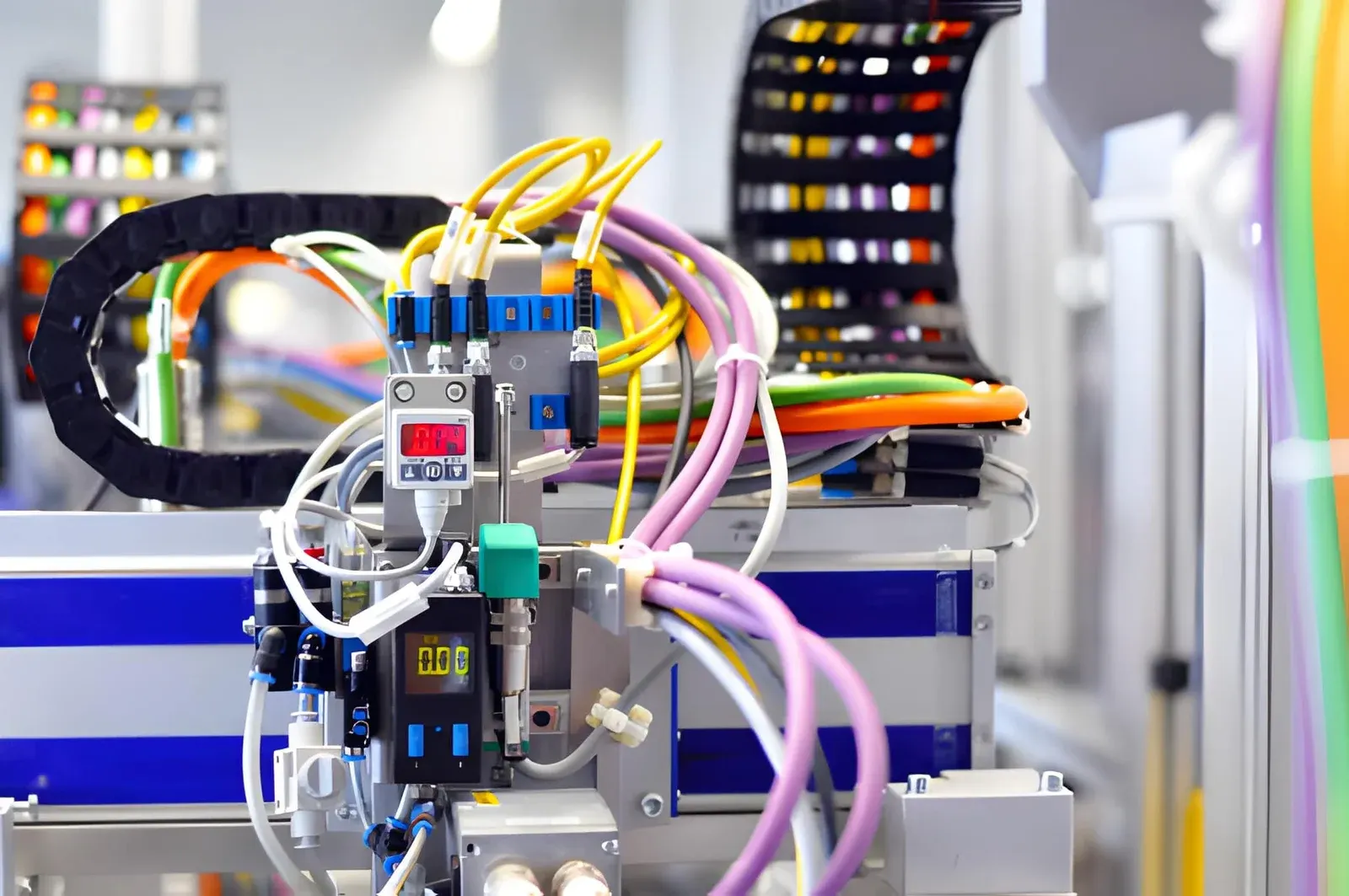
In a complete machine you often see all three solutions. The cables run fixed in a tray from the cabinet to the machine, move with the axis via a cable carrier and end in a protective hose on the robot. On each section the cable has different requirements.
Pay particular attention to the cables in the moving parts. A standard installation cable belongs in a tray, not in a carrier or hose. For moving use, choose a flexible cable made for continuous movement. Which cables for a cable carrier explains what to look for, and the Cable Finder finds the lightest TRAXLINE cable that can handle your movement.
Which cable routing suits your machine?
Start with the movement. If the cable is stationary, a cable tray is enough. If it moves linearly, open the Cable Carrier Configurator and enter the travel length, speed and cables. You see straight away which series fit, and a specialist checks your configuration free of charge. If it's a robot, choose the make, model and layout in the Dress Pack Configurator. If you're unsure which solution fits, send a photo or drawing via a quote request and we'll think it through with you.
Calculate it yourselfCable carrier configuratorCalculate, select and assemble a cable carrierOpen the cable carrier configuratorFrequently asked questions
What is the difference between a cable tray and a cable carrier?
A cable tray is for cables that are stationary. A cable carrier is for cables that move with a moving part. The carrier keeps the bending radius constant and the cables in a fixed layout.
Can I use a cable tray for a moving part?
No. In a fixed tray the cable bends in a different place with every movement and chafes along edges. For moving parts choose a cable carrier or, on a robot, a protective hose.
What is a cable protection hose?
A corrugated, flexible hose around a bundle of cables and hoses. It follows movements in all directions, including rotation, and is mainly used along robot arms. With clamps and a retraction system it forms a dress pack.
Can a cable carrier be fitted on a robot arm?
On the robot arm itself usually not, because it moves in three dimensions. There you choose a protective hose. On a linear axis under the robot, a cable carrier is the normal solution.
Do you also supply cable trays?
No. We supply cable carriers from Tsubaki Kabelschlepp, flexible TRAXLINE cables, protective hoses and dress packs from Reiku and cable entries from Icotek and Detas Ultra.
Next step
Calculate it yourself or browse the range. We check your result free of charge.
Series on this topic
Question about this topic?
Ask Olaf directly
Inside Sales at Wisman Techniek