

Short answer
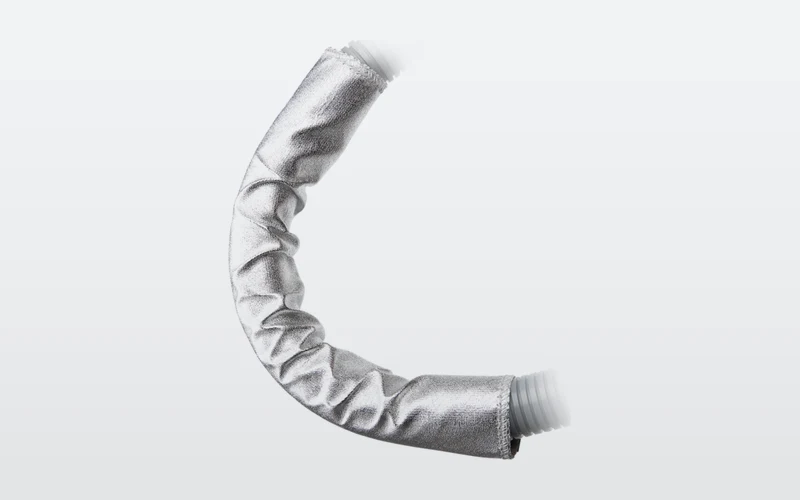
A cobot dress pack is a light hose package that guides cables and hoses to the tool of a cobot. It consists of a thin, highly flexible protective hose, clamps along the segments of the arm and a fitting at the tool. A retraction system is usually not needed. Choose the hose by the bundle diameter and the clamps by the arm diameter of your model.

A cobot dress pack keeps the cables and hoses to the tool tight along the arm, so they do not chafe, do not kink and do not snag on anything. On a cobot this matters just as much as on a large industrial robot, but the design is different. The package is lighter, the hose thinner and a retraction system is usually not needed. You choose the hose by the thickness of your bundle and the clamps by the diameter of the arm.
Below you can read where a cobot has different requirements, how to determine the hose size, which holders are available and what to look out for during installation.
What is a cobot dress pack?
A dress pack is the package that bundles and protects all lines to the tool. How that works per axis on an industrial robot is explained in what is a dress pack. On a cobot the task is the same, with a simpler design.
The cobot package consists of three parts:
- (01)A light protective hose around the cables and hoses, which follows the movement of the arm.
- (02)Clamps along the segments of the arm, which hold the hose in place.
- (03)An end fitting at the tool, on axis 6.
In the dress pack configurator a cobot gets four clamps with clamping jaws over axes 1 to 6 and an end fitting on axis 6 as standard. Heat protection is not included as standard. If you weld with a cobot, indicate this; how to protect the hose in that case is explained in dress pack for a welding robot.
Why does a cobot need a different dress pack?
A cobot works alongside people and is often moved or converted. That makes four differences compared with a robot in a guarded cell.
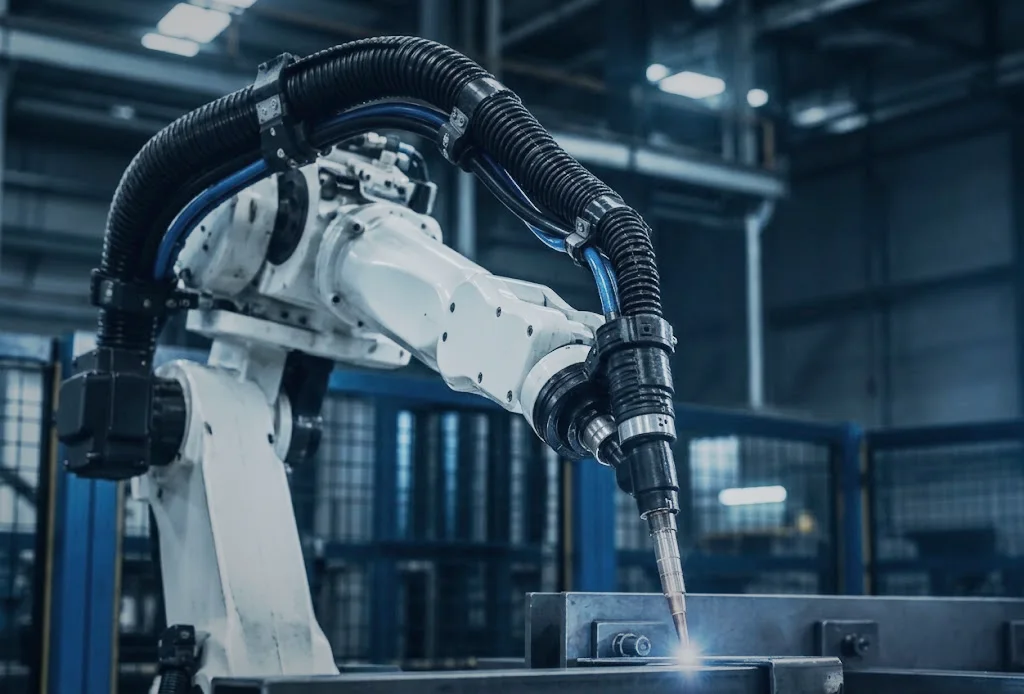
The arm must stay free. A loop hanging next to the arm can snag on a workpiece, a fixture or a person. A cobot dress pack therefore lies tight against the arm, without loose loops.
The package adds weight. Everything hanging on the arm counts towards the load. Cobots have a limited payload, so a heavy hose or large holders reduce what the gripper may lift. Do not choose heavier than necessary.
The wrist rotates a long way. On many cobots axis 6 can rotate a long way. The hose must be able to follow that movement around the tool without twisting. Check in the data of your model how far axis 6 rotates, and keep enough free hose length at the wrist.
The application changes. Today a gripper with vacuum, next month a screwing unit with an extra sensor. A package that you can easily open and extend saves time with every conversion.
A retraction system, as on the upper arm of larger robots, is usually not needed on a cobot. The difference in hose length between retracted and extended is small, and clamps keep the hose tight enough. How this works on industrial robots is explained in choosing a dress pack for your robot.
Which hose size fits a cobot?
Measure the bundle at its thickest point, with all cables and hoses going to the tool. Then choose the smallest hose whose inner diameter encloses the bundle. Do not choose larger: a hose that is too wide gives the cables room to twist inside it.
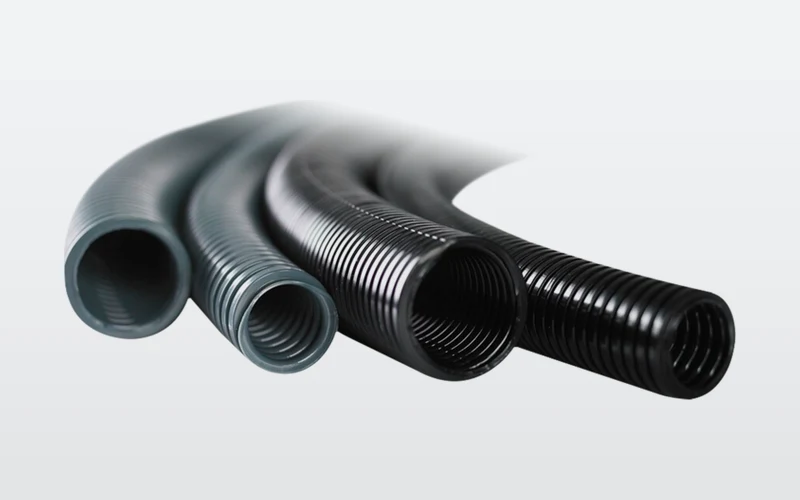
For cobots the configurator calculates with hose size 29 in the PARAB series as standard. This is a highly flexible corrugated tube made of polyamide 12 in a light version, with excellent resistance to alternating bending. The main sizes from the catalogue:
| Hose | Inner diameter | Outer diameter | Min. dynamic bending radius |
|---|---|---|---|
| PARAB-17F | 16,5 mm | 21,0 mm | 80 mm |
| PARAB-23F | 23,0 mm | 28,0 mm | 90 mm |
| PARAB-29F | 28,5 mm | 34,0 mm | 120 mm |
| PARAB-36G | 35,9 mm | 42,0 mm | 180 mm |
A calculation example: your bundle consists of an air hose, a vacuum hose and a sensor cable and measures 26 mm at its thickest point. At 23.0 mm the PARAB-23F is too small. The smallest size that fits is the PARAB-29F, with an inner diameter of 28.5 mm. Then pay attention to the dynamic bending radius of 120 mm: the bend at the wrist must not be tighter.
If connectors have to go through the hose, the connector determines the size, not the cable. If you cannot slide the hose over the connectors, there are split hoses that you wrap around the bundle, see choosing a cable protection hose. All series and sizes are listed under protective hoses.
Calculate it yourselfDress pack configuratorConfigure a dress pack for your robotOpen the dress pack configuratorWhich holders are available for a cobot?
On a cobot you fix the hose to the round segments of the arm. You therefore choose the holders by the arm diameter. The Reiku range includes:
| Holder | What for | Arm diameter |
|---|---|---|
| TPXWB-U | Universal fixing for cobots | 54 to 110 mm |
| LSDFB-U | Universal fixing with rotary flange, light application | 54 to 110 mm |
| MESUB | Cobot clamp with console, heavy application | 54, 66, 75, 86 or 108 mm |
| SKB-UR | Cable sheathing for the arm | 54, 66, 75, 86 or 108 mm |
| VAURH-3510 | Holder for axis 6 | For UR 3, UR 5 and UR 10 |
There are also ready-made sets: the CoBot Kit EASY, SMART and STRONG. The STRONG is available per model, for the UR3, the UR5 and the UR10/16. If you work with another brand, choose the universal fixings by the arm diameter of your model.
Each holder has its own function. A fixed clamp holds the hose in place, a holder with a rotary flange lets it rotate with the segment below. At the wrist you want the hose to be able to rotate, on the lower arm you want it fixed. All holders, with article numbers, can be found under holders and fixings.
How do you install a cobot dress pack?
- (01)Map the bundle. Note every cable and hose to the tool, with its diameter and whether it has a connector.
- (02)Choose the hose by the bundle diameter, as described above.
- (03)Measure the arm. Determine per segment where a clamp goes and what arm diameter you have there.
- (04)Move the arm through the entire program. Do this slowly and without the tool working. Check in the extreme positions whether the hose pulls tight anywhere, kinks or touches the workpiece.
- (05)Set the hose length at the wrist in the position where axis 6 is rotated furthest. That is where you need the most length.
- (06)Fix the cables at both ends with strain relief, so they cannot creep inside the hose.
If a cable keeps breaking around the wrist of an existing robot, the cause is usually torsion or a bend that is too tight. What to do about it is explained in cable breakage on your robot.
Cobot on a linear axis or mobile platform?
If the cobot is mounted on a linear axis, two movements come together. A cable carrier runs along the travel, the dress pack on the arm. The transition between them deserves attention: there the movement changes from one plane to three dimensions. Fix the cables at that point with strain relief, so that the cable carrier and the dress pack do not pass anything on to each other. The difference between the two is explained in cable carrier, protective hose or cable tray.
If the cobot is on a mobile base, the bundle is often shorter but is disconnected more often. A dress pack with an easily accessible end fitting then saves work with every relocation.
When should you have the dress pack assembled?
For a single cobot with a simple gripper you can easily choose the package yourself with the configurator. Have it assembled if the bundle is thick, if several connectors have to go through, or if you have several cobots in a line that you want to equip identically. If you work on cobots in a cleanroom or laboratory, also take a look at pharma and cleanroom.
We assemble Reiku dress packs and install them on site, see installation and commissioning. Send us the brand and model of the cobot, the bundle and a photo of the tool, and we will take a look free of charge. Loose hoses, clamps and holders for an existing package can be ordered via parts.
Frequently asked questions
Does a cobot need a dress pack?
Yes, as soon as cables or hoses run along the arm to the tool. Without guidance they hang loose, chafe against the arm and can snag on a workpiece or a person. A light cobot package keeps them tight along the arm.
Does a cobot dress pack have a retraction system?
Usually not. On a cobot the difference in hose length between retracted and extended is small, and clamps along the segments keep the hose tight enough. The cobot package in the configurator works without a retraction system.
Which hose size should I choose for a cobot?
The smallest hose whose inner diameter encloses the bundle at its thickest point. For cobots the configurator calculates with size 29 as standard, the PARAB-29F, with an inner diameter of 28.5 mm.
Does a cobot dress pack fit every brand?
You choose the universal fixings by the arm diameter, from 54 to 110 mm. That way they fit cobots of different brands. For Universal Robots there are also sets per model. In the configurator you choose the brand and model.
Does the dress pack count towards the payload?
Yes. Everything hanging on the arm loads the cobot. So choose the lightest hose and the smallest holders that suit your bundle.
Next step
Calculate it yourself or browse the range. We check your result free of charge.
Question about this topic?
Ask Daan directly
Robotics Division at Wisman Techniek