Short answer
A cable carrier can be installed vertically hanging (bend at the bottom) or vertically standing (bend at the top). Hanging is usually the simplest, because gravity keeps the carrier straight. Standing, the carrier wants to deflect sideways and needs extra lateral guidance. Not every type is suitable for vertical installation; this is stated per type in the data.
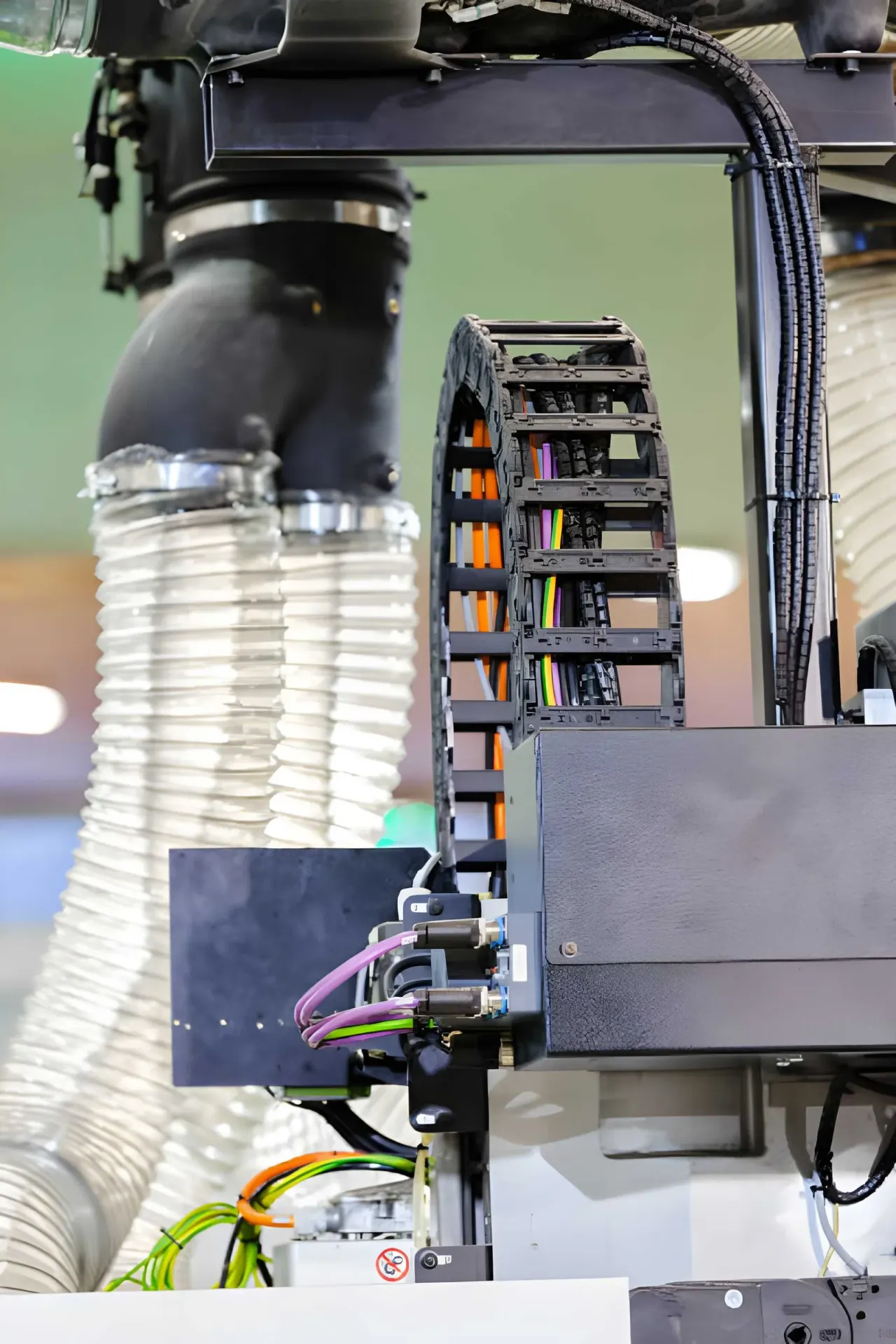
You can install a cable carrier vertically in two ways: hanging, with the bend at the bottom, or standing, with the bend at the top. Hanging is usually the simplest, because gravity straightens the carrier by itself. Standing, gravity works against it and the carrier wants to deflect sideways, so extra lateral guidance is needed there. In both cases you choose a type that is suitable for vertical installation according to the manufacturer's data.
Vertical applications are found in lifting equipment, lifts, vertical axes of machining centres, gantries with a Z axis and warehouse systems that move in height. In this article you read how to choose the right installation direction, what to look out for with the cables and how to determine the length. If you first want to know how a carrier behaves horizontally, read self-supporting or gliding.
What is the difference between a hanging and a standing cable carrier?
The difference lies in where the bend is and which way gravity acts.
| Vertically hanging | Vertically standing | |
|---|---|---|
| Bend | At the bottom | At the top |
| Gravity | Pulls the carrier straight | Presses the carrier together |
| Behaviour | Calm, the carrier hangs like a loop | Wants to deflect sideways or topple over |
| Guidance | Usually not needed | Extra lateral guidance needed |
| Load on the fixing | Weight of carrier and cables hangs on the fixings | Weight rests on the carrier itself |
With a hanging carrier both parts of the loop hang under their own weight. The carrier stays in line by itself and does not touch itself. That is why hanging is preferred in most cases, if the machine allows it.
With a standing carrier the loop stands upright with the bend at the top. The weight of the links and the cables presses on the carrier. Without guidance it can buckle sideways, start to swing or run into the machine. Guidance at the side, for example a channel or guide profile, keeps it in line.
Which cable carrier is suitable for vertical installation?
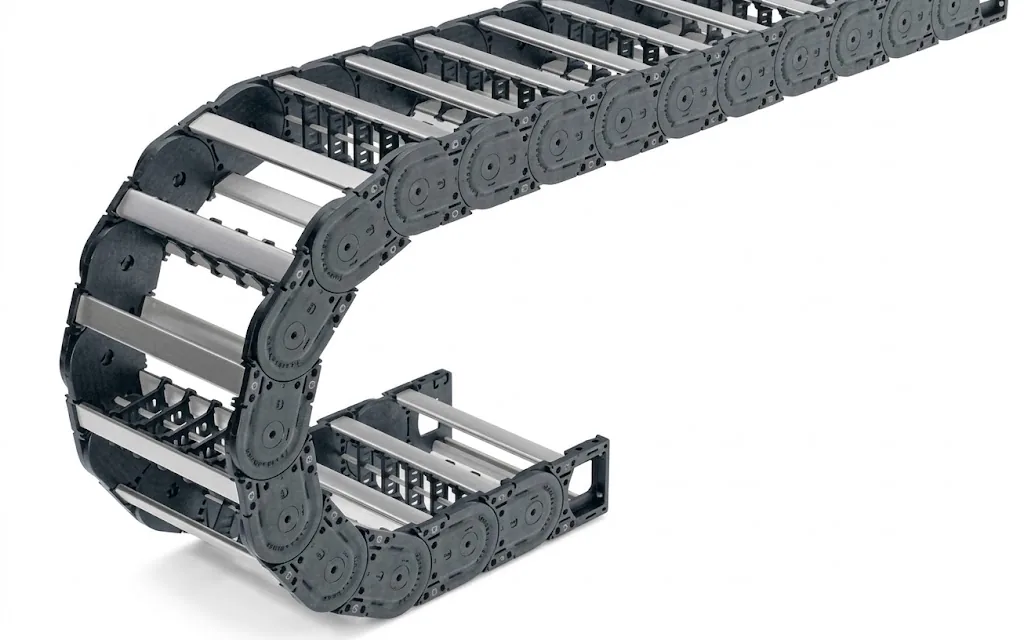
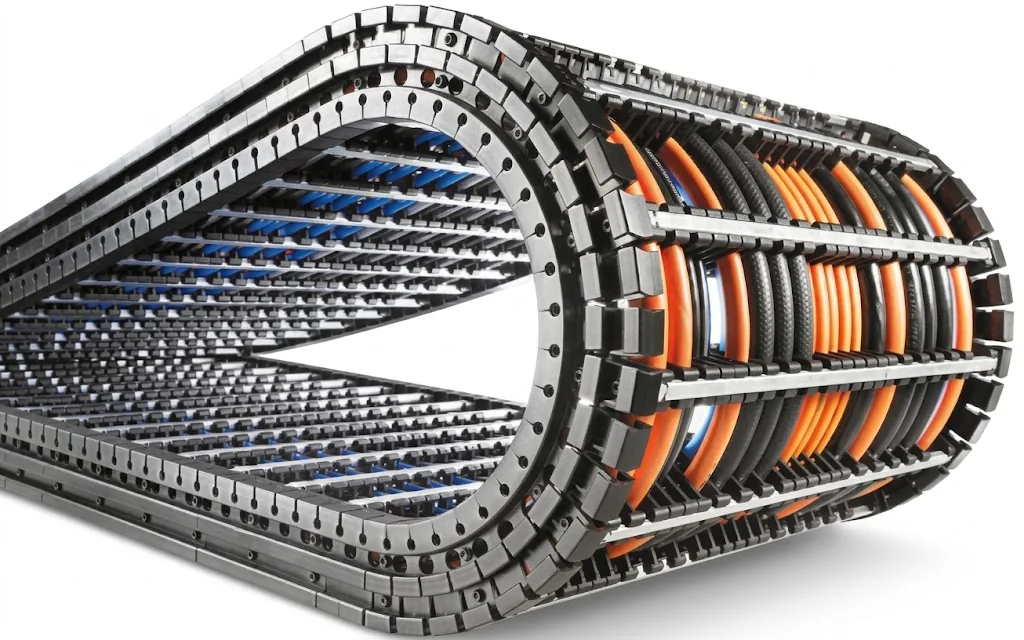
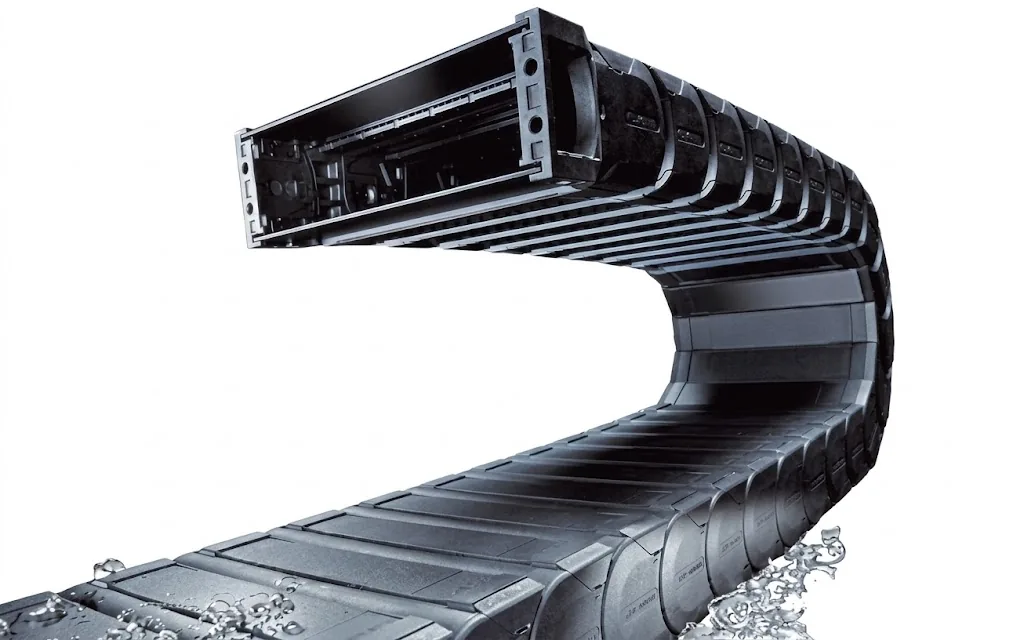
Not every type may be used vertically. In our data it is stated per type whether it is suitable for vertical installation, as the manufacturer specifies. It is possible with many plastic series, such as the UNIFLEX Advanced, the QUANTUM and the enclosed TKA. Within a series it can differ per type: with the M series most types are suitable, but not all.
If in the Cable carrier configurator at the Movement step you choose the installation direction vertical hanging, vertical standing or lying on its side, the types that are not suitable for it are ruled out automatically. You see the reason given: not suitable for this installation direction.
Calculate it yourselfCable carrier configuratorCalculate, select and assemble a cable carrierOpen the cable carrier configuratorBe careful with the limits for travel length, speed and acceleration. The terms self-supporting and gliding belong to a horizontal carrier. With vertical installation the carrier behaves differently, so those limits say less. If you are close to a limit, or your application is heavy or fast, have it checked. We do that free of charge.
What do you look out for with a vertically hanging cable carrier?
Hanging is the calmest arrangement, but a few points deserve attention.
- (01)Sturdy fixing: the weight of the carrier and the cables hangs on the fixed point and the driver. Use the end connectors that belong to the type and fasten them to a rigid part of the machine.
- (02)Strain relief at both ends: in a hanging carrier the cables want to sink downwards under their own weight. Secure them at the fixed point and at the driver, so that they cannot slide in the carrier and no tension is placed on the connections.
- (03)Space below the bend: the bend moves up and down with the movement. Make sure there is enough free space below the lowest position, so that the bend does not hit anything.
- (04)Wind and vibration: with a tall carrier outdoors or on a machine with a lot of vibration the loop can start to swing. Light lateral guidance may then still be needed.
How to install strain relief and end connectors in practice is explained in installing a cable carrier.
What do you look out for with a vertically standing cable carrier?
A standing carrier requires more preparation. Gravity does not help here.
- Lateral guidance: the carrier needs guidance at the sides, over the height where it can deflect. Without guidance it deflects, starts to swing or runs into the machine.
- Rigidity of the type: a type with rigid side plates and little lateral play stays in line better. If in doubt, choose a heavier type.
- Weight of the cable package: the heavier the package, the more the carrier is loaded. Keep the package as light as you can and distribute it evenly across the width.
- Speed and acceleration: fast movements place extra forces on a standing loop. Always provide them, then we will check the application.
If the machine can also be designed with a hanging carrier, for example by placing the fixed point at the top, that is usually the better choice.
What is a cable carrier lying on its side?
With a carrier lying on its side the carrier is tilted 90°. The bend then lies horizontally and the carrier moves on its side. You see this on machines where there is no room above and below, but there is room at the side.
The weight of the carrier and the cables then acts on the side of the links instead of on the underside. That is why a carrier lying on its side usually needs support over the travel length, such as a gliding surface or channel on which it lies. Here too: not every type is suitable. If in the configurator you choose lying on its side, the types that according to the data may only be used horizontally are ruled out. With a long travel length, always have the support checked by us.
How do you determine the length of a vertical cable carrier?
You calculate the length in the same way as for a horizontal carrier. If the fixed point is in the middle of the stroke, the length is half the travel length plus the bend (π × bending radius) plus two links, rounded up to whole links. If the fixed point is at the end, the whole travel length counts.
An example with a stroke of 2,000 mm, a bending radius of 100 mm and a pitch of 50 mm, fixed point in the middle:
- Half travel length: 1,000 mm
- Bend: π × 100 ≈ 314 mm
- Two links: 2 × 50 = 100 mm
- Total: approximately 1,414 mm, rounded to whole links of 50 mm that becomes 1,450 mm (29 links)
With vertical installation the position of the fixed point also determines where the bend is in the lowest and highest positions. So check that the bend stays clear of the machine in both extreme positions. With the calculation tool cable carrier length you calculate this in a few seconds.
Calculate it yourselfCalculate cable carrier lengthLength and number of links from travel length and radiusCalculate itYou choose the bending radius on the most sensitive cable in the package, as with a horizontal carrier. How to determine it is explained in determining the bending radius of a cable carrier, or calculate it with the bending radius calculation tool.
What does vertical installation mean for the cables?
Cables in a vertical carrier have a harder time than you would think. Their own weight acts in the longitudinal direction, and with a tall stroke that adds up.
- Choose cables for moving applications: cables made for use in a cable carrier, with a construction that can withstand many bending cycles. See flexible cables or search for one with the Cable finder.
- Lay the cables loosely next to each other: not stacked and not crossed, with play all around. Use dividers to keep cables and hoses separate.
- Lay them in without torsion: a cable laid in twisted is more likely to end up in a spiral in a vertical carrier.
- Secure them on both sides: that applies to every carrier, but even more so vertically, because otherwise the weight of the cable pulls on the connection.
How to divide up the inner space properly is covered in dividing a cable carrier. If the cables in an existing carrier are already twisting into a spiral, see cables twisting in the carrier.
Unsure about the installation orientation?
Send us the stroke, the speed, the installation space and the cables that need to go in. Bas and his colleagues will check the calculation free of charge and recommend a type suited to your installation orientation, with the guidance or support that goes with it.

Frequently asked questions
Can every cable carrier be installed vertically?
No. The manufacturer specifies for each type whether it is suitable for vertical installation. In the Cable carrier configurator, types that are not suitable are automatically excluded when you choose a vertical installation orientation.
Is hanging or standing better?
Hanging, with the bend at the bottom, is usually the simplest. Gravity keeps the carrier straight and guidance is rarely needed. Standing is also possible, but it requires lateral guidance and a type that is stiff enough.
Does a vertically standing cable carrier need a channel?
It needs lateral guidance so that it does not deflect sideways or topple over. That can be a channel or a guide profile. Which guidance is suitable depends on the stroke, the type and the cable package.
Do you calculate the length of a vertical cable carrier differently?
No. The length is half the travel length plus π × bending radius plus two links, rounded up to whole links, when the fixed point is in the middle. Do check that the bend stays clear in the highest and lowest positions.
Why are the cables sagging in my vertical cable carrier?
Usually they are not properly secured at one or both ends. Secure the cables with strain relief at the fixed point and at the driver, so that they cannot slide down in the carrier.
Next step
Calculate it yourself or browse the range. We check your result free of charge.

Series on this topic
Question about this topic?
Ask Bas directly
Cable Carriers Specialist at Wisman Techniek