Short answer
Give a hydraulic hose 20% clearance on the outer diameter, its own compartment with dividers and a position on the outside of the carrier. The bending radius of the carrier follows the dynamic bending radius from the hose data sheet if that is larger than 7.5 times the diameter. Include the weight including oil and secure the hose at both ends, without torsion.
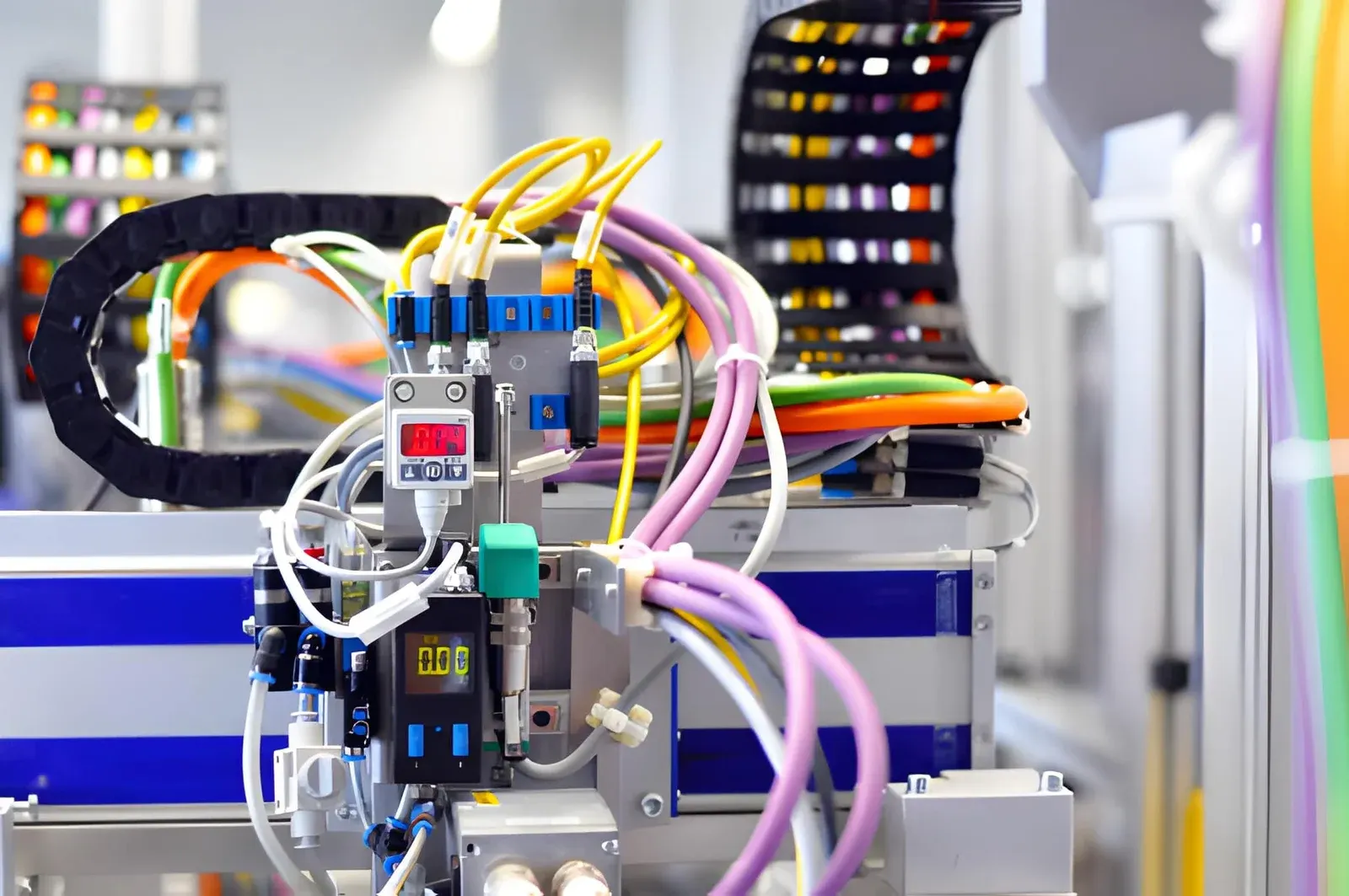
A hydraulic hose in a cable carrier needs more space and more attention than a cable. Allow 20% clearance on the outer diameter, give the hose its own compartment, place it on the outside of the package and include the bending radius of the hose when choosing the carrier. Anyone who skips this will see the hose chafe after a short time, or worse: damage the cables next to it.
Why does a hydraulic hose behave differently from a cable?
A cable hardly changes shape in the carrier. A hydraulic hose does. Under pressure it swells in diameter and changes in length. With every pressure peak it moves a little. That happens thousands of times a day, while the carrier is also rolling out.
In addition, a hydraulic hose is stiffer and heavier than a cable of the same diameter. It is filled with oil, often has a steel braid or spiral and ends in crimped fittings that are larger than the hose itself. All of these points determine how you lay the hose in the carrier.
How much clearance does a hydraulic hose need in a cable carrier?
On this site, for hoses we calculate with an effective diameter of outer diameter × 1.20. For cables that is × 1.10. The difference lies in the swelling under pressure: a hose that fits at rest must still lie freely in its compartment under working pressure.
The change in length under pressure is stated in the hose data sheet. For many hoses it is a few per cent, and that seems little. But on a 5 metre hose, 1 per cent is already 50 mm. That length has to go somewhere. If the hose lies taut between two fixed points, it pushes against the crossbars or pulls on the fittings.
So never calculate with the diameter from the catalogue without clearance. With calculate fill level you can immediately see which inner height and inner width your package needs, with the right clearance for cables and hoses. How to arrange the whole package is explained in arranging a cable carrier: fill level, additional load and dividers.
What bending radius does a hydraulic hose need in a cable carrier?
For the carrier we calculate with at least 7.5 times the diameter of the thickest cable or hose. For hydraulic hoses that is often not enough. The data sheet states a minimum bending radius, and for hoses with a steel braid or spiral it is usually larger than for a cable of the same diameter.
Pay attention to which value you use. Many manufacturers give a bending radius for a hose that is bent once and then stays still. In a cable carrier the hose bends with every stroke. Therefore ask the hose supplier for the value for moving use, and take the larger of the two: 7.5 times the diameter or the value from the data sheet.
An example. Your package has a motor cable of 16 mm, four control cables of 9 mm and two hydraulic hoses with an outer diameter of 20 mm.
- (01)Thickest line: the 20 mm hose
- (02)Minimum according to the rule of thumb: 20 × 7.5 = 150 mm
- (03)If the hose data sheet states 200 mm for moving use, 200 mm becomes the minimum
- (04)Choose the next available radius of the type that is at least as large
The difference between 150 and 200 mm seems small, but the build height of the carrier grows by twice the radius. So check early whether that extra height fits in your machine. In calculating the bending radius for cable and cable carrier you can read how to do that step by step.
Calculate it yourselfCalculate the bending radiusMinimum bending radius from your thickest cableCalculate itWhere do you place a hydraulic hose in the cable carrier?
A hydraulic hose belongs in its own compartment, separated from the cables by a divider. There are three reasons for this:
- Movement: the hose swells and changes in length. In its own compartment that does not disturb the cables.
- Heat: hydraulic oil can get hot. A cable lying against a warm hose is heated along with it.
- Damage: if a hose leaks or bursts, the cables next to it remain better protected.
Place heavy hoses on the outside of the carrier and distribute the weight left and right as evenly as possible. Two hoses of the same size, for example a pressure line and a return line, therefore go left and right, not together on one side. Light cables go in the middle. That way the carrier keeps running straight and the links are loaded evenly.
Never stack hoses of different diameters on top of each other without a shelf. They then roll over each other and start to twist, resulting in chafing. That same pattern is also covered in cables twisting in the carrier.
In ChainLogic you draw the layout in the cross-section. You place hoses, cables and dividers in position and immediately see whether anything collides and how full the carrier is.
Calculate it yourselfChainLogicLay out cables, hoses and dividers in the cross-sectionOpen ChainLogicHow heavy is a hydraulic hose with oil?
For the additional load, the hose counts together with its contents. The weight of the empty hose is in the data sheet. You calculate the weight of the oil yourself using the inner diameter.
Take a hose with an inner diameter of 12.7 mm (1/2 inch). The cross-section inside is approximately 127 mm². With a hydraulic oil density of around 870 kg/m³, that is approximately 0.11 kg of oil per metre of hose. That comes on top of the hose's own weight. With two or four hoses it adds up quickly.
A heavier package means a shorter self-supporting length, more sag and more load on the links. With long travel lengths or heavy hoses you then end up with a gliding arrangement or a heavier series. For that, read self-supporting or gliding. The plastic K series and, for long travel lengths, the TKHP are made for heavy cable and hose loads, for example. If it gets even heavier, or heat and dirt are involved, look at the steel S/SX.
How do you secure a hydraulic hose in the cable carrier?
Secure the hose at the fixed point and at the driver, just like cables, with a clamp or strain relief on the end connectors. Between those two points the hose lies freely in its compartment. That way it can move in the carrier and absorb its change in length, without the forces ending up on the fittings.
Pay attention to three things when securing:
- No torsion. A hose fitted twisted wears faster and can leak at the fitting. Look at the print on the hose: it must lie straight over the entire length.
- Straight out of the carrier. Outside the carrier, let the hose first run straight for a while before it bends towards its connection. A sharp bend directly after the clamp loads the hose twice over.
- Space for the fittings. Crimped fittings are thicker than the hose. With a carrier that has crossbars that can be opened, you lay the hose in from above. If the carrier cannot be opened, check before assembly whether the fitting fits through the compartment.
What mistakes do you see most often with hoses in a cable carrier?
In practice we come across the same mistakes again and again:
- Calculating hoses with the diameter from the catalogue, without clearance
- Basing the bending radius only on the cables and forgetting the hose
- Hoses and cables in the same compartment, without a divider
- Not counting the weight of the oil
- A hose that lies taut between two clamps and has no room to move
- A hose fitted twisted
How do you choose a cable carrier for cables and hydraulic hoses?
In the Cable carrier configurator, enter your cables and hoses, with the outer diameter for each line and whether it is a hose. The configurator calculates with 20% clearance for hoses, determines the minimum inner dimensions and radius and filters the types that suit your travel length. A Wisman specialist checks the result free of charge.
If you are unsure about the bending radius of a hose, the weight or the layout, send your cable list and the hose details along with a quote request. We will work through the package with you and, if desired, supply the carrier cut to length, with cables and hoses in the right layout.

Frequently asked questions
May cables and hydraulic hoses go in the same cable carrier?
Yes, that is very common. Do give the hoses their own compartment with a divider, so that the swelling and the heat of the hose do not affect the cables.
How much clearance does a hydraulic hose need?
Allow 20% on the outer diameter. A 20 mm hose therefore needs a compartment of at least 24 mm, in height and in width.
What bending radius applies to a hydraulic hose in a cable carrier?
The larger of two values: 7.5 times the outer diameter or the minimum bending radius for moving use from the hose data sheet. Then choose the next available radius of the carrier.
Do I need to include the weight of the oil?
Yes. The additional load is the weight of all cables and hoses per metre, hoses including their contents. You calculate the oil using the inner diameter of the hose and the density of the oil.
Next step
Calculate it yourself or browse the range. We check your result free of charge.
Series on this topic

Question about this topic?
Ask Bas directly
Cable Carriers Specialist at Wisman Techniek