
On 18 and 19 November the shore power sector meets in Rotterdam at the Shore Power Summit. The conference is an initiative of the trade magazine WorldCargo News, hosted by the Port of Rotterdam Authority. This is reported by Nieuwsblad Transport. According to the organisers, the question is no longer whether shore power will come, but about scale, grid capacity and whether it can be made financially viable.
What is going on
The programme includes ports such as Bilbao, Barcelona, Amsterdam, Rotterdam and Gothenburg, shipping lines such as Maersk, Hapag-Lloyd and Stolt Tankers, and suppliers of shore power systems. Participants can take a boat trip past the Maasvlakte, where shore power installations are currently being built.
The driver is European regulation. According to the report, large container ships and passenger ships must use shore power at berth in many ports from 2030, and the ports must be able to supply those connections. This follows from the European AFIR and FuelEU Maritime rules. The report estimates the investment in shore power in the Netherlands at 220 million euros.
A large project is already under way in Rotterdam. Rotterdam Shore Power, a partnership of the Port of Rotterdam Authority and Eneco, commissioned ABB to supply shore power at three container terminals on the Maasvlakte: APM Terminals Maasvlakte II, Hutchison Ports ECT Delta and Hutchison Ports ECT Euromax. According to Bouwen en Uitvoering it involves 35 connection points, enough for 32 container ships at the same time, with a total capacity of more than 100 MVA. The installations are due to be in operation in the second half of 2028.
Why a shore power cable is a moving cable
A ship never lies at exactly the same spot on the quay twice. Even once it is moored, it moves with the tide, loading and unloading. The cable between the quay and the ship has to follow that movement, carrying a lot of power and often a signal connection for the control system as well.
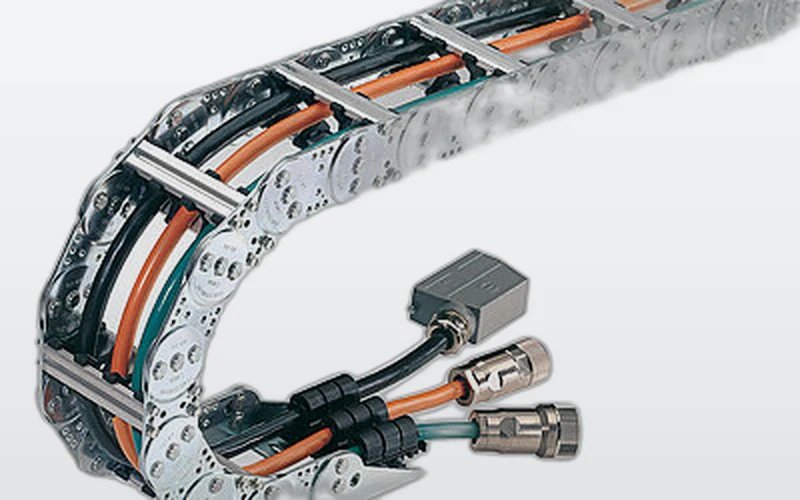
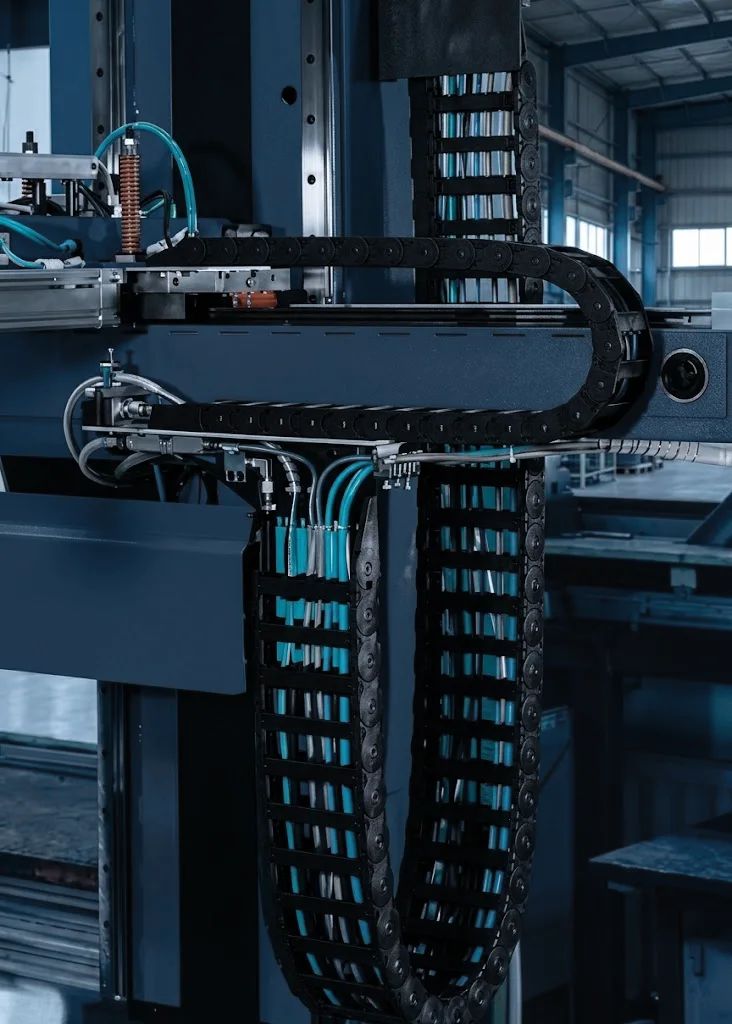
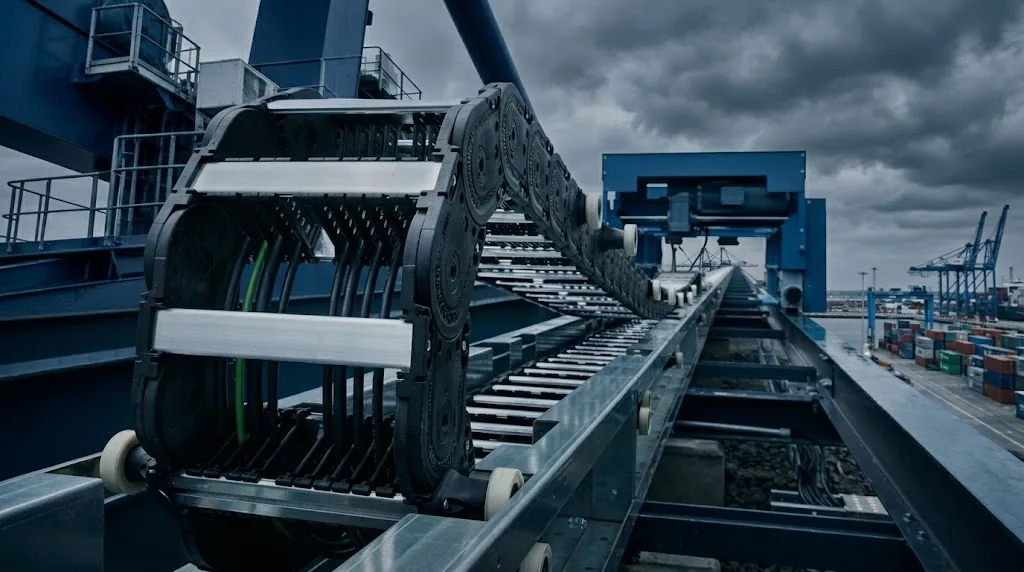
In installations where the connection point moves along the quay, the cable travels with it over a long distance, and a cable carrier can provide the guidance there. The reports do not say which solution will be used in the Rotterdam installations.
Tsubaki Kabelschlepp has developed TKSPS for this application, a range of standardised cable carrier systems for shore power for cruise and container ships. According to the manufacturer, the cable carriers with roller guidance run in the quay or in a channel along the quay edge, protected from the weather. The materials are UV-resistant and resistant to salt water, components have corrosion protection up to C5-M, and IEC 80005-1 is applied where required. A monitoring system records the push and pull forces and the condition of the glide shoes.
What does this mean for ports and installation builders?
Shore power combines three things that put a heavy load on a cable carrier: a long travel distance, outdoor operation and heavy cables. Three points to consider early:
- Plan for a long, gliding travel distance. Over tens of metres a cable carrier cannot support itself. It glides in a channel, and then the gliding limits for speed and acceleration apply. Read cable carrier with long travel: gliding in a channel.
- Choose a cable carrier and cables for outdoor use. UV, rain, frost and salty air call for a different version than a machine hall. What to watch for is explained in cable carriers outdoors. With heavy cables and a harsh environment you often end up with a steel cable carrier; the trade-off is explained in steel or plastic cable carrier.
- Let the cable package determine the cable carrier. Heavy power cables determine the inner dimensions, the radius and the weight per metre. How to calculate that step by step is explained in calculating a cable carrier.
What Wisman Techniek does
Wisman Techniek is the exclusive Dutch dealer of Tsubaki Kabelschlepp and works for cranes and ports in the Netherlands and beyond. We supply cable carriers for long travel distances and outdoor use, with channel, cables and end connections, and we maintain and overhaul existing cable carriers on the quay. Are you working on a shore power project or another installation with a long travel distance on the quay? Send us the travel distance and the cable list, and we will work through it with you free of charge.