


Short answer
A hygienic cable entry has a flat, smooth surface without edges and corners where dirt collects, and is made of material suitable for contact with food. Cables without a connector go through a hygienic membrane plate, such as the DES PDM Clean from Detas Ultra or the KEL-DPU-HD and KEL-DPZ-HD from Icotek. Cables with a connector go into a frame with special grommets, such as the blue KT-BL for food or the KT CR for cleanrooms.
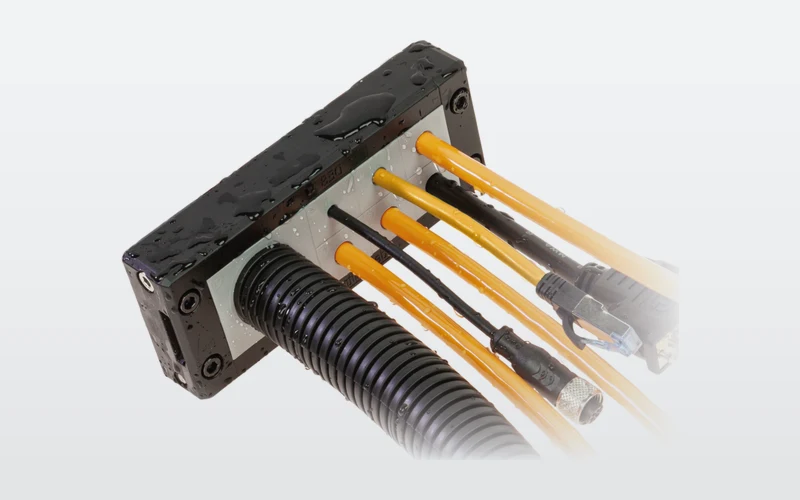
A hygienic cable entry is an entry for the control cabinet or machine wall that you can clean well and in which no dirt gets trapped. The surface is flat and smooth, there are no open corners or ridges, and the material is suitable for an environment with food or medicines. In a packaging line or a pharmaceutical production area, the cable entry is often the first place where things go wrong: an ordinary cable gland has threads, ridges and edges where product, water and cleaning agent remain behind. Below you can read which hygienic cable entries exist, how to choose and what to watch out for during installation.
What makes a cable entry hygienic?
With an ordinary cable entry, the focus is on sealing and strain relief. A hygienic version adds three requirements:
- No places where dirt remains. Rounded shapes, no sharp edges and no recesses on the outside. Detas Ultra describes this for the DES PDM Clean as "a rounded shape without sharp edges". Icotek speaks of a design "free of dirt-collecting recesses".
- A smooth surface. The smoother it is, the less sticks to it. For the KEL-DPU-HD and the KEL-DPZ-HD round, Icotek specifies a roughness of Ra = 0.421 µm according to ISO 4287.
- Suitable material. On the Clean plates from Detas Ultra, the material is FDA-approved. On the HD plates from Icotek, the elastomer is FDA-compliant and meets the European rules for materials in contact with food (1935/2004/EC and (EU) 10/2011).
In addition, the cable entry must be able to withstand wet cleaning. Where water is sprayed, choose at least IP65 or IP66. What those classes mean exactly is explained in IP rating of cable entries: IP54 to IP68.
Which hygienic cable entries are there?
For cables without a connector, a membrane plate is the simplest solution. You pierce the front membrane and push the cable through. The second membrane clamps the cable. This gives you one closed surface in the cabinet wall instead of a row of cable glands.
| Cable entry | Brand | Opening | Cable Ø | Sealing |
|---|---|---|---|---|
| DES PDM 24 Clean | Detas Ultra | Cut-out 112 × 36 mm | 2.8–16.2 mm, per opening | Two membranes |
| DES PDM M Clean | Detas Ultra | Metric, M32 and M50 | 2.8–12.5 mm, per opening | Two membranes |
| KEL-DPU-HD | Icotek | Cut-out for 24-pin connector | 3,2–20,5 mm | IP66 / IP68 |
| KEL-DPZ-HD round | Icotek | Metric, M25–M63 | 3,2–22,2 mm | IP66 / IP68 |
According to Icotek, the KEL-DPZ-HD round was developed in line with the EHEDG hygienic design guidelines and is Ecolab-certified. The hexagonal lock nut is included. All variants with dimensions and article numbers are listed under cable entry plates.
How do you route cables with a connector hygienically?
A membrane closes around the sheath of a cable. A cable with a plug does not fit through. For pre-assembled sensor, bus and servo cables you therefore need a split solution: a frame in which you place the cable with a grommet. Icotek has two special grommet families for this.
- KT-BL for the food industry. Blue grommets for cables from 1 to 35 mm, up to IP65, for the KEL-ER-BL frame. The blue colour is a signal colour: if a small piece falls into the product, you can see it. For thin cables from 1 to 8 mm there is the KT-BL multi with double and quadruple grommets, up to IP54.
- KT CR for cleanrooms. Grommets for cables from 1 to 35 mm, up to IP66 / IP68, for the KEL-ER CR and KEL-U CR frames. Articles ending in .600 and .601 have been tested for particle emission for cleanroom class 1 according to ISO 14644-1.
All grommets are halogen-free and free of silicone. You can find them under cable grommets. How frames and grommets work in general is explained in choosing a cable entry: cable gland, frame or cable entry plate.
How do you choose the right hygienic cable entry?
Go through these five questions:
- (01)Food or cleanroom? With food, it is about cleanability and suitable material. In a cleanroom, it is mainly about particles released by the cable entry itself.
- (02)Does the cable have a connector? Without a connector, go for a membrane plate; with a connector, a frame with KT-BL or KT CR grommets.
- (03)What opening do you have? A rectangular cut-out or a metric hole. For a new build you choose the opening to suit the cable entry; for an existing cabinet it is the other way around.
- (04)How is it cleaned? For wet cleaning with a water jet, choose IP66. According to Icotek, the KEL-DPU-HD is also highly resistant to aromatic solvents, oils, greases and mineral products.
- (05)What temperature? Check the limits per type. The HD plates from Icotek are suitable from -40 to 80 °C, the standard KEL-DPU plate up to 100 °C. The HD plates have fire rating UL94-HB, the standard plates UL94-V0. If cleaning is done hot or the cabinet is near an oven, check this in advance.
Worked example: does your cable package fit through one Clean plate?
A packaging machine has a cabinet with a cut-out of 112 × 36 mm. The following must pass through it: 8 sensor cables of 5 mm, 4 control cables of 9 mm and 2 motor cables of 11.5 mm, all without a connector.
The DES PDM 24 Clean comes in three layouts:
| Plate | Openings 2.8–6.5 mm | Middle openings | Largest openings |
|---|---|---|---|
| DES PDM 24/13 CLEAN | 2 | 6 × 4,6–10,2 mm | 5 × 8,6–16,2 mm |
| DES PDM 24/25 CLEAN | 12 | 7 × 4,4–9,7 mm | 6 × 6,8–12 mm |
| DES PDM 24/32 CLEAN | 21 | 8 × 4,6–10,2 mm | 3 × 6,8–12 mm |
The 24/13 is ruled out: it has only 2 small openings for the 8 sensor cables. The 24/25 fits: 8 of the 12 small openings for the sensor cables, 4 of the 7 middle ones for the 9 mm cables and 2 of the 6 largest for the motor cables. That leaves 11 openings for later. A membrane you do not pierce stays closed, so you do not need blanking plugs.
Each cable must fall within the range of its opening. A 5 mm cable in an opening for 6.8 to 12 mm does not seal properly. With a hygienic cable entry in particular, that is a problem: it creates a gap where moisture and dirt creep in.
Calculate it yourselfCable entry plannerFrom cable list to cable entry with article numbersOpen the plannerThe Cable entry planner solves this puzzle for you. For Detas Ultra, the planner asks whether you need a Clean version and then shows only the Clean plates, with the layout and the article numbers.
What should you watch out for during installation and cleaning?
A hygienic cable entry is only as good as its installation:
- Use round, smooth cables. A membrane or grommet seals on a round sheath. A flat or damaged sheath leaves a gap. Which sheath suits cleaning and oil is explained in PUR or PVC cable in the cable carrier.
- Only pierce the openings you use. A pierced membrane without a cable is a hole.
- Mount on a flat wall. The seal against the cabinet wall must make contact all the way round, otherwise a seam forms.
- Earth shielded cables inside the cabinet. The cable entry seals, an EMC clamp takes care of the earthing. See connecting EMC shielding.
- Check at every major cleaning. See whether membranes and grommets still fit tightly around the cable and whether there are no residues behind the edge.
If the cables come from a moving machine part, also secure them outside the cabinet. That way there is no pull on the membrane. More on this in what is strain relief.
Help with your hygienic cable entry
Are you working on a machine for packaging and food or for pharma and cleanroom? Send us your cable list with, per cable, the diameter and whether it has a plug, the size of the opening and how it is cleaned. Olaf and his colleagues will propose a suitable cable entry free of charge, with price and delivery time. You can also do this via a quote request.

Frequently asked questions
What is a hygienic cable entry?
A cable entry with a flat, smooth surface without edges and recesses where dirt collects, made of material suitable for food or pharma. Examples are the DES PDM Clean from Detas Ultra and the KEL-DPU-HD and KEL-DPZ-HD from Icotek.
Can a cable with a plug go through a hygienic cable entry plate?
No. A membrane closes around the cable sheath; a plug does not fit through. Cables with a connector go into a frame with grommets, such as the KT-BL for food or the KT CR for cleanrooms.
Why are the grommets for food blue?
Blue is a signal colour in the food industry. If a particle ends up in the product, it stands out. Icotek supplies the KT-BL grommets for this.
Which IP rating do you need for wet cleaning?
Where cleaning is done with a water jet, choose at least IP65 and usually IP66. The hygienic plates from Icotek achieve IP66 / IP68.
Are hygienic cable entries suitable for high temperatures?
That differs per type. The HD plates from Icotek are suitable from -40 to 80 °C. If cleaning is done hot or the cabinet is near a heat source, ask us which version fits.
Next step
Calculate it yourself or browse the range. We check your result free of charge.
Question about this topic?
Ask Olaf directly
Inside Sales at Wisman Techniek