Short answer
Choose an open cable carrier in a clean environment: it is lighter, dissipates heat better and you can lay cables in quickly. Choose a closed cable carrier as soon as swarf, dust or dirt can reach the cables, for example in machining centres, woodworking and outdoor applications.
Choose an open cable carrier if the environment is clean and a closed cable carrier as soon as swarf, dust or dirt can reach the cables. It looks like a detail, but it decides how long your cables last. An open carrier in a machining centre works fine at first and causes cable breakage months later, when nobody links it to the choice of carrier any more.
What is the difference between an open and a closed cable carrier?
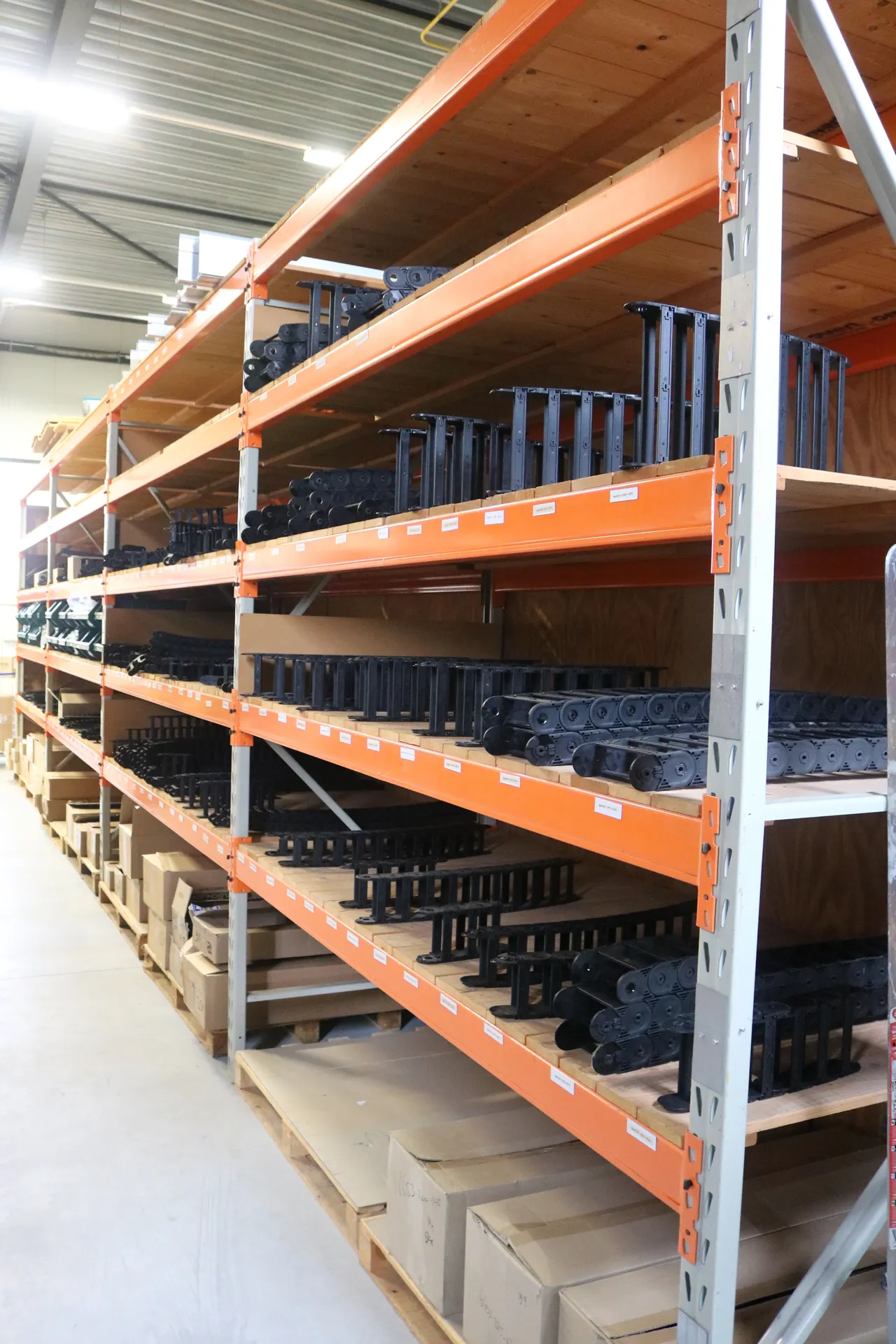
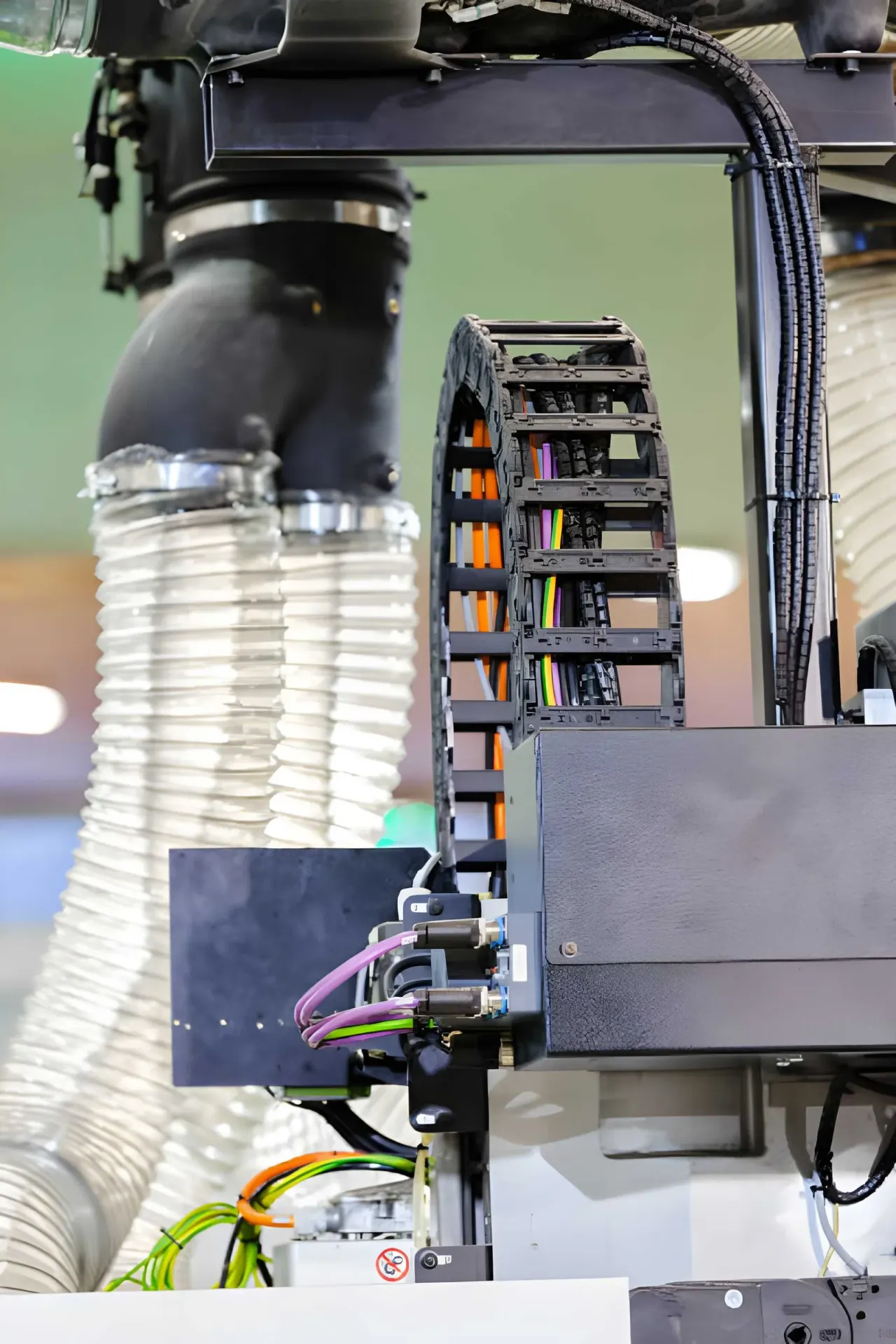
The difference is in the top and bottom of the links. An open cable carrier only has crossbars between the side plates. You can see the cables, air can pass and you open a crossbar to lay a cable in.
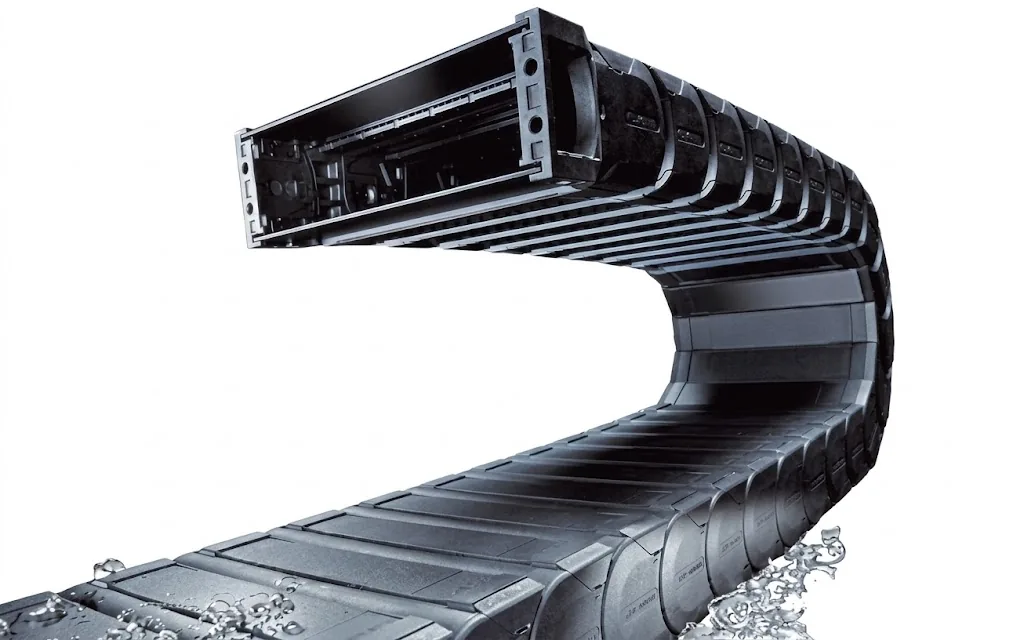
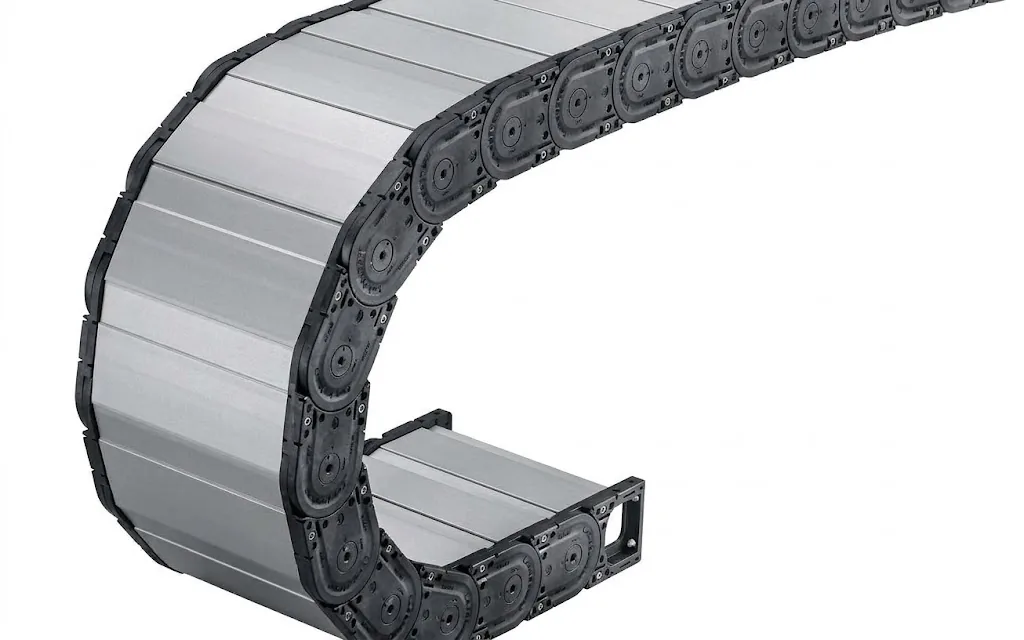
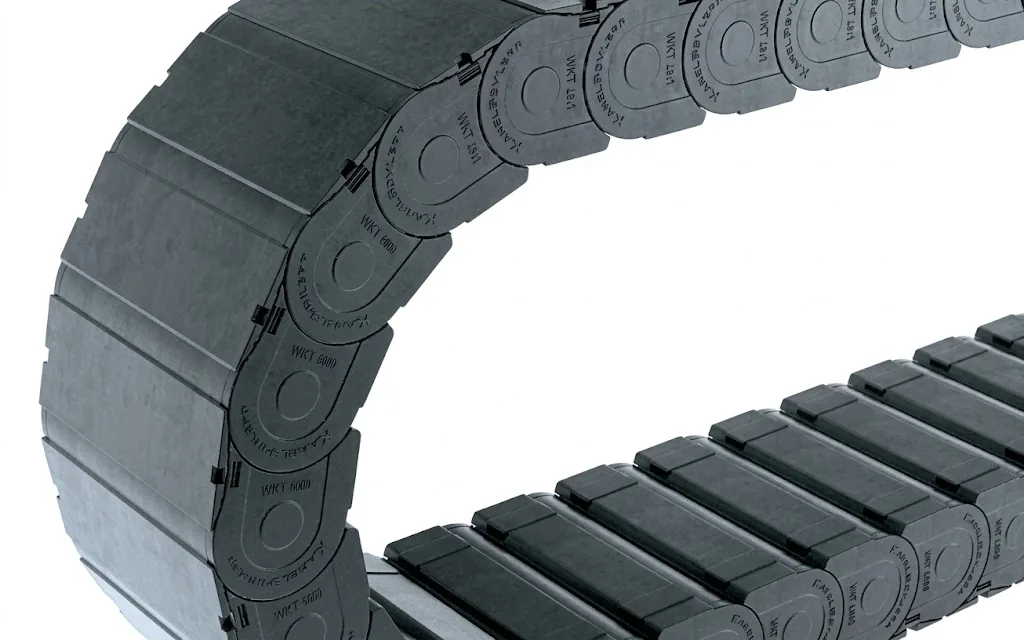
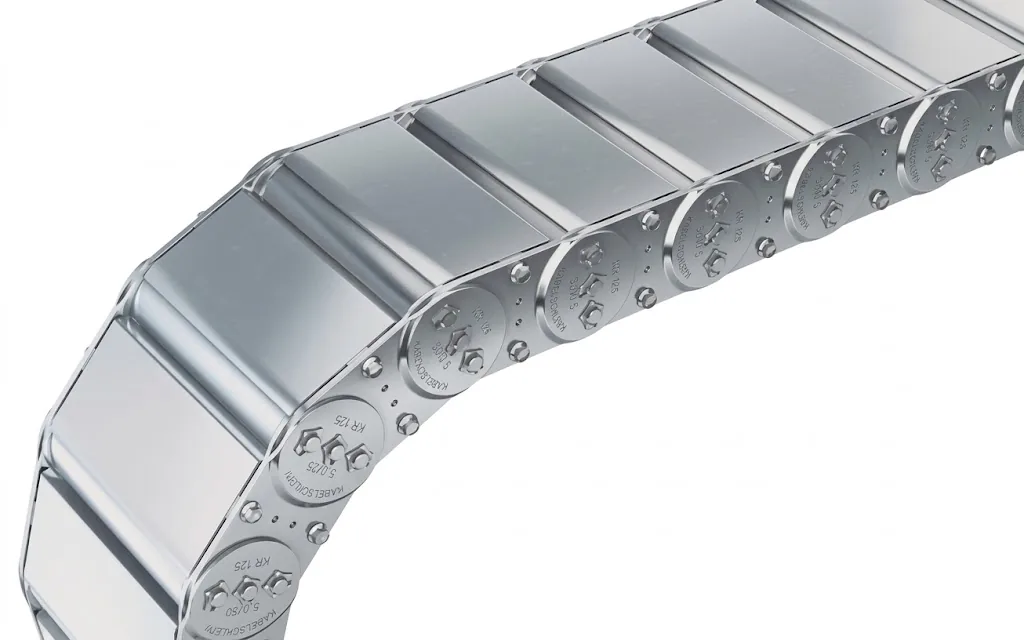
A closed cable carrier has a solid top and bottom. The cables lie fully shielded in a closed channel. In the Tsubaki Kabelschlepp range these designs are called enclosed cable carriers: in plastic these are the MT, TKA and UAT series, in steel the S/SX Tubes.
| Property | Open cable carrier | Closed cable carrier |
|---|---|---|
| Protection | Cables lie open | Shielded against swarf and dust |
| Weight | Lower | Higher |
| Inserting cables | Fast, often openable per link | Via opening lids, a little more work |
| Heat dissipation | Good | Less |
| Environment | Clean to lightly contaminated | Swarf, abrasive dust, wood dust, dirt |
When do you choose an open cable carrier?
An open carrier is the standard in clean machines and halls: handling, assembly, packaging and electronics. There you gain little from shielding and a lot from the advantages of an open design.
- Low weight: less mass to accelerate, which helps at high speeds and short cycles
- Good heat dissipation: power cables that get warm can lose their heat
- Quick access to the cables: check, add or replace cables without removing lids
- Wide range: most series are open, from compact to heavy
A lightly contaminated environment does not automatically call for a closed carrier. Series such as M and K in the open design are also intended for indoor contaminated environments. The TKK has a dirt-resistant link system in which less dirt and chips build up. You will find the full open range under plastic cable carriers.
When do you need a closed cable carrier?
As soon as something can fall into the carrier that does not belong there. These are the situations we see most often:
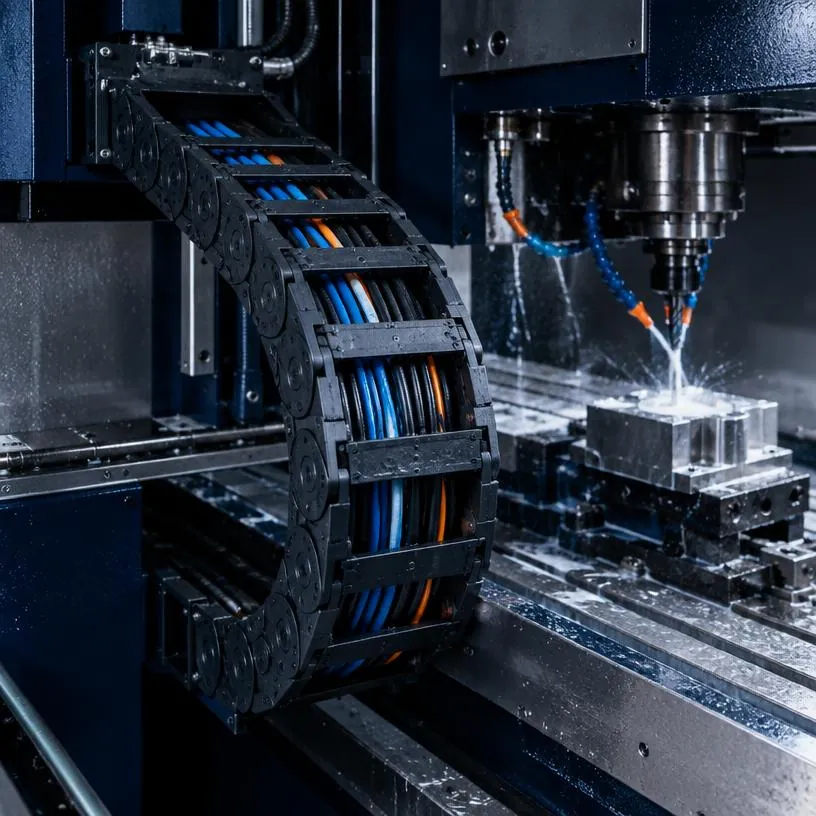
- Swarf: metal and woodworking, CNC machining centres, sawing and milling machines
- Dust and grit: sawmills, recycling, construction machinery and grinding processes
- Coolant with dirt: splash water that carries swarf and grinding dust into the carrier
- Hot particles: plastic has limited resistance to welding, cutting and hot swarf; choose steel or a closed design
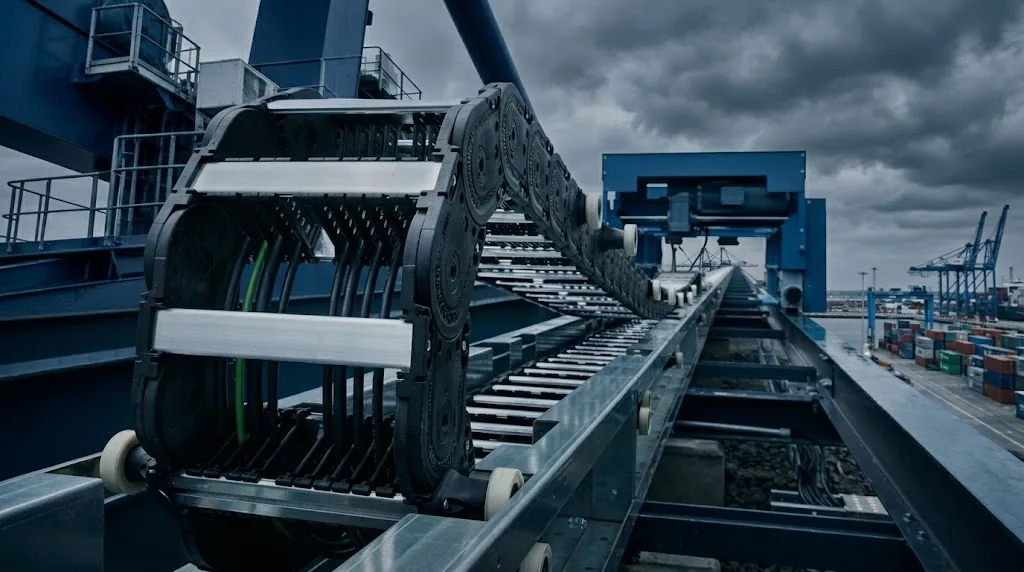
- Outdoors: weather, sand and dirt in mining, the steel industry, offshore and ports
If you work in woodworking or with machining equipment, start with a closed design. Only if you are sure nothing will end up in the carrier is open an option.
What happens when swarf gets into an open cable carrier?
Swarf that falls into an open carrier stays between the cables. In the bend it is clamped between cable and link, and with every stroke it cuts a little further into the jacket. Sometimes it takes months, but it ends in cable breakage.
You will recognise this in the troubleshooting guide: cables that keep failing while the carrier still looks fine from the outside. Hinges and sliding surfaces also wear faster when there is dirt between them. The article on recognising wear on your cable carrier tells you what to look for.
Do you already have an open carrier in a contaminated machine? Then run through the Carrier check. You will see straight away whether your carrier is fine, needs attention or needs action.
Troubleshooting guideCable break in the cable carrierCables that keep failing, intermittent signals or failing motors.Go to the solutionWhich closed cable carrier suits your application?
There are four series of enclosed cable carriers. They differ in material, dimensions and the environment they are made for.
| Series | Material | Inner height | Travel length | Environment |
|---|---|---|---|---|
| TKA | Plastic | 20,5–45,5 mm | up to 150 m | Swarf and dust in CNC, metal and woodworking |
| MT | Plastic | 26–68,5 mm | up to 270 m | Contaminated and swarf, many layout options |
| UAT | Plastic | 50 mm | up to 150 m | Heavy industry, outdoors, offshore |
| S/SX Tubes | Steel / stainless steel | 30–104 mm | up to 17.8 m | Swarf, heavy duty, marine |
The TKA is fully sealed, with a chip and dust-tight design, and can be opened on the inside and outside of the bend. The MT is the variable closed carrier: inner widths up to 800 mm, many layout options and also openable on both sides. The UAT is made for harsh conditions, with high impact and wear resistance and a weather-resistant construction.
If it gets heavy, hot or marine, you end up with the S/SX Tubes, a fully covered steel carrier. If you are unsure about the material, first read choosing steel or plastic.
How important is opening access on a closed carrier?
A closed carrier also has to be opened to lay in or replace cables. So check where it opens: on the inside or on the outside of the bend. That decides how easily you can reach the cables later once the carrier is installed.
With the TKA and the MT you choose per type between opening on the inside or the outside. For the UAT and the S/SX Tubes our data lists no openable version. Agree in advance how you will lay in the cables and replace them later.
An in-between option is an open carrier with a cover on the top only. It protects against whatever falls in from above, but does not close the carrier completely.
How to choose in four steps
- (01)Determine the environment: clean, contaminated, swarf or outdoors. If hot particles are involved, look at steel.
- (02)Choose open or closed: clean means open, swarf and dirt near the cables means closed.
- (03)Determine the inner dimensions: the thickest cable × 1.10 must stay below the inner height, and the bending radius is at least that diameter × 7.5.
- (04)Check travel length, speed and acceleration per type in the configurator.
An example. Your thickest cable is 18 mm. Its effective size is 18 × 1.10 = 19.8 mm, so you need an inner height of at least 19.8 mm. The minimum radius is 18 × 7.5 = 135 mm. A TKA38 with an inner height of 26 mm and a radius of 145 mm then fits.
If you do not know where to start yet, the cable carrier selection guide first asks three questions, starting with the environment. If you already know your cables, open the Cable carrier configurator with a closed design for a contaminated environment. Wisman checks your calculation free of charge.
Calculate it yourselfCable carrier configuratorCalculate, select and assemble a cable carrierOpen the cable carrier configuratorFrequently asked questions
Does a closed cable carrier last longer than an open one?
In a contaminated environment it often does, because dirt does not reach the cables and hinges. In a clean environment the difference is small and an open carrier is lighter and easier to maintain.
Is a closed cable carrier heavier?
Yes. The solid top and bottom add weight. At high speeds or with a long self-supporting length, that counts in the choice of type.
Can I add lids to an open cable carrier later?
For some series, yes. We will check which type you have and what is available for it.
Which closed cable carrier is suitable for swarf?
In our data the TKA and the MT are intended for contaminated environments with swarf, the TKA with a chip and dust-tight design. For heavy loads and marine environments there is the steel S/SX Tubes. The complete overview is in comparing open and closed.
Can I use an open cable carrier in a lightly contaminated hall?
Often you can. Open series such as M, K and TKK are also intended for indoor contaminated environments. If swarf or abrasive dust can reach the cables, choose closed.
Next step
Calculate it yourself or browse the range. We check your result free of charge.
Series on this topic
Question about this topic?
Ask Bas directly
Cable Carriers Specialist at Wisman Techniek