

Short answer
You protect a cable harness without disconnecting cables by using system sleeving that you lay around the bundle and zip shut. Choose BEKUM (soft PVC) for most machines and control cabinets and BENYL (coated polyester fabric) for an aggressive environment. If the bundle contains sensitive signal cables, take the shielded B2X or B4X. The size is the smallest nominal size that fits around the bundle.
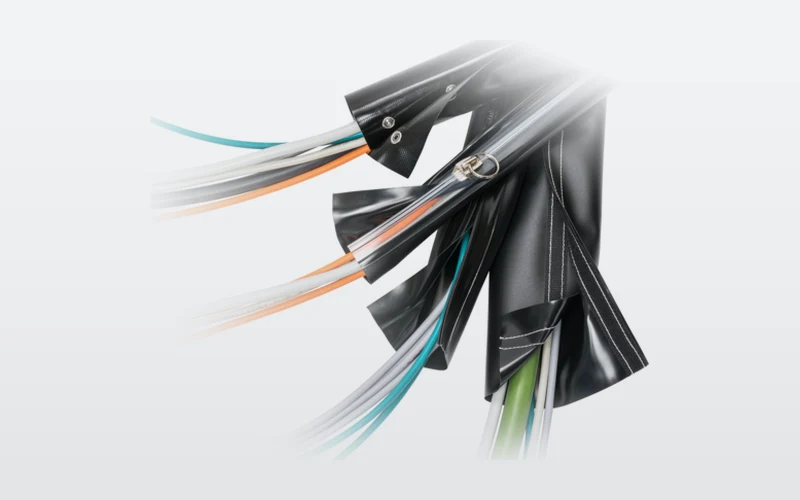
The simplest way to protect a cable harness is system sleeving: a flat sheath that you lay around the bundle and zip shut with a pair of pliers. The cables stay connected, connectors do not need to come off and the bundle then becomes one unit protected against chafing, oil and dirt. You choose three things: the sheath, the closure and the size. If you also want to protect the cable harness against interference, choose a version with copper shielding underneath.
Below you can read when sleeving is the right choice, how to choose the version and how to determine the size. All data comes from the Reiku catalogue, whose system sleeving Wisman supplies.
When should you protect a cable harness?
A cable harness in a machine, a control cabinet or a vehicle is rarely completely free. It runs along sheet metal edges, over a frame or through an opening, and there it chafes a little with every vibration. Over time the outer jacket of a cable fails at that point. The environment plays a role too: oil, coolant and cleaning agents attack a bare bundle faster than a bundle that is wrapped.
Sleeving does two things at once. It bundles the cables, so the cable harness becomes one neat strand that you can fasten in one go. And it protects the bundle mechanically. The catalogue lists applications in control cabinet building, controls, machines, equipment, rail vehicles and automotive.
Protecting a cable harness without disconnecting cables
The big advantage of system sleeving is that you fit it afterwards around an existing bundle. That is useful in three situations:
- the cables are already connected or have a connector at both ends;
- you want to add another cable to the bundle later;
- an existing cable harness is damaged in a few places and still needs to be protected.
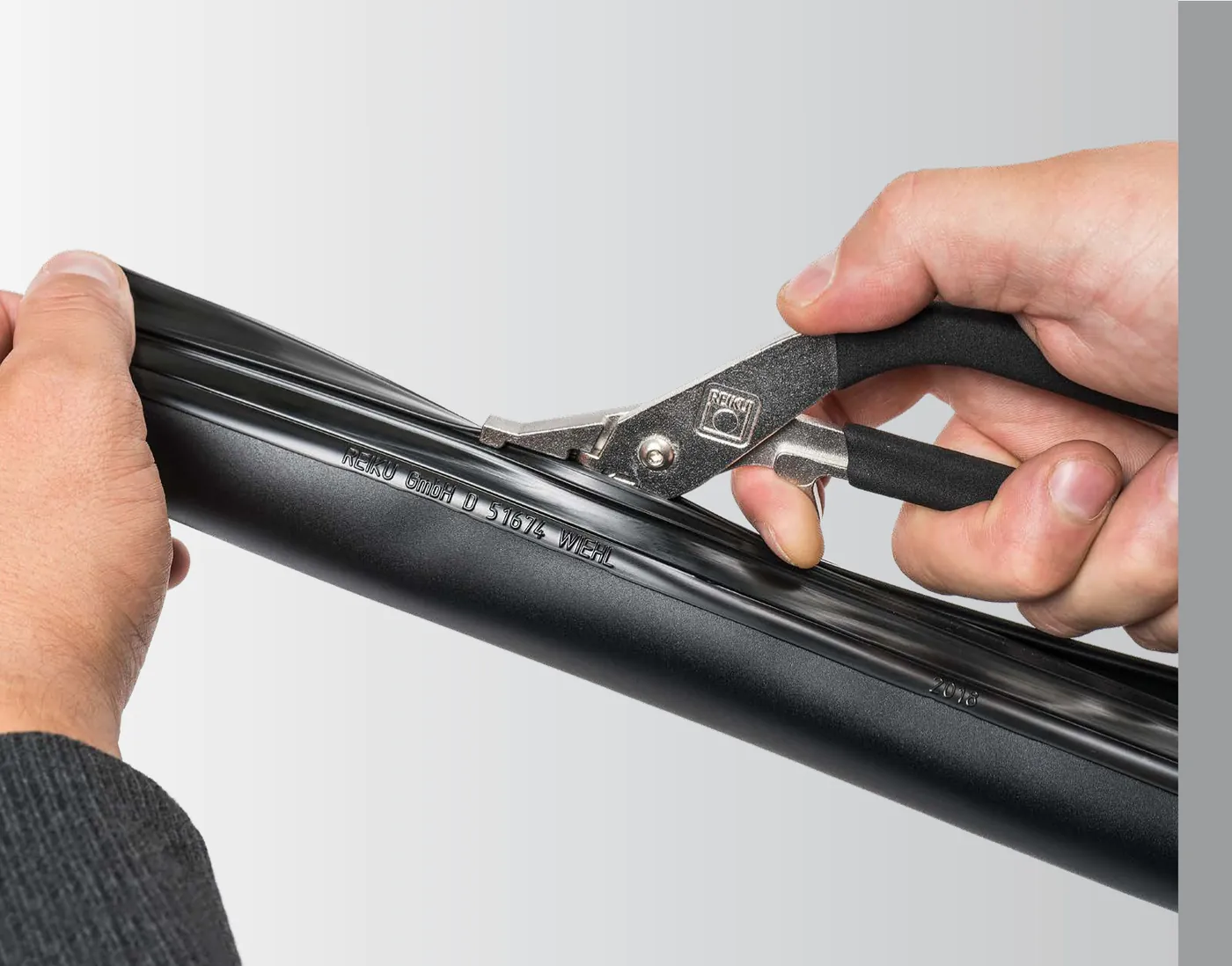
Fitting works like this: you lay the sheath around the bundle, with the overlap on the left and the arrow profile on top. You pull the U-profile open slightly, put the Z pliers on it and pull the pliers along the bundle. The sheath then closes like a zip over the full length. The steps with photos are on the system sleeving page.
Which sheath do you choose: BEKUM or BENYL?
You choose the sheath based on the environment. According to the catalogue, both are resistant to most acids, oils and alkalis.
| Sheath | Material | Wall | Temperature | Feature |
|---|---|---|---|---|
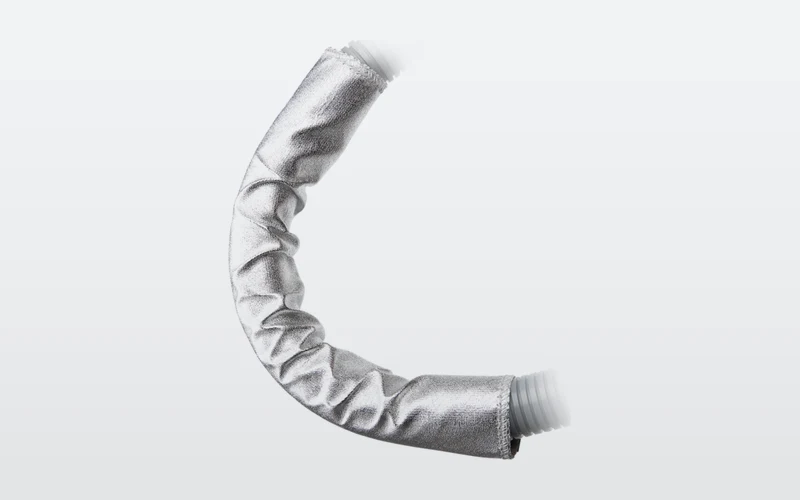
| BEKUM | Soft PVC | 0,5 mm | −30 to +80 °C | Very flexible, self-extinguishing, black or grey |
| BENYL | Polyester fabric, vinyl coated on both sides | 0,6 mm | −20 to +75 °C | Abrasion-resistant, flame-retardant, black |
BEKUM is the universal choice. It is flexible, so the bundle stays easy to route, and it suits most machines and control cabinets. Choose BENYL if the environment is tougher and abrasion resistance matters more than flexibility. Do watch the temperature: BENYL goes down to −20 °C on the cold side and up to +75 °C on the warm side, BEKUM to −30 and +80 °C.
If the bundle comes close to a heat source, sleeving is not enough. For radiant heat you need heat protection. Which material fits there is explained in heat protection for cables.
When do you choose shielded sleeving?
If the cable harness contains control or signal cables that are sensitive to high-frequency interference, you can shield the bundle as a whole. For that there are the B2X and B4X versions, with BEKUM or BENYL as the outer sheath:
- B2X has a tightly knitted two-layer braid of fine copper wire under the sheath.
- B4X has a four-layer braid.
Thanks to the inner overlap, the shielding covers more than 360° after closing. A tinned copper earth braid provides a low-resistance ground connection, to be connected by soldering or crimping. Just as with a shielded cable, the shielding only works if that connection to earth is good. How to approach that is explained in EMC shielding of cables.
The shielded series come in nominal sizes from 20 to 120 mm, the standard BEKUM and BENYL from 9 to 120 mm.
Z, M or G closure: which closure fits?
| Closure | Material | When | Close with | To be glued |
|---|---|---|---|---|
| Z | PVC | Standard, quick to close | Light Z pliers | Ja |
| M | PVC | Larger bundles or fitting on the floor | M slider or by hand | Ja |
| G | Polyamide | Hook-and-loop, for tight spaces or special applications | By hand | No |
If you do not specify a closure, Reiku supplies the Z closure. If you want the sleeving to stay closed, you bond the Z or M closure with RSQ adhesive. After about 12 hours of drying you can no longer open it. If you expect to add cables later, do not bond it. The hook-and-loop closure cannot be bonded, but it is easy to open again.
Which size of sleeving do you need?
Measure the bundle at its thickest point and choose the smallest nominal size that fits around the bundle. According to the catalogue, the sizes have a tolerance of ±10%. If your bundle is just under a size, take one size larger so the closure shuts without pulling.
The sleeving is supplied as flat strip material on disposable reels of 50 metres. On request it can be cut to length, slit or perforated.
Worked example: a cable harness of 43 mm
A cable harness of eight control and power cables runs 12 metres through a machine and chafes against the frame in two places. It contains no signal cables that need shielding, and the environment is oily but not aggressive. The bundle measures 43 mm at its thickest point.
- (01)Sheath. Oil is no problem for BEKUM and the temperature stays within −30 to +80 °C. It will be BEKUM.
- (02)Shielding. Not needed, so the standard BEKUM without copper braid.
- (03)Closure. The bundle is in a normal position, so the standard Z closure. A sensor cable may be added later, so do not bond it.
- (04)Size. The BEKUM sizes around this bundle are 40 and 45 mm. The smallest that fits around 43 mm is 45 mm.
- (05)Weight. BEKUM in NW 45 weighs 13.0 kg per 100 metres. For 12 metres that is about 1.6 kg.
The article number consists of the series code, the colour, the closure and the size. For BEKUM (SK), black (B), Z closure, NW 45 it is SKBZ-45. You can find all combinations in the sizes and article numbers table.
Can sleeving also go around moving cables?
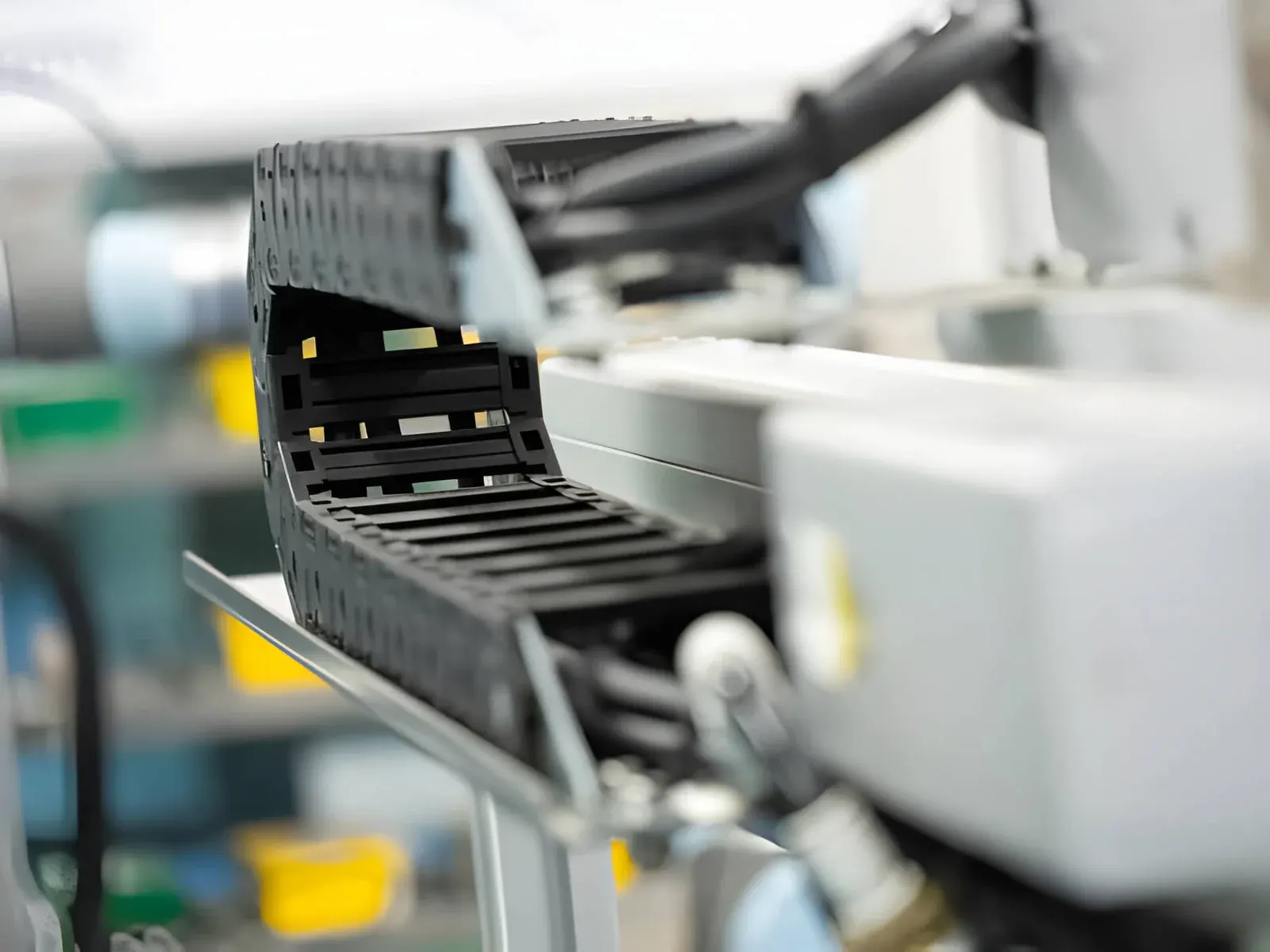
System sleeving is made to protect a bundle and hold it together. The catalogue does not state suitability for cables that bend with every movement, such as in a cable carrier or on a robot arm. There you need a different solution:
- Cables that travel back and forth go in a cable carrier. Each cable then gets its own place and a fixed bending radius.
- Cables on a robot run through a protective hose with holders. How to choose one is explained in choosing a cable protection hose.
Sleeving can be used on the fixed section before or after such a moving part, for example the bundle between the cable carrier and the control cabinet.
From cable harness to control cabinet
Where the cable harness enters the cabinet, the sleeving has to stop and a cable entry takes over. There the bundle becomes individual cables again, each passing through the cabinet wall sealed and with strain relief. Which cable entry suits cables with and without connectors is explained in cables into the cabinet. With the Cable entry planner you work out which frames or plates you need.
Calculate it yourselfCable entry plannerFrom cable list to cable entry with article numbersOpen the plannerFrequently asked questions
How do you protect a cable harness afterwards?
With system sleeving. You lay the sheath around the existing bundle and zip it shut with pliers. Cables and connectors stay in place.
What is the difference between BEKUM and BENYL?
BEKUM is soft, flexible PVC, self-extinguishing and usable from −30 to +80 °C. BENYL is polyester fabric vinyl-coated on both sides, abrasion-resistant and flame-retardant, for tougher environments, from −20 to +75 °C.
Can I shield a cable harness against interference?
Yes, with the shielded version B2X (two layers of copper braid) or B4X (four layers). A tinned earth braid provides the connection to earth.
Which size of sleeving do I need for my cable harness?
Measure the bundle at its thickest point and choose the smallest nominal size that fits around it. If you are just under a size, take one size larger.
Can I open the sleeving again later?
Yes, as long as you do not bond it. The Z and M closures can be permanently sealed with RSQ adhesive; the hook-and-loop closure (G) can always be opened. Unsure about the version? Send the dimensions of your bundle with a quotation request.
Next step
Calculate it yourself or browse the range. We check your result free of charge.

Question about this topic?
Ask Daan directly
Robotics Division at Wisman Techniek