

Short answer
Choose heat protection for cables based on the radiant heat at the cable's position. GLASO.A withstands radiant heat up to 350 °C, GLASIL.A up to 650 °C and KEVLAR® up to 800 °C. Around a bundle you fit a split sleeve, around an irregular shape you wrap a tape, and for a screen you use fabric. Choose the sleeve by the smallest nominal size that fits around the bundle.
You choose heat protection for cables by the radiant heat the cable receives at its position, not by the temperature of the source itself. Reiku supplies three materials: GLASO.A up to 350 °C, GLASIL.A up to 650 °C and KEVLAR® up to 800 °C radiant heat. Then you choose the form: a split sleeve around a bundle, a tape for wrapping or fabric for a screen. This keeps cables and hoses intact near furnaces, casting work or a welding robot, without wrapping them more heavily than needed.
Below you can read how to determine the temperature, which material and form suit your situation and how to find the right size.
Why does a cable need heat protection?
The jacket of a cable is made for a certain temperature range. If the cable comes close to a furnace, a casting line or a flow of hot workpieces, it has to cope with heat radiation outside that range. The jacket first becomes hard or soft, then starts to crack and eventually the conductor is exposed. With a cable that moves, such as in a cable carrier or a dress pack, this happens faster, because a weakened jacket tears further with every bend.
Heat protection works as a reflective layer around the cable. All three materials have an aluminium layer on the outside that reflects a large part of the heat radiation: up to 90 percent for GLASO.A and up to 95 percent for KEVLAR®. The cable itself therefore stays cooler.
How do you determine the temperature for heat protection?
The limits of the materials apply to radiant heat. That is the heat the source emits and that falls on the cable. Measure or estimate that heat at the position of the cable or hose. A furnace of 900 °C does not mean that the cable half a metre away also receives 900 °C.
If you do not know the temperature exactly, take the hottest point the cable passes, even if that is only a short part of the travel length. If your value is close to the limit of a material, choose the heavier material. The Heat guide does this automatically: above 90 percent of the limit it also shows the material with more margin.
GLASO.A, GLASIL.A or KEVLAR®: which material fits?
Choose the lightest material that can handle your temperature and your requirements. A heavier material than needed adds little.
| Material | Radiant heat up to | Basic | Features |
|---|---|---|---|
| GLASO.A | 350 °C | Glass fabric, outside aluminium coated | Reflects up to 90%, resistant to oil and fuel, inner side does not absorb water |
| GLASIL.A | 650 °C | Silica fabric, aluminium coated on one side | Asbestos-free, resistant to oil and acids |
| KEVLAR® | 800 °C | Para-aramid fabric with aluminium foil | Reflects up to 95%, high cut resistance, coated side has good UV resistance |
Besides the temperature, three requirements can determine the choice:
- Acids in the environment: GLASIL.A and KEVLAR® are resistant to acids. For GLASO.A the catalogue does not state this.
- Sharp edges or workpieces: KEVLAR® has high cut resistance.
- Sun and outdoor air: with KEVLAR®, the coated side has good UV resistance.
The catalogue lists applications in steelworks, smelters, glassworks, the automotive industry, the plastics processing industry and at hardening furnaces, among others. If you work in one of those sectors, also have a look at steel and heavy industry or glass and ceramics.
ProductHeat protectionReiku heat protection: GLASO (up to +350 °C), GLASIL (up to +650 °C) and KEVLAR® (up to +800 °C). Protective sleeves for cables and hoses in hot environments.View the productSleeve, tape or fabric: which form of heat protection do you choose?
Each material comes in three forms. You choose the form by what you want to protect.
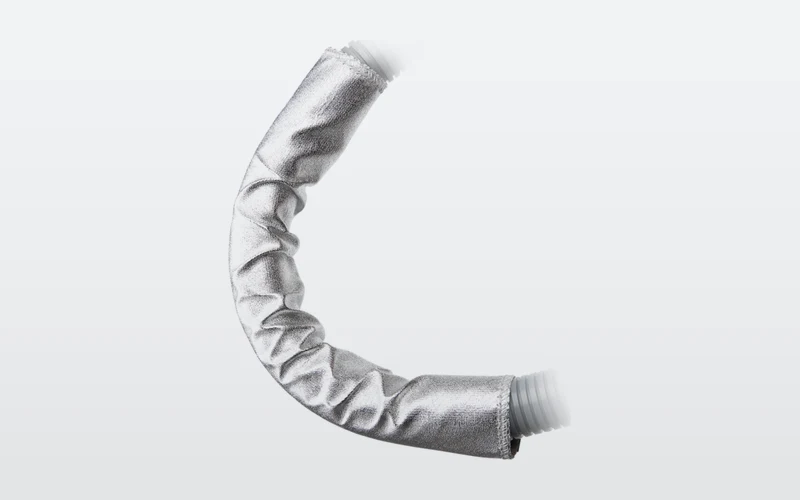
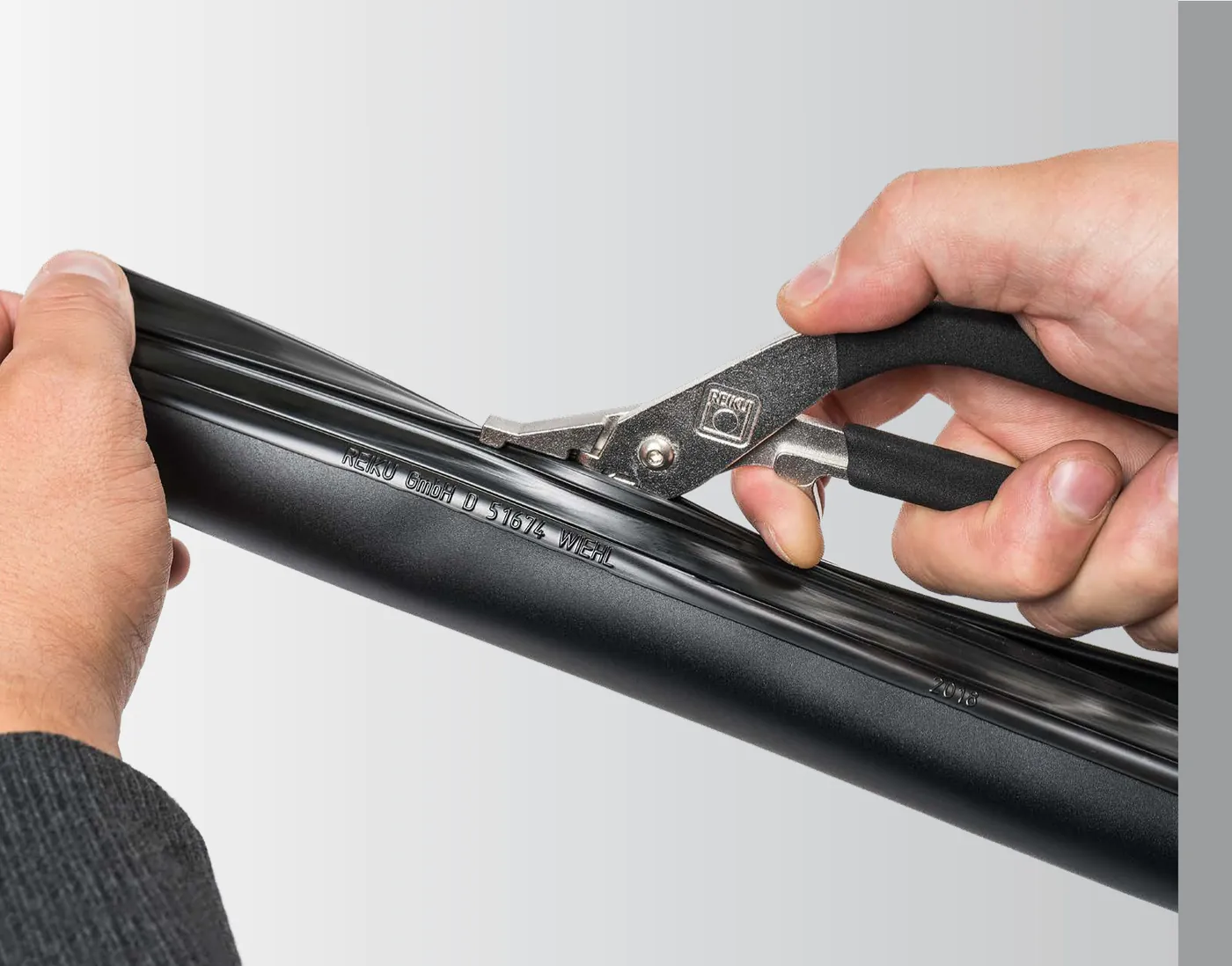
Sleeve. You fit a split heat protection sleeve around a round bundle of cables or hoses and close it along its length. You do not need to disconnect the cables, so it also fits retrospectively around an existing installation. The sleeves close with hook and loop; with GLASO.A and KEVLAR® press studs are also possible. The nominal sizes range from 12 to 300 mm for GLASO.A and from 12 to 280 mm for GLASIL.A and KEVLAR®.
Tape. You wrap a tape from the roll around a bundle or around a part with an irregular shape, such as a transition or a connection. You cut it to size. The tapes are available from 25 to 300 mm wide.
Fabric. You use sheet material on a roll for heat shields, heat curtains and custom dimensions, for example a screen between the heat source and a cable carrier. GLASO.A and GLASIL.A can be cut with ordinary scissors; for KEVLAR® special scissors are recommended.
Other widths, lengths and nominal sizes are available on request.
Worked example: heat protection for a 37 mm bundle
A bundle of three cables and an air hose runs past a furnace. At the position of the bundle you estimate the radiant heat at 330 °C. The bundle measures 37 mm at its thickest point.
- (01)Material. GLASO.A goes up to 350 °C and is therefore enough. But 330 °C is above 90 percent of that limit (315 °C). That is why GLASIL.A, up to 650 °C, comes into view as an alternative with more margin.
- (02)Form. It is a round bundle, so a split sleeve.
- (03)Size. The smallest nominal size that fits around 37 mm is 40 mm. In GLASO.A that is the GA08 S 040 with a wall thickness of 0.8 mm or the GA12 S 040 with 1.2 mm. If you choose GLASIL.A, it is the GI10 S 040 (1.0 mm) or the GI18 S 040 (1.3 mm).
If a bundle only just fits a size, take one size larger. With a 39 mm bundle in a 40 mm sleeve it is very tight. The Heat guide gives that warning itself.
Calculate it yourselfHeat guideThe right heat protection for cables and hosesOpen the heat finderHeat protection in a cable carrier or a dress pack
With moving cables it is about more than just the jacket. Two situations are common.
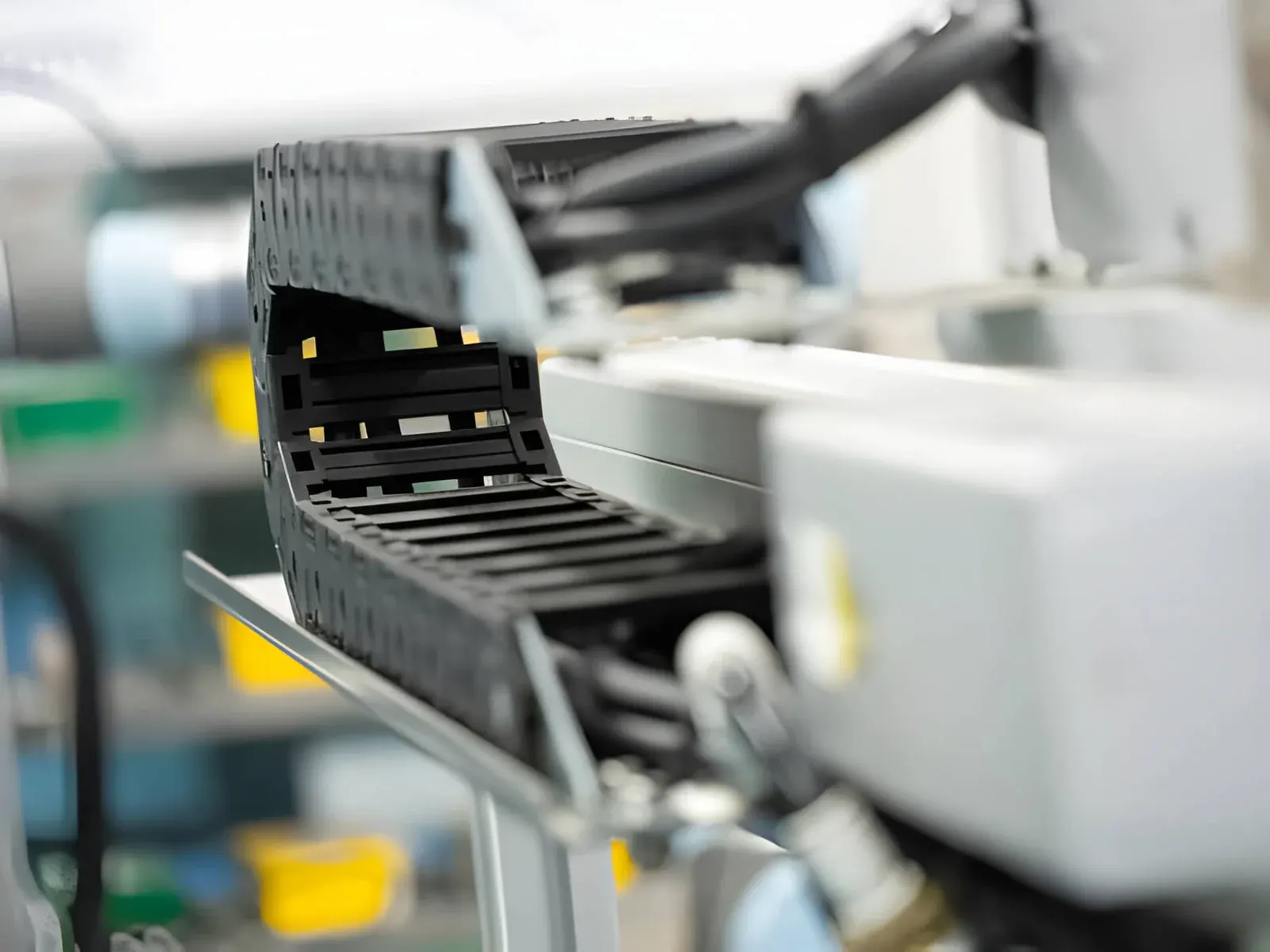
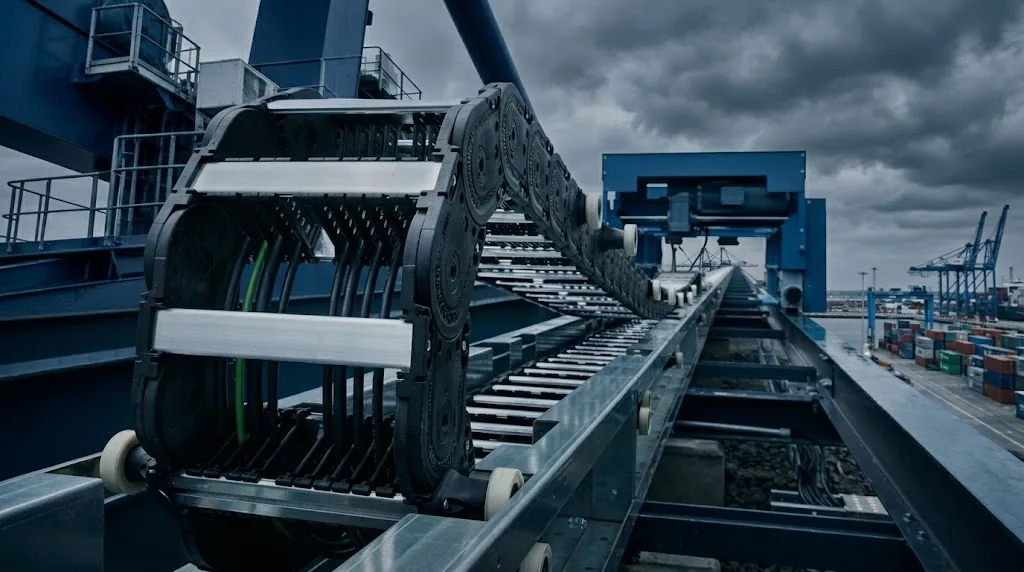
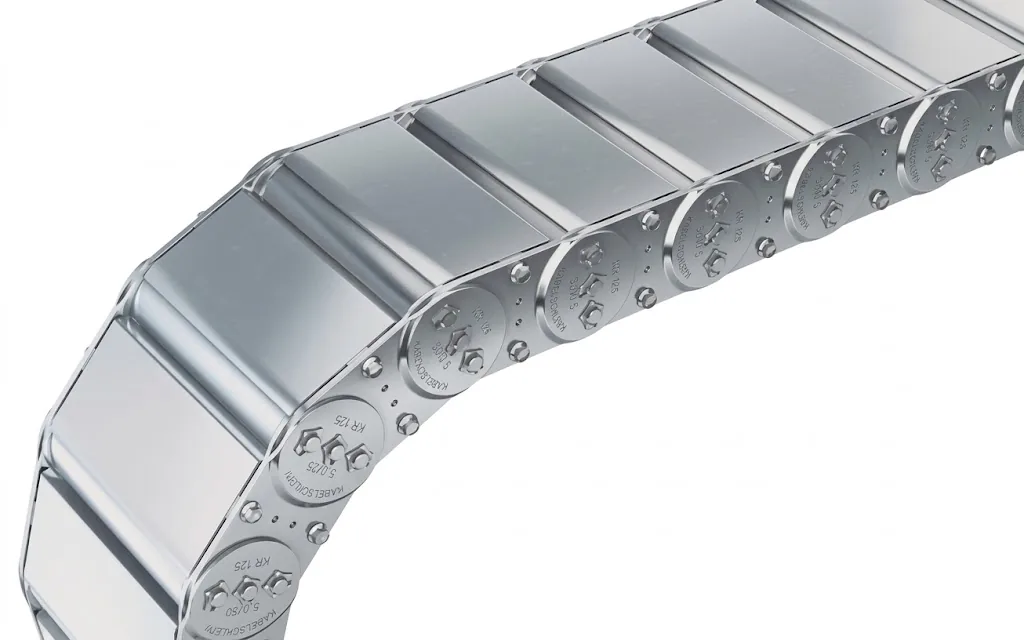
A cable carrier close to a heat source. A plastic cable carrier has limited resistance to heat and hot chips. At high temperatures you are more likely to choose a steel cable carrier, possibly as an enclosed cable carrier such as the S/SX Tubes. If it is about radiant heat, combine the carrier with a screen of heat protection fabric. You can read the trade-off in steel or plastic cable carrier. In the cable carrier configurator you choose the environment and see which series fit.
A robot near a furnace or in a foundry. On a robot's hose package, the heat protection goes on the section closest to the heat. You do not need to wrap the whole package. In the Dress pack configurator you switch on heat protection when building up your dress pack.
Cables that are fixed and only need to be bundled and protected can also be housed in system sleeving. It is intended for bundling and mechanical protection. If heat is also involved, heat protection is added.
Which cable do you choose under the heat protection?
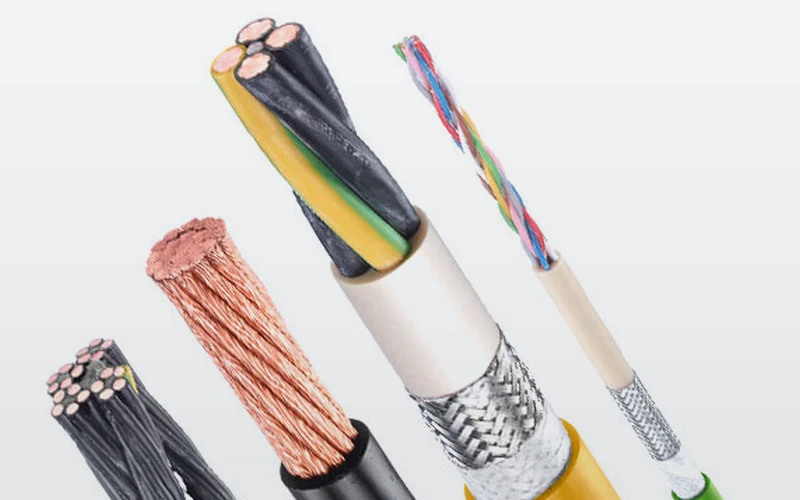
Heat protection reduces the heat that falls on the cable, but the cable itself still has to suit the application. A cable in a cable carrier or on a robot arm must be suitable for movement. Which jacket suits oil, cold or outdoor use is explained in PUR or PVC cable. Flexible cables by type can be found in the flexible cables range.
Frequently asked questions
Up to what temperature does heat protection protect cables?
GLASO.A withstands radiant heat up to 350 °C, GLASIL.A up to 650 °C and KEVLAR® up to 800 °C. These limits apply to radiant heat at the position of the cable.
Does heat protection also protect against welding spatter?
The catalogue rates the materials on radiant heat. For welding spatter, sparks and contact with hot parts it gives no limit. We assess those situations personally based on your process.
Can I fit heat protection around existing cables?
Yes. The heat protection sleeves are split and close with hook and loop, with GLASO.A and KEVLAR® also with press studs. You wrap a tape around the bundle. You do not need to disconnect any cables.
Which size of heat protection sleeve do I need?
Measure the bundle at its thickest point and choose the smallest nominal size that fits around it. If the bundle only just fits, take one size larger.
What do I choose if the temperature is unknown?
Measure or estimate the radiant heat at the hottest point the cable passes. If that is not possible, ask us to take a look via a quote request. We assess the situation free of charge.
Next step
Calculate it yourself or browse the range. We check your result free of charge.
Series on this topic
Question about this topic?
Ask Daan directly
Robotics Division at Wisman Techniek