


Short answer
The cable length is the length of the cable carrier plus the route from the fixed point to the cabinet, plus the route from the driver to the connection, plus a short reserve at both ends for terminating. Inside the carrier itself, the cable is roughly as long as the carrier. Calculate each cable separately and round up.
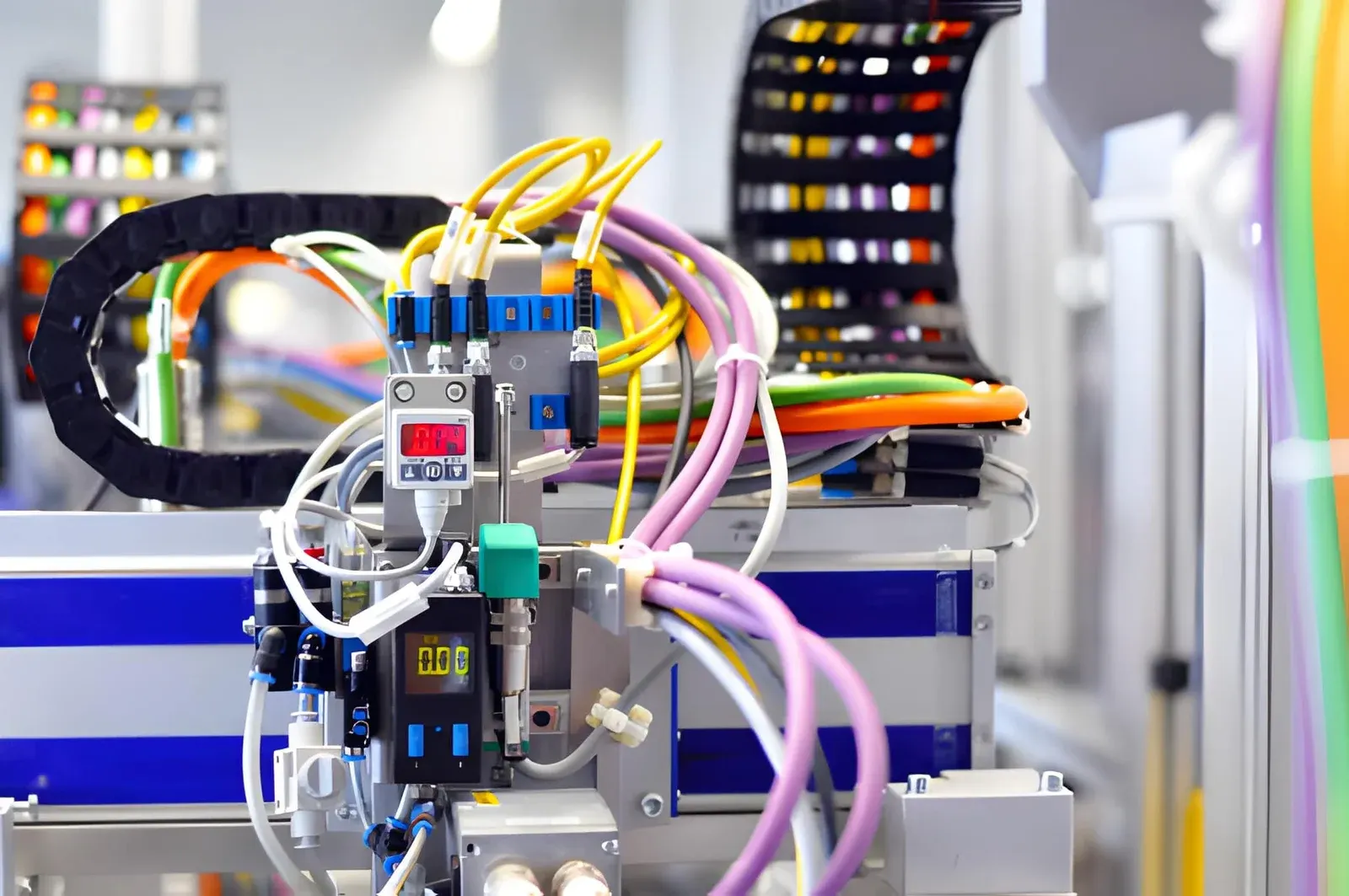
You calculate the cable length in a cable carrier in three parts: the section inside the carrier, the fixed route from the fixed point to the cabinet, and the route from the driver to the motor, sensor or valve block. Add a short reserve at both ends so the cable can be terminated properly. The section inside the carrier is roughly as long as the carrier itself. Anyone who estimates the cable length from the travel length alone almost always orders too short or far too long.
A cable that is too short means a new cable, because a joint in the moving section is not an option. A cable that is far too long costs money and causes trouble at the connection. In this article we work through an example and show where most mistakes are made.
What makes up the cable length in a cable carrier?
A cable in a cable carrier runs from the cabinet to the moving part of the machine, in one piece. Along the way it passes four zones:
- (01)The fixed route: from the cabinet or terminal box to the fixed point of the carrier. This section does not move.
- (02)The carrier: from the strain relief at the fixed point to the strain relief at the driver.
- (03)The moving route: from the driver to the connection on the slide, the head or the crane.
- (04)The reserve: a piece at both ends for stripping, connecting and, if needed, terminating again later.
So the formula is:
Cable length = fixed route + carrier length + moving route + reserve
Each cable has its own fixed and moving route. The motor cable goes to the motor, the encoder cable to the encoder and the control cables perhaps to a valve block further along. So calculate per cable, not one length for the whole package.
How long is a cable inside the cable carrier itself?
Inside the carrier, the cable is roughly as long as the carrier. It runs from strain relief to strain relief and follows the line of the links in the bend. If the cable lies properly in the middle of the inner height, it is neither stretched nor compressed in the bend.
The carrier length itself depends on the travel length (S), the bending radius (KR), the pitch (p) and the position of the fixed point. These are the same calculation rules as in the Cable carrier configurator:
- Fixed point in the middle: L = S/2 + π × KR + 2 × p
- Fixed point at the end: L = S + π × KR + 2 × p
Then round up to whole links. How you arrive at that length is explained step by step in calculating a cable carrier.
Calculate it yourselfCalculate cable carrier lengthLength and number of links from travel length and radiusCalculate itWorked example: the cable length for a 3 metre gantry
We use the same example as in the article on calculating a cable carrier: a travel length of 3000 mm, a UNIFLEX Advanced 1455 with a pitch of 45.5 mm, a radius of 150 mm and the fixed point in the middle. That gives a carrier of 46 links, 2093 mm.
The carrier holds a motor cable, four control cables and a data cable. The cabinet is 1.5 metres from the fixed point. On the slide, the motor cable runs another 0.6 metres to the motor, the control cables 1.0 metre to a valve block and the data cable 0.8 metres to a sensor. As reserve, in this example we allow 0.3 metres per end.
| Cable | Fixed route | Carrier | Moving route | Reserve | Length per cable |
|---|---|---|---|---|---|
| Motor cable | 1,5 m | 2,09 m | 0,6 m | 0,6 m | 4,8 m |
| Control cable (4×) | 1,5 m | 2,09 m | 1,0 m | 0,6 m | 5,2 m |
| Data cable | 1,5 m | 2,09 m | 0,8 m | 0,6 m | 5,0 m |
Rounded up to a tenth of a metre, you therefore order 4.8 metres of motor cable, 4 × 5.2 = 20.8 metres of control cable and 5.0 metres of data cable. 30.6 metres in total. If you calculated only with the 3 metre travel length, you would be about 2 metres short per cable.
What does the position of the fixed point do to the cable length?
With the fixed point at the end of the travel length, the same carrier becomes 79 links, 3594.5 mm. That is 1.5 metres longer. If the cabinet is still 1.5 metres from the fixed point, every cable also becomes 1.5 metres longer. For the six cables in the example, that is more than 9 metres of extra cable.
Do pay attention to where the cabinet is. If the cabinet is at the start of the travel length and you put the fixed point in the middle, the fixed route actually becomes half a travel length longer. The carrier gets shorter, but the cable does not. A fixed point in the middle then saves carrier length and moving weight, but hardly any cable. So always measure the actual route from the cabinet to the fixed point, along the cable tray and not in a straight line.
Which mistakes do you see most often when determining the cable length?
- Calculating with the travel length instead of the carrier length. With the fixed point in the middle, the carrier is shorter than the travel length; with the fixed point at the end it is longer. In the example, that is almost 0.6 metres due to the bend and the two extra links.
- Measuring the route in a straight line. Cables run along trays, around corners and through cable entries. Measure the route the way the cable will actually follow it.
- One length for all cables. Cables that go to different places on the slide can easily differ by half a metre.
- Taking up excess length in the carrier. You do not lay a cable that is too long as a loop in the carrier. That loop chafes, twists and breaks. Remove excess length at the connection end, as we also explain in shortening or extending a cable carrier.
- Fitting the cable taut between the strain reliefs. Put the carrier in its middle position and let the cable lie relaxed before you fix the strain relief at both ends.
- A joint inside the carrier. A connection in the moving section bends with every stroke. A cable in a cable carrier should be one piece from fixed point to driver.
How do you order cables for a cable carrier cut to length?
Make a cable list with, per cable, the type, the cores and cross-section, the outer diameter and the calculated length. You also need the diameter for the inner dimensions of the carrier and the bending radius, so you use that list twice. If you still need a cable suitable for moving applications, the Cable finder lets you find TRAXLINE cables by type, cores, travel length and number of movements.
Calculate it yourselfCable finderThe right flexible cable for your cable carrierOpen the cable finderFor flexible cables with copper, the length also counts in the price because of the copper surcharge, which is charged per metre. Ordering a few metres too many for the whole package then adds up. How that surcharge works is explained in copper surcharge on cables.
If you would rather not cut the cables to length and lay them in yourself, Wisman can supply the carrier complete: carrier to length, cables inside and the strain relief at both ends. Then provide the fixed and moving route per cable, or send a drawing. In the configurator, you choose at the result whether the cables should be included and whether we lay them in.

Rather have it checked?
Enter your cables and travel length in the Cable carrier configurator. You get the carrier length in whole links and can add the cables from the range straight away. Add the fixed and moving route per cable and you have your order list. In doubt? Send your list with a quote request. A specialist will check the lengths free of charge.
Frequently asked questions
How do you calculate the cable length in a cable carrier?
Add up the length of the carrier, the route from the fixed point to the cabinet, the route from the driver to the connection and a short reserve at both ends. Do this per cable and round up.
Is the cable in the carrier longer than the carrier itself?
No, roughly the same length. The cable runs from strain relief to strain relief and follows the line of the links in the bend. Lay it in relaxed, with the carrier in its middle position.
Can I lay a cable that is too long as a loop in the cable carrier?
No. A loop chafes, twists and can break. Remove the excess length at the connection end.
Does a fixed point in the middle always save cable length?
Not always. The carrier gets shorter, but if the cabinet is at the start of the travel length, the fixed route gets longer by the same amount. So measure the actual route from the cabinet to the fixed point.
Can Wisman supply the cables cut to length in the cable carrier?
Yes. We supply the carrier to length with the cables inside and the strain relief at both ends. Give us the fixed and moving route per cable and we will check the lengths.
Calculate it yourself
Which cable carrier fits your machine?
Enter two dimensions. The configurator opens with these values and shows the matching series right away. We check your result free of charge.
Not sure? Leave it blank and fill it in in the configurator.
Next step
Calculate it yourself or browse the range. We check your result free of charge.

Series on this topic
Question about this topic?
Ask Bas directly
Cable Carriers Specialist at Wisman Techniek