

Short answer
You read a cable code such as 4G1.5 from left to right. The first number is the number of cores, the letter tells you whether there is a green-yellow protective earth conductor, and the last number is the cross-section per core in mm². So 4G1.5 means four cores of 1.5 mm², one of which is green-yellow. 4x1.5 means four cores without a green-yellow core. Brackets around the code, such as (7G1), indicate a shielded cable.
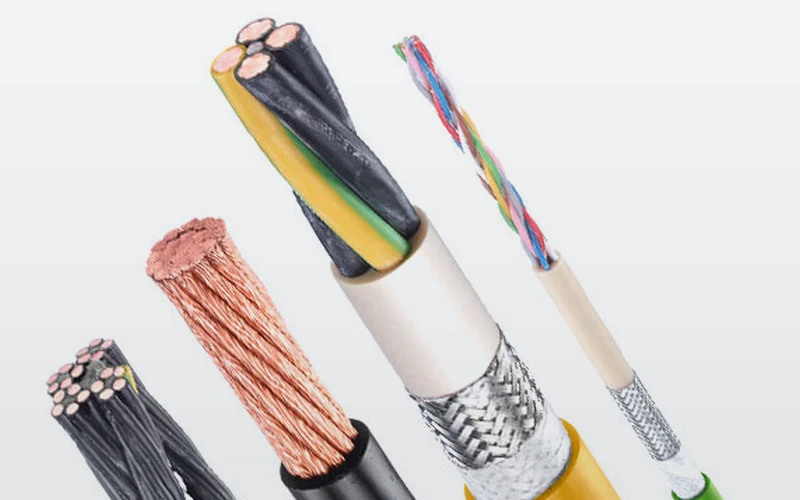
Reading a cable code is easier than it looks. A designation such as 4G1.5 contains three things: the number of cores (4), whether there is a green-yellow protective earth conductor (G) and the cross-section per core in mm² (1.5). If there is an x instead of a G, as in 4x1.5, the cable has no green-yellow core. With those three details you know which cable you are looking for. For the cable carrier you then need one more dimension that is not in the code: the outer diameter.
Below you can read how to break down the code, what brackets and pairs mean, what the name of the cable itself tells you and why two cables with the same code are not always the same thickness.
How do you read a cable code such as 4G1.5?
The code consists of three parts, always in the same order:
| Part | Example | Meaning |
|---|---|---|
| First number | 4G1.5 | Number of cores in the cable |
| Letter | 4G1.5 | G = with green-yellow protective earth conductor, x = without |
| Last number | 4G1.5 | Cross-section per core in mm² |
A few examples from the TRAXLINE cables we supply:
- 4G1.5: four cores of 1.5 mm², one of which is the green-yellow earth. A common power cable for a motor.
- 7G1: seven cores of 1 mm², one of which is green-yellow. A typical control cable.
- 2x1.5: two cores of 1.5 mm², without a green-yellow core.
- 1x1.5: one core of 1.5 mm². You mainly see single-core cables like this with large cross-sections.
In price lists and datasheets, the decimal comma often becomes a point and a ² is sometimes added: 4G1.5² and 4G1,5 mm² are the same cable.
What is the difference between 4G1.5 and 4x1.5?
The number of cores and the cross-section are the same; the difference is the earth. In 4G1.5, one of the four cores is green-yellow and intended as the protective earth conductor. That leaves three cores for phases or signals. In 4x1.5, all four cores are ordinary cores without green-yellow colouring.
So for a motor with three phases and earth you choose a 4G cable. If you also need a neutral, it is a 5G cable. If you are unsure what your installation requires, let the electrical engineer who draws up the schematic decide. They also choose the cross-section, based on current, length and voltage drop.
What do brackets and a code such as 3x2x0.25 mean?
With shielded cables, the cores are often shown in brackets, such as (4G1.5) or (7G1). The brackets indicate that the shielding surrounds everything inside them. What shielding does and when you need it is explained in shielded cable in the cable carrier.
Data cables have codes with two x's. 3x2x0.25 means three pairs of two cores of 0.25 mm², so six cores in total. Pairs are used to transmit signals without interference. An example is the DATA 700 TPi C in (3x2x0.25), with an outer diameter of 8.6 mm.
With bus cables such as USB you sometimes come across AWG instead of mm². AWG is the American gauge for wire thickness: the higher the number, the thinner the core. For such cables you usually choose not by the code but by the bus system the machine uses.
What does the name of the cable tell you besides the code?
The code tells you how much copper is in the cable. The name tells you what the cable is made for. With TRAXLINE cables, it tells you three things.
The type. CONTROL is a control cable, POWER a power cable, DATA a data cable. POWER ONE is a single-core power cable.
The class. The number 200, 400, 700 or 1000 indicates how heavily the cable may move. Class 200 is for short strokes and simple bending applications, class 1000 for the highest number of cycles and the longest travel lengths. The jacket follows from this: PVC for 200 and 400, PUR for 700, TPE for 1000. Why the jacket matters is explained in PUR or PVC cable in the cable carrier.
The shielding. A C in the name means shielded, CD double shielded. So the POWER 700 1kV is unshielded, the POWER 700 C 1kV shielded. A value such as 600V or 1kV in the name is the voltage the cable is intended for.
So a full designation such as POWER 700 C 1kV (4G1.5) means: shielded power cable, class 700 with PUR jacket, for 1 kV, with four cores of 1.5 mm², one of which is green-yellow.
Why are cables with the same code not the same thickness?
Because the code only says something about the cores, not about the layers around them. Insulation, construction, jacket and shielding together determine the outer diameter. Two examples from the data:
| Cable | Code | Outer diameter | Copper weight |
|---|---|---|---|
| POWER 700 1kV | 4G1,5 | 8,4 mm | 0,058 kg/m |
| POWER 700 C 1kV | (4G1,5) | 10,5 mm | 0,089 kg/m |
| CONTROL 700 600V | 7G1 | 9,5 mm | 0,070 kg/m |
| CONTROL 700 C 600V | (7G1) | 11,6 mm | 0,106 kg/m |
The same cores, but the shielded version is more than 2 mm thicker. The shielding also contains copper, so the copper weight is higher. You see this reflected in the copper surcharge, which is explained in copper surcharge on cables: how to calculate it.
For the cable carrier, it is precisely the outer diameter that counts. So never assume that a cable with the same code from another manufacturer or series is the same thickness. Check the datasheet or the series page, for example for the POWER 700 C 1kV.

From cable code to cable carrier: which dimensions do you need?
The code helps you find the cable; the outer diameter helps you choose the cable carrier. We work with two rules of thumb:
- (01)Inner height: at least the outer diameter × 1.1. This gives the cable 10% clearance so it can move freely.
- (02)Bending radius: at least the largest cable diameter × 7.5, or the minimum bending radius from the datasheet if that is larger.
A worked example with the POWER 700 C 1kV (4G1.5) of 10.5 mm. The inner height must be at least 10.5 × 1.1 = 11.6 mm. The bending radius at least 10.5 × 7.5 = 79 mm, rounded up. If you choose the unshielded POWER 700 1kV 4G1.5 of 8.4 mm, that becomes 9.3 mm inner height and a 63 mm radius. The same number of cores, but a different cable carrier.
If you have more cables, the thickest cable determines the radius and you add up the width per cable. How to do that is explained in which cables in a cable carrier. The calculation tool calculate bending radius works out the radius for you.
How do you quickly find the right cable for a code?
If you already know the code, use the Cable finder. You choose the number of cores and the cross-section, whether shielding is needed, and how far and how often the cable moves. The Cable finder puts the lightest class that is sufficient at the top, with outer diameter and article number.
Calculate it yourselfCable finderThe right flexible cable for your cable carrierOpen the cable finderIf the cables go into a cable carrier, you can select them straight from the range in the cable carrier configurator. The configurator takes the outer diameter into account in the layout and chooses a cable carrier that fits. You can order the cables complete with it.
Calculate it yourselfCable carrier configuratorCalculate, select and assemble a cable carrierOpen the cable carrier configuratorFrequently asked questions
What does the G in 4G1.5 mean?
The G means that the cable contains a green-yellow protective earth conductor. 4G1.5 is a cable with four cores of 1.5 mm², one of which is green-yellow.
Is 4x1.5 the same as 4G1.5?
No. Both have four cores of 1.5 mm², but 4x1.5 has no green-yellow core. Always state in an order whether the protective earth conductor is required.
What does a cable code in brackets mean?
You see brackets with shielded cables, such as (7G1). The shielding surrounds the cores shown inside the brackets.
How thick is a 4G1.5 cable?
That depends on the series. For TRAXLINE cables, an unshielded POWER 700 1kV 4G1.5 is 8.4 mm and the shielded POWER 700 C 1kV (4G1.5) is 10.5 mm. The outer diameter per variant is shown on the series page.
Which size of cable carrier do I need for a 4G1.5 cable?
Calculate with the outer diameter of the cable: inner height at least diameter × 1.1 and bending radius at least diameter × 7.5. At 8.4 mm, that is 9.3 mm inner height and a 63 mm radius. With more cables, the configurator works out the whole layout for you.
Calculate it yourself
Which cable carrier fits your machine?
Enter two dimensions. The configurator opens with these values and shows the matching series right away. We check your result free of charge.
Not sure? Leave it blank and fill it in in the configurator.
Next step
Calculate it yourself or browse the range. We check your result free of charge.
Series on this topic
Question about this topic?
Ask Bas directly
Cable Carriers Specialist at Wisman Techniek