

Short answer
Place the fixed point of a cable carrier in the middle of the travel length whenever you can. The carrier is then at its shortest, because the loop only has to cover half the travel length, and the self-supporting range of the type is at its largest. With the fixed point at the end, the carrier becomes roughly half a travel length longer and the self-supporting range is halved. If the middle is not possible, the length is calculated from the longest section measured from the fixed point.

The fixed point of a cable carrier is ideally placed in the middle of the travel length. This is where the carrier is fixed to the machine and where the cables enter the movement. In the middle, the cable carrier is at its shortest and can bridge the greatest distance self-supporting. With the fixed point at the end or somewhere in between, the carrier gets longer and it also changes whether it can still support itself. Below you can read how to choose the position and what it does to the length, with a worked example.
What is the fixed point of a cable carrier?
A cable carrier has two ends. The fixed point sits on a part of the machine that does not move. This is where the cables from the cabinet or cable tray enter the carrier. The driver sits on the moving part, such as the slide, the trolley or the gantry, and pulls the carrier along.
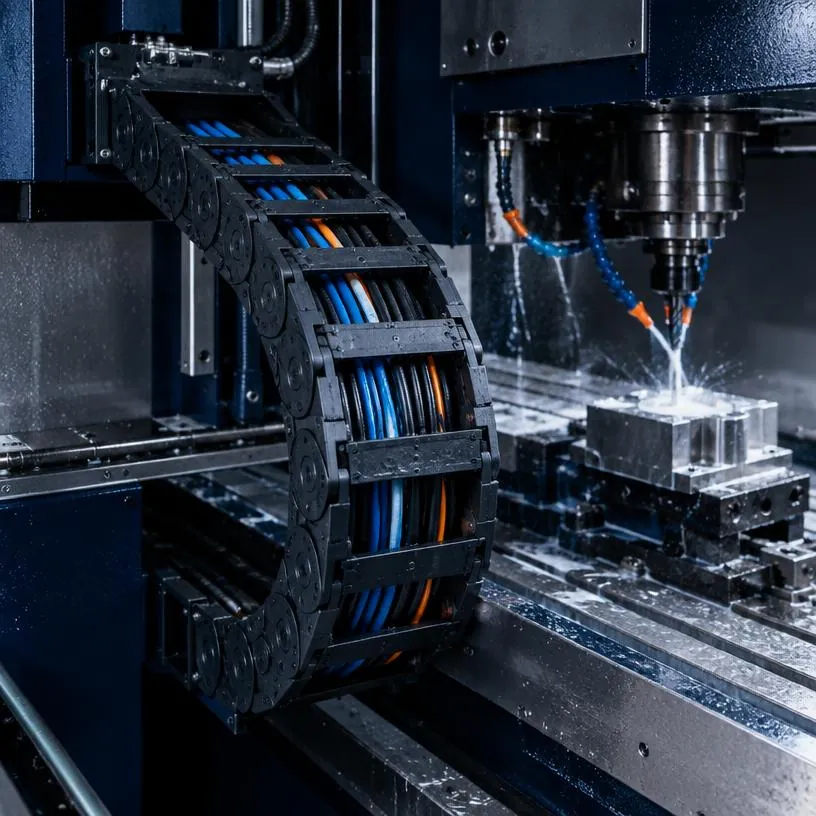
Between the two, the carrier runs in a loop. The lower run lies still on the floor or in the channel, the upper run moves with the driver. The bend in between rolls back and forth. How far that bend has to roll depends on where the fixed point is. That is why its position determines the length of the carrier.
Fixed point in the middle or at the end: what is the difference?
With the fixed point in the middle of the travel length, the loop only has to roll half the travel length in each direction. With the fixed point at the end, the loop has to cover the full travel length. You can see this in the formulas we also use in our calculation tools:
- Fixed point in the middle: L = S/2 + π × KR + 2 × p
- Fixed point at the end: L = S + π × KR + 2 × p
Here S is the travel length, KR the bending radius and p the pitch, the length of one link. Then round up to whole links.
The middle has another advantage. Every type has a maximum self-supporting travel length. The catalogue value applies to a light cable package with the fixed point in the middle. With the fixed point at the end, half of that applies. A carrier that is comfortably self-supporting in the middle sometimes has to glide at the end, or go up a size.
What if the fixed point cannot be in the middle?
In many machines the middle does not work. The cabinet is on one side, a frame is in the way or the cable tray comes in somewhere else. In that case you can also place the fixed point somewhere between the middle and the end.
The rule is then simple: the loop must be able to cover the longest section from the fixed point. If the fixed point is at distance a from the start of the travel length, that longest section is the larger of a and S − a. That figure goes into the formula in place of S/2:
L = longest section + π × KR + 2 × p
The self-supporting range shifts as well. The range of the type is multiplied by S divided by twice the longest section. In the middle that factor is 1, at the end 0.5, and in between it lies somewhere in the middle. In the Cable carrier configurator you can enter your own fixed point position; the configurator then calculates length and range in this way.
Worked example: three positions for the fixed point
A gantry has a travel length of 3000 mm. We use a UNIFLEX Advanced UA1455 with a bending radius of 150 mm and a pitch of 45.5 mm. The bend and the connections together are π × 150 + 2 × 45.5 = 562.2 mm. Self-supporting, this type reaches up to 4.8 m travel length, with a light package and the fixed point in the middle.
| Fixed point position | Longest section | Raw length | Links | Length | Self-supporting up to |
|---|---|---|---|---|---|
| Middle (1500 mm) | 1500 mm | 2062,2 mm | 46 | 2093 mm | 4,8 m |
| Op 1000 mm | 2000 mm | 2562,2 mm | 57 | 2593,5 mm | 3,6 m |
| End (0 mm) | 3000 mm | 3562,2 mm | 79 | 3594,5 mm | 2,4 m |
Three things stand out:
- (01)With the fixed point at 1000 mm instead of in the middle, the carrier becomes 11 links longer, over half a metre.
- (02)At the end, the carrier is 1.5 metres longer than in the middle.
- (03)At the end, the self-supporting range is 2.4 m. That is less than the travel length of 3 m. In this set-up the carrier then has to glide in a channel, or you choose a larger type.
At 1000 mm, 3.6 m is still enough for 3 m travel length. So a fixed point that is not exactly in the middle is often a perfectly good solution, as long as you check the numbers. The configurator uses the bend length from the catalogue when it is known. For this UA1455 with radius 150 that is 563 mm, almost the same as the formula. To check it yourself, use calculate the length of your cable carrier.
Calculate it yourselfCalculate cable carrier lengthLength and number of links from travel length and radiusCalculate itWhat does the fixed point position do to the cables?
A shorter carrier means shorter cables in the movement and less weight for the driver to pull. But the cables also run from the cabinet to the fixed point. If the cabinet is at the start of the travel length and you put the fixed point in the middle, that fixed section becomes half a travel length longer. The carrier gets shorter, the cables do not.
So look at the total: the fixed route from the cabinet to the fixed point plus the length in the carrier plus the connection at the driver. Measure the fixed route along the cable tray, not in a straight line. How to calculate this step by step is explained in calculating cable length in a cable carrier.
If the cable package is heavy, the middle counts even more. The self-supporting range drops with the weight per metre. A fixed point at the end then halves that range once more. With a heavy package and a travel length of a few metres, that is the moment to choose between a larger type and a gliding set-up. The difference between the two is explained in self-supporting or gliding.
Where is the fixed point on a gliding cable carrier?
On a long travel length, the upper run of the carrier glides over the lower run in a guide channel. Here too the middle of the travel length is the usual position: the carrier is at its shortest and the channel does not need to be longer than the travel length itself. On a crane or gantry with tens of metres of travel, a fixed point at the end can easily cost many metres of carrier and cable.
With a gliding carrier, pay attention to the transition at the fixed point. That is where the cables enter the channel, and the carrier must connect there straight and without a kink. Which channel fits and what to look out for is explained in guide channel for your cable carrier.
What should you check when mounting the fixed point and driver?
The position has been chosen, now the mounting has to be right. Three points:
- In line: fixed point, channel and driver are in one line with the direction of travel. A misaligned driver pulls the carrier against the side.
- At the right height: on a self-supporting carrier the driver sits at the height of the upper run, so that it runs straight. The installation height is given in the data of the type.
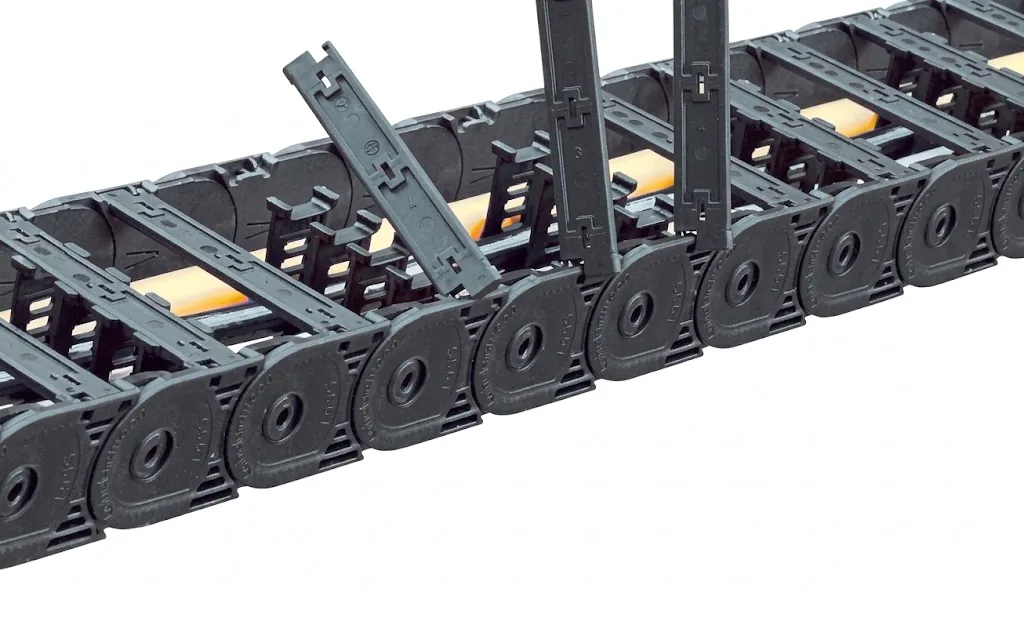
- The right end connectors: fixed point and driver each get an end connector that matches the type, often with strain relief for the cables.
More about alignment in mounting a cable carrier. Which end connectors are available is explained in end connectors of a cable carrier.
Rather have it checked?
If you know the travel length and where the cables come in, we will check the carrier for you free of charge. Send us the travel length, the position of the fixed point or the cabinet, the cable list and the space available in the machine. Wisman Techniek then advises on the type, the radius and the set-up, and if you like supplies the carrier complete with cables, assembled in our workshop in Ruurlo.
Calculate it yourselfCable carrier configuratorCalculate, select and assemble a cable carrierOpen the cable carrier configurator
Frequently asked questions
Where do you put the fixed point of a cable carrier?
In the middle of the travel length whenever possible. The loop then only has to cover half the travel length, the carrier is at its shortest and the self-supporting range of the type is at its largest.
How much longer does a cable carrier get with the fixed point at the end?
About half a travel length, rounded up to whole links. With 3000 mm travel length and a UA1455 with radius 150 mm, the carrier goes from 46 to 79 links, from 2093 to 3594.5 mm.
Can the fixed point also be somewhere between the middle and the end?
Yes. Then calculate the length with the longest section from the fixed point instead of half the travel length. Also check the self-supporting range, because it gets smaller the further the fixed point is from the middle.
Why can my cable carrier not be self-supporting with the fixed point at the end?
The maximum self-supporting travel length in the catalogue applies with the fixed point in the middle. At the end it is halved. A carrier that is comfortably within limits in the middle sometimes has to glide in a channel at the end, or go up a size.
What is the difference between the fixed point and the driver?
The fixed point sits on a stationary part of the machine, where the cables enter the carrier. The driver sits on the moving part and pulls the carrier along.
Calculate it yourself
Which cable carrier fits your machine?
Enter two dimensions. The configurator opens with these values and shows the matching series right away. We check your result free of charge.
Not sure? Leave it blank and fill it in in the configurator.
Next step
Calculate it yourself or browse the range. We check your result free of charge.
Series on this topic
Question about this topic?
Ask Bas directly
Cable Carriers Specialist at Wisman Techniek