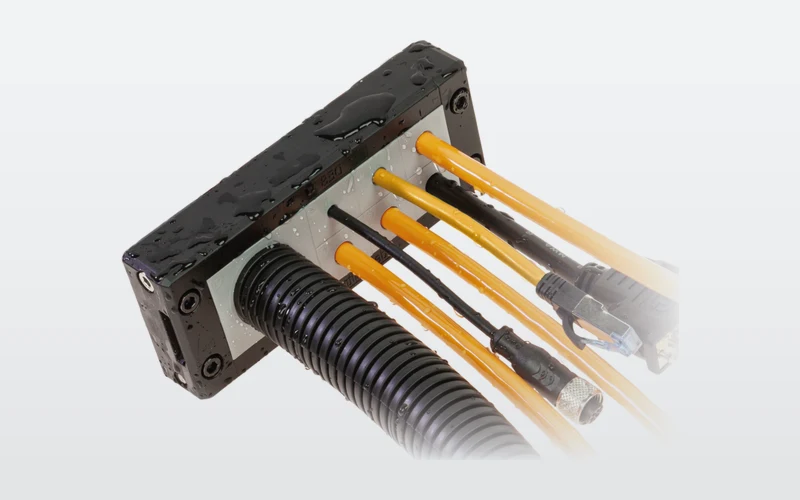


Short answer
With a split cable gland you choose two sizes. The hole size (M20, M25, M32 and up) follows from the connector, because it has to pass through the hole in the wall. The grommet follows from the outer diameter of the cable. Then you choose the type by number of cables, IP rating, straight or angled, and screw or snap-in mounting.
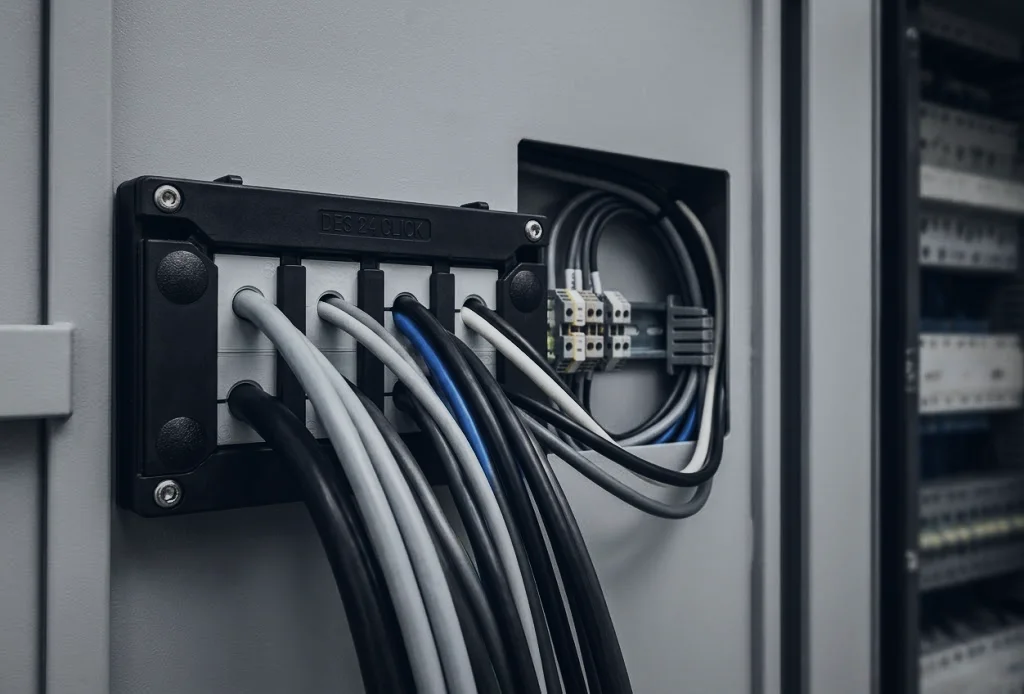
You choose a split cable gland by two sizes. The hole size, for example M25 or M32, is set by the connector: it has to pass through the hole in the wall. The grommet in the gland is chosen by the outer diameter of the cable. Only then do you look at the type: how many cables per gland, which IP rating, straight or angled, and screwed or snapped in. If you only look at the cable, you end up at installation with a plug that does not fit through the cabinet wall.
What is a split cable gland?
You slide an ordinary cable gland over the cable. That only works if there is no plug on it yet. A split cable gland consists of two halves. You push the cable with its connector through the hole in the wall, place the grommet around the cable, close the gland around it and fix it in the hole. The connector stays on and you do not have to cut or reconnect anything.
This is especially useful for pre-assembled sensor, bus and servo cables. They come with a plug fitted by the manufacturer, and a cable that you cut and reconnect yourself is a source of errors. For its split cable glands, icotek also names as an advantage that the warranty on pre-assembled cables is retained this way.
A split cable gland is one of the ways to route a cable with a plug through a wall. The other two are a cable entry frame and a separate entry grommet. Which one to choose when is explained in choosing a cable entry: gland, frame or entry plate.
What hole size does a split cable gland need?
The glands have a metric thread and fit a standard metric hole. In the range of split cable glands the sizes run from M16 to M80. The opening size is given per model in the variant table, for example 25.5 mm for a DESPRED 25 and 32.5 mm for a DESPRED 32.
Choose the hole size in this order:
- (01)Measure the connector. Take the largest dimension of the plug, including any bend protection or nut. The connector has to pass through the hole before you close the gland.
- (02)Choose the smallest hole size the connector fits through. If the plug is a tight fit, go one size up. A hole that is too small only shows up during installation.
- (03)Check whether there is already a hole. If the cabinet already has a round bore, that sets the size. A split cable gland fits it without a new cut-out, which makes it suitable for retrofits.
- (04)Check the wall thickness for snap-in mounting. Snap-in glands have a fixed range for the wall thickness. For the icotek QVT-CLICK this is 1.5 to 2.5 mm for sizes 16 and 20 and 1 to 2.5 mm for sizes 25 to 50. If the wall is thicker, choose a version with a lock nut.
Which grommet fits the diameter of your cable?
The grommet closes around the cable and provides the sealing and the strain relief. You choose it by the outer diameter of the cable, not by the connector. Measure that diameter or take it from the data sheet. How to read a cable code is explained in reading a cable code: 4G1.5 or 4x1.5?
At Detas Ultra the small grommets are called SPP and the large ones SPG. The number in the name is the lower limit: an SPP 12 is for cables from 12 to 13 mm. The SPP grommets run from 2 to 17 mm, the SPG grommets from 17 to 35 mm. At icotek they are called KT grommets. The KVT-ER works with grommets for 1 to 16 mm and with large grommets for 13 to 35 mm.
Which grommets fit differs per gland:
| Gland | Hole size | Grommets per gland | Cable Ø |
|---|---|---|---|
| DESCLICK 20 | M20 | 1 small grommet, up to SPP 12 | 2 to 13 mm |
| DESCLICK 25 and 32 | M25, M32 | 1 small grommet, up to SPP 16 | 2 to 17 mm |
| DESPRED 25 and 32 | M25, M32 | 1 small grommet | 2 to 17 mm |
| DESPRED 63 | M63 | 1 large grommet or 4 small ones | up to 34 mm |
| OSF 16 to 32 | M16 to M32 | small or multiple SPC grommets | 2 to 14 mm |
| OSF 50 and 63 | M50, M63 | 4 small SPC grommets or 1 large SPL grommet | 2 to 14 mm or 12 to 29 mm |
| KVT-ER 25 and 32 | M25, M32 | 1 small grommet | 1 to 16 mm |
| KVT-ER 50-2 | M50 | 2 small grommets | 1 to 16 mm |
| KVT-ER 63-4 | M63 | 4 small grommets | 1 to 16 mm |
| KVT-ER 63-1 | M63 | 1 large grommet | 13 to 35 mm |
With multiple grommets, more cables pass through one gland. This way the DESPRED 50-90 takes up to 16 cables and the icotek KVT 80 up to 24 lines.
How many cables go through one split cable gland?
Most split cable glands take one to four cables. Beyond that the glands get large and many of them end up next to each other on the wall. For a row of six or more glands in one place, a cable entry frame is often the better choice. It bundles many cables in one rectangular cut-out. How many cables fit in a frame is explained in cable entry frame: how many cables fit?
A gland is strongest in places with few cables: a sensor on a machine frame, a motor with its own supply, a control box with two bus cables. And in places where round holes already exist.
Which type of split cable gland should you choose?
Once the sizes are known, you choose the type on four points.
- IP rating. The icotek KVT-ER achieves IP66 and IP68 and provides strain relief to EN 62444. The KVT, KVT-W90, KVT-SNAP, KVT 80 and QVT achieve IP54. The degree of protection also depends on the grommets you choose. What the figures mean is explained in IP rating for cable entries.
- Straight or angled. If there is little space behind or next to the wall, or the cable has to go straight down, choose a 90° version. These are available as OSF 90 (M16 to M32), DESPRED 50-90 and KVT-W90 (M32 and M50).
- Screw or snap in. Most glands are fixed with a lock nut. The DESCLICK, KVT-SNAP and QVT-CLICK snap into the hole. With a series of many glands, that saves installation time.
- Size of the opening. For a large hole with many cables there is the KVT 80 for M80. For small holes from M16 there are the QVT and the OSF 16.
Worked example: four cables through the wall of a control box
A control box gets four pre-assembled cables: a 12 mm servo cable, a 22 mm motor cable and two 6 mm sensor cables. All four have a connector. This is how you choose the glands with Detas Ultra:
- (01)Servo cable, Ø 12 mm. Grommet SPP 12 (12 to 13 mm). This fits a DESCLICK 20, provided the connector passes through an M20 hole. If the connector is larger, take a DESCLICK 25 with the same grommet.
- (02)Motor cable, Ø 22 mm. Too thick for a small grommet, so an SPG 22 (22 to 23 mm). That large grommet fits a DESPRED 63.
- (03)Two sensor cables, Ø 6 mm. One SPP 6 each. You can give each its own DESCLICK 20, or put them together in one DESPRED 63 with four small grommets. Two positions then stay empty and get a blind grommet, SPP 0. Those positions are free for extra cables later.
If the same cabinet had to achieve IP68, it would be the icotek KVT-ER: a KVT-ER 32 for the servo cable, a KVT-ER 63-1 with a large grommet for the motor cable and a KVT-ER 50-2 for the two sensor cables.
Rather not work this out by hand? In the Cable entry planner you enter the diameter for each cable and whether it has a plug. The planner calculates with the DESCLICK, the DESPRED and the KVT-ER, shows which glands, frames or plates fit and gives a parts list with article numbers.
Calculate it yourselfCable entry plannerFrom cable list to cable entry with article numbersOpen the plannerWhat should you watch for when installing a split cable gland?
A split cable gland is quick to fit, but a few things often go wrong:
- Grommet on the sheath, not on the shield. The grommet clamps onto the outer sheath. If a shielded cable needs earthing in the cabinet, do that with an EMC clamp behind the wall.
- Cable straight through the gland. A cable that runs through the gland at an angle presses the grommet in on one side and seals less well.
- Seal empty positions. A gland with four positions and two cables gets two blind grommets. Otherwise you will not achieve the IP rating.
- Take up pull on the cable. The gland provides strain relief, but if the cable comes from a moving machine, also secure it at the moving part. How that works is explained in what is strain relief?
If the cables come from a cable carrier, also choose cables suitable for continuous movement. In the range of flexible cables you will find control, motor and data cables with and without shielding.
Would you rather we put the glands together for you? Send your cable list with the diameters and connectors with a quote request for cable entries. Wisman Techniek supplies the split cable glands from Detas Ultra and icotek and checks the combination for you.
Frequently asked questions
What is the difference between a split cable gland and an ordinary cable gland?
You slide an ordinary gland over the cable, so the connector has to come off. A split cable gland consists of two halves and closes around the cable, so the connector stays on.
Do I choose the gland size by the cable or by the connector?
By both. You choose the hole size by the connector, because it has to pass through the hole in the wall. You choose the grommet by the outer diameter of the cable.
Which split cable gland is waterproof?
The icotek KVT-ER achieves IP66 and IP68, for holes from M25 to M63. Many other split cable glands achieve IP54. Always check the grommets too and seal empty positions with a blind grommet.
How many cables go through one split cable gland?
Usually one to four. With multiple grommets it can be more: the DESPRED 50-90 takes up to 16 cables and the KVT 80 up to 24 lines. With many cables in one place, a cable entry frame is often more practical.
Does a split cable gland fit an existing hole?
Yes, if it is a metric hole. The glands have a metric thread and are available from M16 to M80. Do check whether the connector fits through the hole.
Next step
Calculate it yourself or browse the range. We check your result free of charge.
Question about this topic?
Ask Olaf directly
Inside Sales at Wisman Techniek