

Short answer
For a pneumatic hose in a cable carrier, allow 20% clearance on the outer diameter, choose a hose suitable for moving applications and take as the radius the larger of 7.5 times the thickest diameter and the bending radius from the data sheet. Lay thin hoses in a single layer in their own compartment, without bundling them tightly, and secure them at both ends with a clamp that does not pinch the hose. Couplings belong outside the carrier.
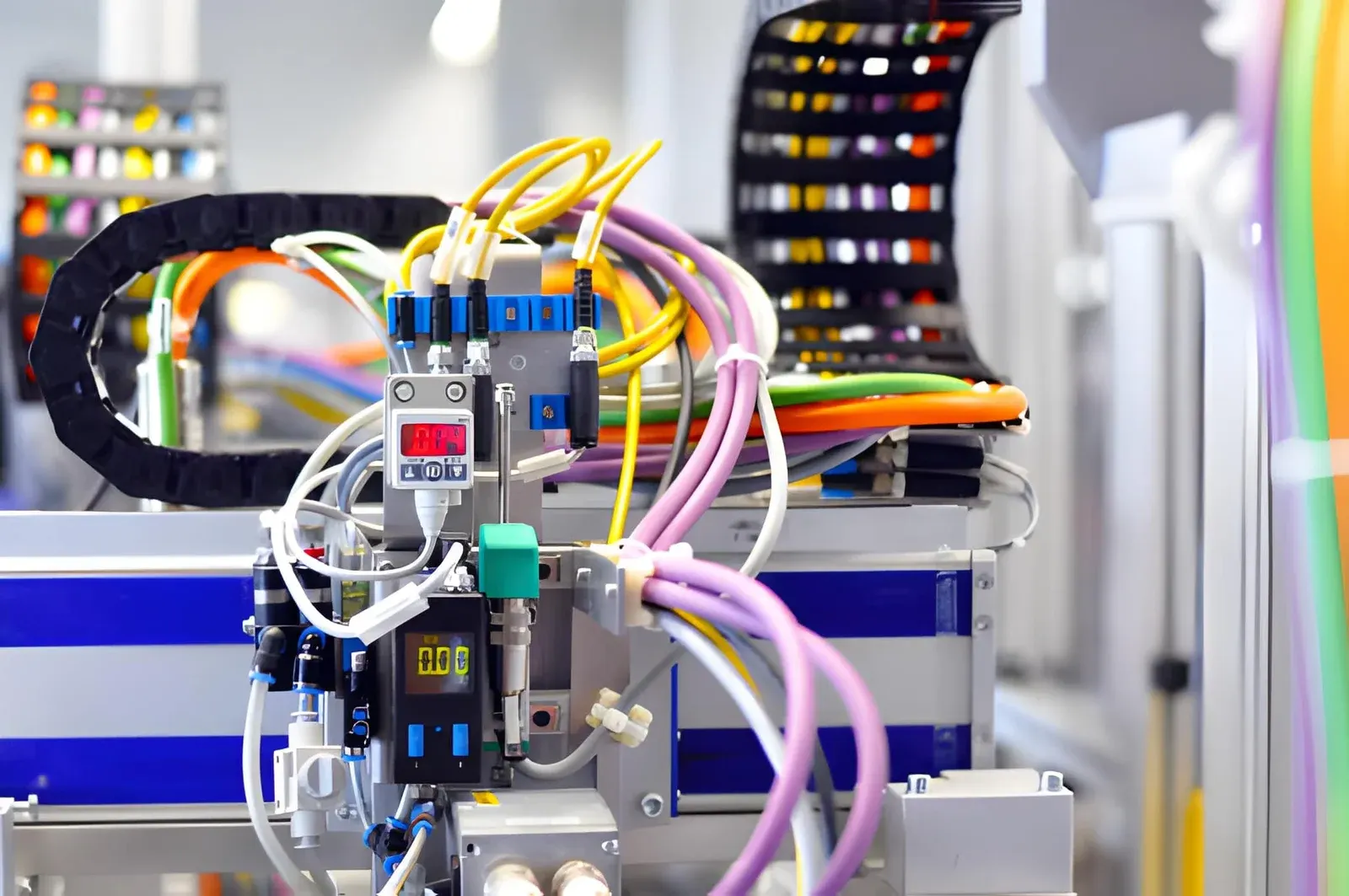
Lay a pneumatic hose in a cable carrier with 20% clearance on the outer diameter, in its own compartment and in a single layer. Choose a hose intended for moving applications, let its bending radius count when choosing the carrier and secure it at both ends without pinching it. An air hose is light and looks simple, but that is exactly why it is often forgotten when planning the layout. You see the result later: hoses that kink, roll over each other or pull out of a coupling.
Below you can read what to look out for, with a worked example and the mistakes we come across most often in practice.
Why does a pneumatic hose in a cable carrier need extra attention?
A pneumatic hose behaves differently from a cable. It has no cores to give it shape, is often thin and light, and reacts to pressure. Three points make the difference:
- Kinking: bend a hose too tightly and it kinks. At that point the bore closes and the wall wears. With a cable you only notice a radius that is too small after a long time; with a hose you sometimes notice it straight away in how the cylinder or gripper works.
- Wandering: thin, light hoses do not stay in place by themselves. With every stroke they shift a little, until they lie on top of each other and start to twist.
- Pressure: under pressure a hose can change slightly in diameter and length. How much is stated in the hose data sheet. The hose must be able to absorb that movement in its compartment.
With a hydraulic hose, weight and heat play a bigger role. With pneumatics it is mainly about radius, position and securing.
Which pneumatic hose is suitable for a cable carrier?
Not every air hose is made to bend millions of times. A hose that lies fixed in a machine may be stiffer than a hose that moves with every stroke of the machine. So ask the hose supplier whether it is suitable for moving applications in a cable carrier and which bending radius applies.
Check these details in the data sheet:
- Outer diameter: you use this to calculate the space in the carrier.
- Minimum bending radius: preferably the value for moving applications, not just the value for a hose that is bent once.
- Working pressure and vacuum: if vacuum runs through the hose, for example for suction cups, the hose must be suitable for it. A hose that collapses under vacuum closes itself off.
- Material: the material determines how supple the hose is and how it copes with oil, coolant or ozone. Choose what the data sheet specifies for your environment.
If in doubt, put the question to the hose supplier before you choose the carrier. The hose helps determine how large the radius and the carrier need to be.
How much clearance does a pneumatic hose need in a cable carrier?
On this site, for every hose we calculate with an effective diameter of outer diameter × 1.20. For cables that is × 1.10. An 8 mm hose therefore needs a compartment of at least 9.6 mm, in height and in width.
The extra clearance gives the hose room to move under pressure and prevents it from getting jammed against the crossbars. A hose that fits exactly is pressed against the wall with every pressure peak and rubs there.
With calculate fill level you see straight away which inner height and inner width your package needs, with the correct clearance for cables and hoses.
Calculate it yourselfCalculate fill levelRequired inner dimensions and fill levelCalculate itWorked example: cables and air hoses in one cable carrier
A gantry with a gripper has this package: one 12 mm servo cable, two 8 mm control cables and six pneumatic hoses with an outer diameter of 8 mm.
- (01)Effective diameters: servo cable 12 × 1.10 = 13.2 mm. Control cables 8 × 1.10 = 8.8 mm. Hoses 8 × 1.20 = 9.6 mm.
- (02)Inner height: the largest effective diameter is 13.2 mm. The inner height must be at least that.
- (03)Inner width, everything side by side: 13.2 + 2 × 8.8 + 6 × 9.6 = 88.4 mm, plus the space for the dividers.
- (04)Bending radius: 7.5 × 12 mm = 90 mm based on the servo cable. If the hose data sheet states a larger radius for moving applications, that value applies.
- (05)Choosing a type: take the next available inner dimensions and radius of a type that are at least as large.
In this example, six hoses of the same size side by side take up more width than all the cables together. You see this often in machines with a lot of pneumatics. If the width does not fit in the machine, you can create two layers with a shelf, provided the inner height allows it. How to weigh this up is explained in cable carrier layout: fill level, additional load and dividers.
Where do you put air hoses in the cable carrier?
Give pneumatic hoses their own compartment with a divider, separate from the cables. Lay them side by side in a single layer and do not fill the compartment so full that the hoses jam against each other. A few rules from practice:
- Do not lay thin hoses loose on thick cables. They sink between the cables and rub there.
- Do not stack hoses on top of each other without a shelf. They roll over each other and twist. You see the same pattern with cables twisting in the carrier.
- Do not bundle them tightly. Tape or cable ties around a bundle of hoses create one stiff package. In the bend, the hoses must be able to slide relative to each other.
- Distribute the weight. Heavy cables on the outside, light hoses more towards the centre, balanced left and right.
In ChainLogic you draw the layout in the cross-section. You place hoses, cables and dividers and see straight away whether anything collides and how full each compartment is.
Calculate it yourselfChainLogicLay out cables, hoses and dividers in the cross-sectionOpen ChainLogicHow do you secure a pneumatic hose to the cable carrier?
Secure the hose at the fixed point and at the driver, just like cables. In between, it lies freely in its compartment. That way the forces of the movement do not end up on the couplings. Read more about the principle in what is strain relief.
When securing, pay attention to these points:
- A clamp that fits. A clamp or saddle for a cable can pinch a hose shut. Choose a fastening that matches the outer diameter of the hose and do not tighten it more than necessary.
- No couplings in the carrier. Push-in fittings, T-pieces and reducers belong outside the carrier, after the clamp. Inside the carrier they are a hard spot that knocks against the crossbars.
- Straight out of the carrier. After the clamp, let the hose run straight for a short distance before it bends towards the valve or the cylinder.
- No torsion. Look at the printing on the hose. It must run straight along the entire length.
Read more about the order of the work in mounting a cable carrier: step by step.
Which mistakes do you see most often with pneumatics in a cable carrier?
During inspections and conversions we see the same points again and again:
- The radius based on the cables only, while the hose needs a larger radius
- A hose that is not intended for moving applications
- Hoses calculated with the diameter from the catalogue, without clearance
- Thin hoses loose between the cables, without their own compartment
- A tightly taped bundle of hoses that cannot slide in the bend
- A cable clamp that pinches the hose
- A coupling in the middle of the carrier
You replace a kinked or worn hose just like a cable. How to open the carrier for this and lay the new line correctly is explained in replacing a cable in a cable carrier.
Which cable carrier suits cables and pneumatic hoses?
Machines with a lot of pneumatics are often fast, light applications: gantries, pick-and-place and packaging machines. A light plastic carrier is usually sufficient there. For most applications the UNIFLEX Advanced is a good all-round choice. With the QuickTrax® you press cables and hoses into flexible strips instead of opening crossbars, and for small packages there is the compact MONO.
Enter your cables and hoses in the cable carrier configurator, with the outer diameter of each line and whether it is a hose. The configurator calculates with the correct clearance, determines the minimum inner dimensions and radius and shows the types that suit your travel length. A Wisman specialist checks the result free of charge.

Frequently asked questions
Can cables and pneumatic hoses go in the same cable carrier?
Yes, that is very common. Do give the hoses their own compartment with a divider, so that they do not sink between the cables or roll over each other.
How much clearance does a pneumatic hose in a cable carrier need?
Calculate with 20% on the outer diameter. An 8 mm hose therefore needs at least 9.6 mm of space, in height and in width.
Which bending radius do you choose for an air hose in a cable carrier?
The larger of two values: 7.5 times the diameter of the thickest cable or hose, or the bending radius for moving applications from the hose data sheet. Then choose the next available radius of the type.
Can I bundle pneumatic hoses with tape or cable ties?
Preferably not. A tight bundle becomes one stiff package in the bend. The hoses must be able to slide relative to each other. Lay them loosely side by side in their own compartment.
Where do you place the couplings of a pneumatic hose?
Outside the carrier, after the clamp at the fixed point or the driver. Inside the carrier a coupling would knock against the crossbars and put extra strain on the hose at that point.
Calculate it yourself
Which cable carrier fits your machine?
Enter two dimensions. The configurator opens with these values and shows the matching series right away. We check your result free of charge.
Not sure? Leave it blank and fill it in in the configurator.
Replacement
Old cable carrier broken
or worn out?
Send the type number, the size or a photo of your current carrier. Within 1 working day you'll hear which replacement fits, what it costs and when it arrives. Also if your carrier is from another brand.
Prefer to search yourself? Find a matching replacement or view all cable carriers from stock.
Next step
Calculate it yourself or browse the range. We check your result free of charge.
Series on this topic
Question about this topic?
Ask Bas directly
Cable Carriers Specialist at Wisman Techniek